
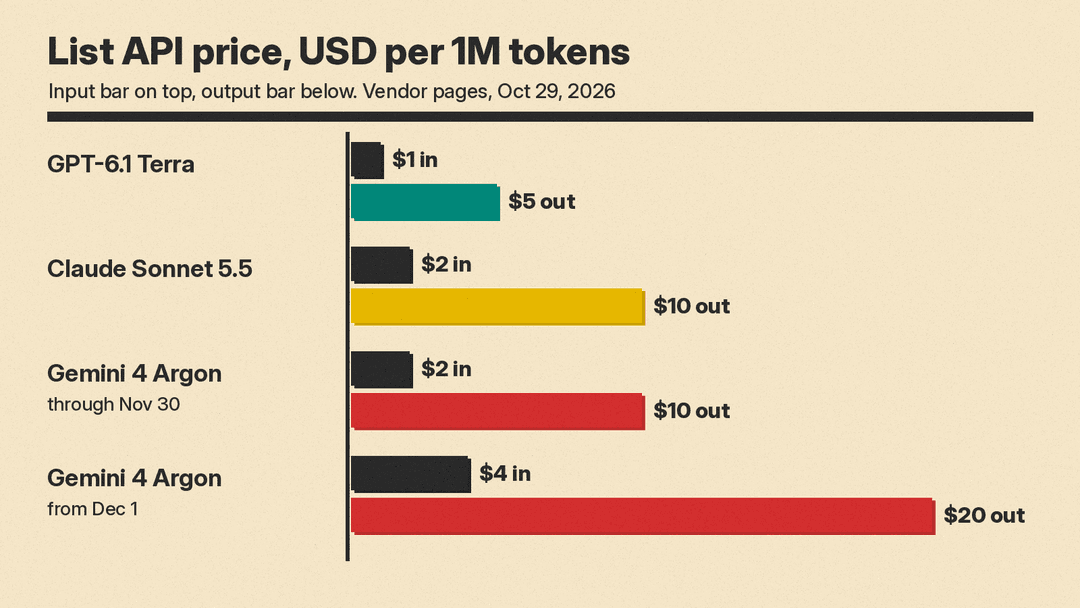
OpenAI released GPT-6.1 Terra on October 26, 2026, according to Artificial Analysis, and its launch post prices it at $1 per million input tokens and $5 per million output tokens. That puts a third pricing option next to two models many teams already use for agents and everyday coding: Anthropic's Claude Sonnet 5.5, which Anthropic lists at $2 input and $10 output, and Google's Gemini 4 Argon, which Google sells at an introductory $2 input and $10 output through November 30, 2026.
This guide compares the three on price, published specs, independent benchmark scores, cost per task and fit. Every price and spec below was checked on the vendor's own page on October 29, 2026. Independent scores come from Artificial Analysis and were read on its model pages at the same time.
For the frontier tier above these models, see our Gemini 4 Carbon vs GPT-6 Astra vs Claude Opus 5.5 comparison. For the earlier mid-tier picture, see Claude Sonnet 5.5 vs GPT-6.1 Sol vs Gemini 3.8 Flash.
The three models in one line each
- GPT-6.1 Terra (OpenAI): OpenAI's model page calls it "a fast, efficient model for visual reasoning, precise computer use, and clear, natural writing." OpenAI pitches it for high-volume work such as reading invoices and entering their details into accounting software. Our GPT-6.1 Terra explainer covers OpenAI's own test results.
- Claude Sonnet 5.5 (Anthropic): the Claude models overview describes it as "The best combination of speed and intelligence." Anthropic's Sonnet page dates the release to September 28, 2026 and calls it "a faster, lower-cost complement to Opus 5.5."
- Gemini 4 Argon (Google): Google's What's new in Gemini 4 Argon page calls it "our latest, most capable model" and says it can reason longer on hard problems. That page was last updated October 27, 2026, one day before Google announced Gemini 4 Carbon, which is not yet generally available. Our Gemini 4 Argon explainer covers its launch, pricing and usage limits.
The three are not the same tier inside their own families. Terra sits below GPT-6.1 Sol and GPT-6 Astra in OpenAI's lineup. Sonnet 5.5 sits below Opus 5.5 and Fable 5.1 at Anthropic. Google's page calls Argon its most capable model, and the Gemini 4 Carbon model Google announced on October 28, 2026 is going first to "a subset of cyber defenders." What the three share is a price band: as of October 29, 2026, all three cost $2 or less per million input tokens.
API prices
All prices are in US dollars per one million tokens, as each vendor prints them.
GPT-6.1 Terra (OpenAI model page):
- Input: $1. Cached input: $0.05. Cache writes: $1.25 (30-minute retention). Output: $5.
- "Prompts with more than 272K input tokens are priced at 2x input and cache rates and 1.5x output for the full request."
- "Batch and Flex prices are 50% lower than Standard."
- "Fast mode prices are 2x Standard." Regional processing "adds a 10% premium where available."
- OpenAI's launch post says Terra's standard API prices "are 50% lower than those of GPT-5.6 Terra and GPT-6.1 Sol."
Claude Sonnet 5.5 (Claude pricing):
- Input: $2. Output: $10.
- Prompt caching: $0.10 to read, $2.50 to write. The page says caching prices reflect a 5-minute TTL.
- The pricing page says "Save 50% with batch processing."
- "US-only inference is available at 1.1x pricing for input and output tokens."
Gemini 4 Argon (Gemini API pricing):
- Input: "$2.00 through November 30, 2026. $4.00 starting December 1, 2026."
- Output, including thinking tokens: "$10.00 through November 30, 2026. $20.00 starting December 1, 2026."
- Context caching: "$0.10 through November 30, 2026. $0.20 starting December 1, 2026. Implicit caching only (explicit caching is not supported)."
- "Gemini 4 Argon is not available on the Free tier."
- Google adds that "every token the model processes is counted and billed, including thinking tokens and internal tool system instructions and function declarations when using grounding."
What this means: on list price, Terra is the lowest of the three on both input and output. Sonnet 5.5 and Argon match each other at $2 input and $10 output until November 30. From December 1, Argon moves to $4 input and $20 output, the same as Claude Opus 5.5's list price on Claude pricing.
Specs each vendor states
Only specs printed on each vendor's own page are listed.
GPT-6.1 Terra (model page):
- 1,050,000 context window. Maximum input tokens: 922,000. 128,000 max output tokens.
- Input: text, image. Output: text. Audio and video are listed as unsupported.
- Knowledge cutoff: Jun 01, 2026.
reasoning.effortsupportsnone,low,medium(default),high,xhighandmax.- "Tool calling requires the Responses API." Supported tools include computer use, web search, file search, code interpreter, hosted shell, apply patch, skills and MCP.
- Fine-tuning is not supported.
Claude Sonnet 5.5 (models overview):
- 1M token context window. 128K max output tokens on the synchronous Messages API. The overview says the Message Batches API supports "up to 300k output tokens" with the
output-300k-2026-03-24beta header. - Text and image input, text output.
- Thinking: Adaptive. Default effort:
high. - Reliable knowledge cutoff: Jun 2026.
- Comparative latency: "Fast."
- Retirement: "Not sooner than September 28, 2027."
Gemini 4 Argon (What's new in Gemini 4 Argon):
- "Input, thinking, and output share one window of 1,048,576 tokens."
- Long decode: "A single response can now go past 64K tokens, up to 1M tokens minus your input," using background execution.
- Thinking levels:
low,medium(default) andhigh. temperature,top_pandtop_kare ignored if provided.- Google warns that "hard prompts can take several minutes" and recommends HTTP client timeouts of "at least 15 minutes" or background execution.
Two practical differences stand out. Argon is the only one of the three where a single response can run toward 1M tokens. Terra is the only one with a none effort setting; Anthropic's overview says the Models API reports that Sonnet 5.5 does not accept thinking turned off, and Argon's levels start at low.
Independent scores: Artificial Analysis Intelligence Index v5
Artificial Analysis launched Intelligence Index v5 on October 27, 2026. It combines nine evaluations across knowledge work, coding, science and general knowledge, and Artificial Analysis says 60% of the Index now rests on private test sets or held-out answers. Agentic tasks run in Stirrup, its own agent harness. Each score below is for a specific effort setting, which Artificial Analysis names on each model page.
Scores as listed on the Artificial Analysis model pages, checked October 29, 2026:
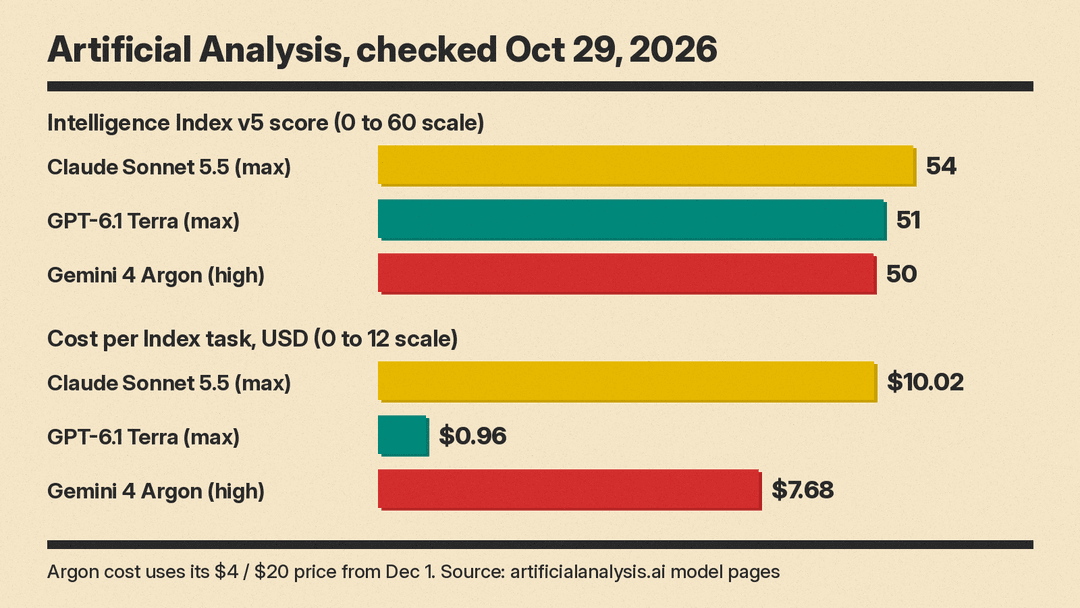
- Claude Sonnet 5.5 (max, default fallback): 54 (model page)
- GPT-6.1 Terra (max): 51 (model page)
- Gemini 4 Argon (high): 50 (model page)
Claude Sonnet 5.5 (max) leads this group of three as of October 29, 2026.
Results on single evaluations, from the v5 launch article (October 27, 2026):
- FrontierCode 2.0 (Cognition's private benchmark of real repository tasks, graded on whether a maintainer would merge the change, each task run three times in Stirrup): GPT-6.1 Terra (max) and Claude Sonnet 5.5 (max) both score 42%, tied with GPT-6 Astra (max). Claude Opus 5.5 (max) leads at 46%.
- AA-Briefcase (agentic knowledge work): Claude Sonnet 5.5 leads every model Artificial Analysis measured, at 1812 Elo.
- AutomationBench-AA (agentic SaaS workflows): Gemini 4 Argon leads every model Artificial Analysis measured, at 78%.
- Effort matters: the article says "Claude Sonnet 5.5 spans 29 points from low to max." A Sonnet 5.5 call at default or low effort will not perform like the max-effort score above.
Cost per task and speed
Per-token prices do not tell you what a job costs, because models use different numbers of tokens to finish the same work. Artificial Analysis measures the average cost to complete one Intelligence Index task at each model's standard price.
- GPT-6.1 Terra (max): $0.96 per task. 99M output tokens used across the Index. 90.9 output tokens per second. (model page)
- Gemini 4 Argon (high): $7.68 per task. 110M output tokens. 82.4 output tokens per second. Artificial Analysis computes this at $4 input and $20 output, Argon's price from December 1, not the introductory rate. (model page)
- Claude Sonnet 5.5 (max, default fallback): $10.02 per task. 340M output tokens. 136.9 output tokens per second. (model page)
The v5 launch article says that of the 10 highest-scoring models it showed, "GPT-6.1 Terra (max) is the cheapest at $0.96 per Intelligence Index task."
The Sonnet 5.5 result is the one to read twice. Its per-token price matches Argon's introductory price, but at max effort it used the most output tokens of the three, so its cost per task is the highest. Its output speed is the fastest of the three, which partly offsets the token count in wall-clock time. Artificial Analysis also lists time to first token at the effort settings above: 463.17 seconds for Sonnet 5.5, 144.16 seconds for Terra and 46.64 seconds for Argon (high). Artificial Analysis says these figures include the model's thinking time before it answers, so they do not show how fast a short chat reply starts.
What each vendor claims
These figures come from the vendors and have not been reproduced by an outside tester unless noted.
OpenAI on Terra (launch post, October 26, 2026):
- Terminal-Bench 4.0 at max reasoning effort: "GPT-6.1 Terra solves 50.3% of tasks, more than double GPT-5.6 Terra's published score of 21.5%."
- On OpenAI's internal benchmark of error-inducing prompts, the error rate at low reasoning effort "fell from 53.6% with GPT-5.6 Terra to 16.7% with GPT-6.1 Terra." At maximum effort it fell to 4.3%.
- On Agents' Last Exam, OpenAI says Terra at medium effort "performs on par with GPT-6 Astra at only one-tenth its price per token."
- OpenAI also states a limit: "For the most complex coding tasks, GPT-6.1 Sol and GPT-6 Astra remain the better choice."
Anthropic on Sonnet 5.5 (Sonnet page):
- Anthropic says Sonnet 5.5 "runs 30% faster and costs up to 30% less for most work" than Sonnet 5.
- It says the model "excels at well-scoped everyday tasks across coding, agents, and knowledge work" and "needs far fewer tokens than Sonnet 5."
Google on Argon (What's new in Gemini 4 Argon):
- Google says Argon "can reason longer on hard problems for better results on complex coding, agentic, math, and science tasks."
- Its migration notes say Argon "can spend more of the limit on thinking than earlier models" and recommend a
max_output_tokensof at least 32,768.
Where you can use each one
- GPT-6.1 Terra: OpenAI says it is available "to all Plus, Pro, Enterprise, and Edu users in ChatGPT Work and Codex," and in the API as
gpt-6.1-terra(launch post). The model page lists the Chat Completions, Responses and Batch endpoints. - Claude Sonnet 5.5: Anthropic says "anyone can chat with Claude using Sonnet 5.5 on Claude.ai," and that developers can use it on the Claude Platform, Amazon Web Services, Google Cloud and Microsoft Foundry (Sonnet page). Sonnet is included in the Free plan on Claude pricing.
- Gemini 4 Argon: "available through the Gemini API and in Google AI Studio" (What's new in Gemini 4 Argon), but not on the API Free tier (pricing).
Which one to use
These are starting points based on the sources above. Run your own tasks at two or three effort levels before you commit, since every vendor here exposes effort as a cost lever.
- High-volume extraction, form filling and screen tasks: start with GPT-6.1 Terra. It has the lowest list price of the three, the lowest Artificial Analysis cost per task, and OpenAI built it around computer use and visual reasoning.
- Coding inside an agent harness: Terra and Sonnet 5.5 tie on FrontierCode 2.0 at max effort. If cost per task matters more than a few Index points, Terra is cheaper to run on Artificial Analysis's numbers. If your team already runs Claude Code or the Claude Platform, Sonnet 5.5 avoids a migration.
- Knowledge work that ends in documents or analysis: Sonnet 5.5 leads AA-Briefcase in the v5 launch results. Budget for its token use at high effort.
- SaaS automation and very long outputs: Gemini 4 Argon leads AutomationBench-AA and is the only one of the three whose single response can run toward 1M tokens. Budget for the December 1 price change.
- Hardest reasoning or coding: none of these three. Move up to the frontier tier; see our Gemini 4 Carbon vs GPT-6 Astra vs Claude Opus 5.5 guide.
Summary
- GPT-6.1 Terra: $1 input, $5 output. Index v5 score 51 (max). $0.96 per task.
- Claude Sonnet 5.5: $2 input, $10 output. Index v5 score 54 (max, default fallback). $10.02 per task.
- Gemini 4 Argon: $2 input, $10 output through November 30, 2026, then $4 and $20. Index v5 score 50 (high). $7.68 per task at the post-December price.
Prices change and scores move as Artificial Analysis adds evaluations. Check the linked pages before you set a budget.
Sources
- OpenAI: Introducing GPT-6.1 Terra
- OpenAI API: GPT-6.1 Terra model page
- Claude pricing
- Claude Platform: Models overview
- Anthropic: Claude Sonnet
- Google: Introducing Gemini 4 Carbon
- Google AI for Developers: What's new in Gemini 4 Argon
- Google AI for Developers: Gemini Developer API pricing
- Artificial Analysis: Announcing Intelligence Index v5
- Artificial Analysis: GPT-6.1 Terra
- Artificial Analysis: Claude Sonnet 5.5
- Artificial Analysis: Gemini 4 Argon
