
OpenAI has released GPT-6.1 Terra, a model it describes as "fast, efficient" and built around "detailed visual reasoning and precise computer use alongside clearer, more natural writing." OpenAI calls it "a significant step up from GPT-5.6 Terra," the earlier model in the Terra line.
This explainer covers what Terra is for, what it costs, what OpenAI's numbers say about computer use, where you can use it, and who should pick it over OpenAI's bigger models. Every figure below comes from OpenAI's announcement, and most of them are OpenAI's own test results, not independent ones.
If you want the early reaction from testers, see our roundup, What People Are Saying About GPT-6.1 Terra. If you code, our GPT-6.1 Terra for coding guide covers GitHub Copilot and Codex in detail.
What GPT-6.1 Terra is
Terra is not OpenAI's most capable model; OpenAI gives that label to GPT-6 Astra. OpenAI's announcement says it "excels at the communication and computer-based tasks that fill the workday." The examples it gives are ordinary office jobs:
- drafting proposals
- interpreting technical drawings
- filling out forms
- editing videos
OpenAI places Terra on what it calls "the cost-intelligence frontier," offering "a new balance of speed, capability, and cost." In plain terms, the pitch is a model that is quicker than OpenAI's top models and cheaper to run.
Three other OpenAI model names come up throughout the announcement, so it helps to know them:
- GPT-5.6 Terra: the earlier Terra model, the main point of comparison.
- GPT-6.1 Sol: another current OpenAI model that Terra is compared against on price and speed. Our GPT-6 model comparison covers how Sol, Luna and Astra differ.
- GPT-6 Astra: the model OpenAI calls "our most capable frontier model." Our GPT-6 Astra explainer covers its prices and tests.
The announcement also compares Terra with Anthropic's Claude Opus 5.5 on some tests.
Price: what GPT-6.1 Terra costs
For developers who pay per use through the OpenAI API, OpenAI lists these standard prices:
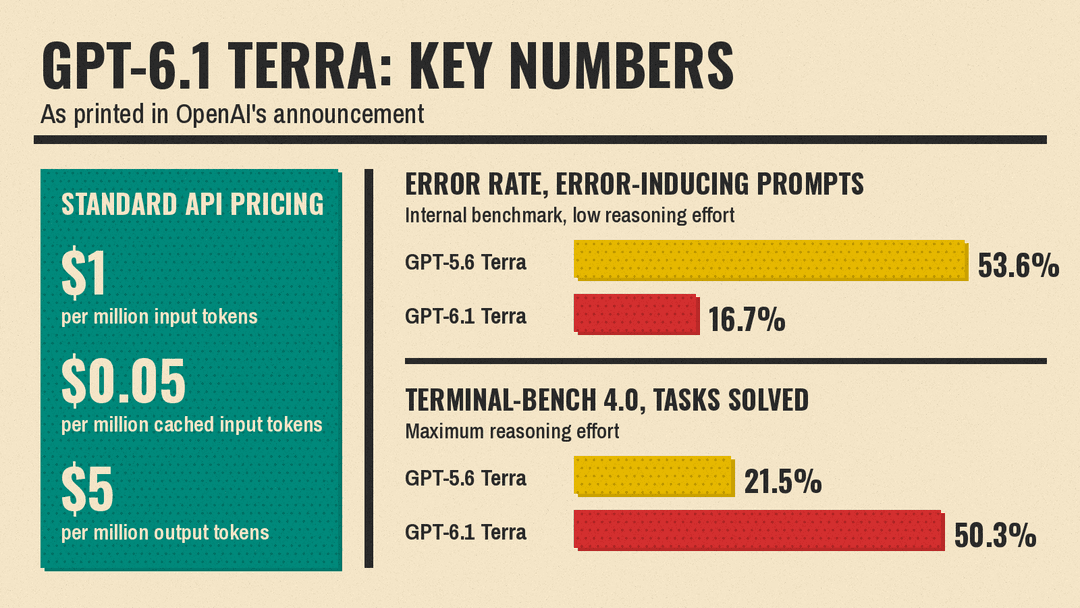
- $1 per million input tokens
- $0.05 per million cached input tokens
- $5 per million output tokens
A token is a small chunk of text. Input tokens are what you send the model and output tokens are what it writes back. Cached input is billed at the much lower rate shown above.
OpenAI says Terra's "standard API prices are 50% lower than those of GPT-5.6 Terra and GPT-6.1 Sol." It frames that as making it "practical for developers to automate high-volume work, like reading incoming invoices and entering their details into accounting software."
If you use ChatGPT or Codex on a subscription, you do not pay per token. Instead, OpenAI says "your plan goes further with GPT-6.1 Terra." In its words, "the same usage allowance covers more tasks than with GPT-5.6 Terra and substantially more than with GPT-6.1 Sol or GPT-6 Astra." OpenAI does not give a number for how many more tasks that means.
Computer use: what OpenAI's tests show
"Computer use" means the model operates software the way a person would: looking at the screen, clicking, typing and moving between apps to finish a task. The subtitle of OpenAI's announcement is "Delivering fast and capable computer use at scale," so this is the headline feature.
Many results below are reported at a "reasoning effort" level. Effort is a setting that controls how much the model reasons before answering, and OpenAI reports different results at different settings.
Agents' Last Exam
OpenAI measured computer use on Agents' Last Exam, which it describes as "a benchmark of professional tasks." Its examples include "turning architectural drawings into a 3D model" and "reviewing an animated film shot by shot to create a time-coded log for a restoration team." OpenAI reports:
- At medium reasoning effort, GPT-6.1 Terra "scores 15 percentage points higher than GPT-5.6 Terra at about one-third the cost."
- It "performs on par with GPT-6 Astra at only one-tenth its price per token."
- At max effort, Terra "is over three times as token efficient as Claude Opus 5.5, and one-fourth its price per token, resulting in a ~9x lower cost per task."
- Terra completes tasks "over three times faster than both GPT-6 Astra and GPT-6.1 Sol."
OSWorld 2.1
OpenAI says OSWorld 2.1 "tests how well AI agents use desktop apps to complete multistep tasks." At medium reasoning effort, OpenAI says GPT-6.1 Terra "surpasses GPT-5.6 Terra's best score at a fraction of the cost per task." The announcement does not print the scores themselves.
MMMU-Pro (visual reasoning)
Reading the screen well is part of using a computer well. On MMMU-Pro, which OpenAI calls "a benchmark of visual reasoning," it says Terra "outperforms GPT-5.6 Terra at every reasoning setting" and "nearly matches the scores" of GPT-6 Astra and GPT-6.1 Sol "at much lower cost."
Our reactions roundup collects what early testers found when they tried these kinds of tasks themselves, including where results depended on the effort setting.
Fewer made-up answers
A common worry with AI models is that they state wrong things with confidence. OpenAI says it has "invested heavily in reducing hallucinations and factual errors" this year, and it reports results on "our internal benchmark of error-inducing prompts":
- At low reasoning effort, the error rate "fell from 53.6% with GPT-5.6 Terra to 16.7% with GPT-6.1 Terra, a drop of nearly 37 percentage points."
- At maximum effort, "the error rate fell by 18 percentage points to 4.3%, nearly matching the rates for GPT-6 Astra and GPT-6.1 Sol."
Two caveats are worth keeping in mind. This is an internal OpenAI test, so outsiders cannot check it directly. And the prompts were chosen to provoke errors, so the rates describe a hard test set, not how often the model is wrong in everyday chat.
Coding: better, but not OpenAI's top pick for hard jobs
OpenAI calls Terra "a substantial improvement over GPT-5.6 Terra for software engineering." Its two coding results:
- Terminal-Bench 4.0, which "tests how well coding agents solve problems from the command line." At maximum reasoning effort, GPT-6.1 Terra "solves 50.3% of tasks, more than double GPT-5.6 Terra's published score of 21.5%."
- Terminal-Bench-Science 0.1, which tests how well agents "use code to carry out scientific research tasks." At max reasoning, OpenAI says Terra "surpasses GPT-6.1 Sol at lower cost, coming within five points of Opus 5.5 at less than one-fifth the estimated cost."
OpenAI is also direct about the limit: "For the most complex coding tasks, GPT-6.1 Sol and GPT-6 Astra remain the better choice." Our Terra for coding guide goes through where Terra runs in GitHub Copilot and Codex and when to switch to Sol.
Safety and alignment
OpenAI says GPT-6.1 Terra "meets the Critical threshold in cybersecurity under our Preparedness Framework, and maintains the protections developed for GPT-6 Astra."
On behavior, OpenAI says that "according to our evaluations," Terra "is more likely to stay within scope and honestly disclose limitations and potential blockers to the user compared to GPT-5.6 Terra." In its prompt-injection tests, where hidden instructions try to pull the model away from what the user asked, OpenAI says Terra "showed strong resistance to malicious instructions designed to divert it from the user's task." OpenAI points readers to its system card for more detail.
Where you can use GPT-6.1 Terra
According to OpenAI's announcement, starting on launch day:
- ChatGPT Work and Codex: available to "all Plus, Pro, Enterprise, and Edu users."
- OpenAI API: developers can access it as
gpt-6.1-terra.
The announcement does not mention other ChatGPT plans, so if your plan is not on that list, check the model picker in your own account. For GitHub Copilot availability, see our coding guide.
Who should use GPT-6.1 Terra
This section is our reading of OpenAI's own claims, not independent testing.
Good fit:
- Office and admin work. OpenAI built its pitch around drafting proposals, filling out forms and reading technical drawings. If most of your ChatGPT use looks like that, Terra is aimed at you.
- Subscribers who hit usage limits. OpenAI says your allowance "covers more tasks" with Terra than with GPT-5.6 Terra, and "substantially more" than with GPT-6.1 Sol or GPT-6 Astra.
- Businesses automating repetitive tasks. OpenAI's own example is reading invoices and entering them into accounting software. Lower per-token prices matter most when a job runs thousands of times.
- People who care about speed. OpenAI says Terra completed Agents' Last Exam tasks "over three times faster" than GPT-6 Astra and GPT-6.1 Sol.
Probably not the best fit:
- The hardest coding problems. OpenAI itself says GPT-6.1 Sol and GPT-6 Astra "remain the better choice" for "the most complex coding tasks."
- Anyone who needs the top score on every test. On several benchmarks OpenAI says Terra "nearly matches" its bigger models, which also means it does not always match them.
One thing to watch: several of OpenAI's best Terra results are reported at max or maximum effort, while others are at medium or low. What you get may depend on the effort setting you use.
Why it matters
The broader story is price. OpenAI is not claiming Terra is its smartest model. It is claiming Terra does much of what its top models do, faster, and at prices it says are 50% lower than GPT-5.6 Terra and GPT-6.1 Sol. For everyday users that shows up as more room in a subscription. For businesses, OpenAI argues it makes high-volume automation "practical." Independent tests will show how well OpenAI's numbers hold up, and our reactions roundup is a good place to see the first signs. All figures here are as of October 2026, from OpenAI's announcement.
