
Google released Gemini 4 Argon to the public on October 13, 2026, two weeks after it announced the model on September 30 and gave early access to a small group of cyber defenders. Argon is the first model in the Gemini 4 family and Google DeepMind's first proprietary model above the Flash class in more than seven months, according to Artificial Analysis. It is sold to developers through the Gemini API, to companies through Google Cloud, and to consumers through paid Google AI plans.
This explainer covers what Argon is, what it costs, how it scores on benchmarks, what the usage limits look like in the Gemini app, where it is available, and who should consider it. Every figure below comes from Google's own pages or from a named evaluator, with links. Claims circulating on X are labeled as such.
What Gemini 4 Argon is
Google describes Argon as a frontier model for "deep work" on long, multi-step tasks in coding, finance, legal, cybersecurity, and science. The launch post by Koray Kavukcuoglu, SVP at Google DeepMind and Google's Chief AI Architect, frames it around codebase refactoring, document-heavy business work, vulnerability patching, and research.
The model card adds the technical basics:
- Architecture: a large sparse mixture-of-experts transformer with native multimodal support. Google says it is "not a modification or a fine-tune of a prior model."
- Inputs: text, images, audio, and video (the API model page also lists PDF). Output: text only. Argon does not generate images or audio.
- Context: a unified window of 1,048,576 tokens shared by input, thinking, and output.
- Knowledge cutoff: March 2026.
- Training hardware: Google TPUs, with JAX and ML Pathways.
- Known limitations: Google lists hallucinations, "occasional slowness or timeout issues," and less current knowledge in some domains.
The model ID is gemini-4-argon. It is a stable release, not a preview.
What changed for developers
The AI Studio developer guide and the What's new in Gemini 4 Argon doc list several breaks from earlier Gemini models:
- Long decode. Earlier Gemini models capped output (thinking plus response) at 64K tokens. Argon still defaults to 65,536 output tokens per synchronous request, but with background execution on the Interactions API a single response can run up to 1M tokens minus the input. The server generates long answers in hops of up to 64K tokens and stitches them together.
- Thinking levels.
thinking_leveltakeslow,medium(the default), orhigh. The olderthinking_budgetparameter is deprecated. - No sampling controls.
temperature,top_p, andtop_kare ignored. - Implicit caching only. Explicit context caching is not supported. Implicit caching applies to prompts of at least 4,096 tokens on the Gemini API and gives a 95% discount on cached input.
- Longer timeouts. Google recommends HTTP client timeouts of at least 15 minutes, or background execution, because hard prompts can run for several minutes.
Google also recommends raising max_output_tokens to at least 32,768 in existing apps, because Argon can spend more of the limit on thinking than earlier models. That matters for cost, covered next.
Pricing
The headline numbers seen on X, $2 per million input tokens and $10 per million output tokens, are correct, but they are an introductory price that ends on November 30, 2026. The standard price is double.
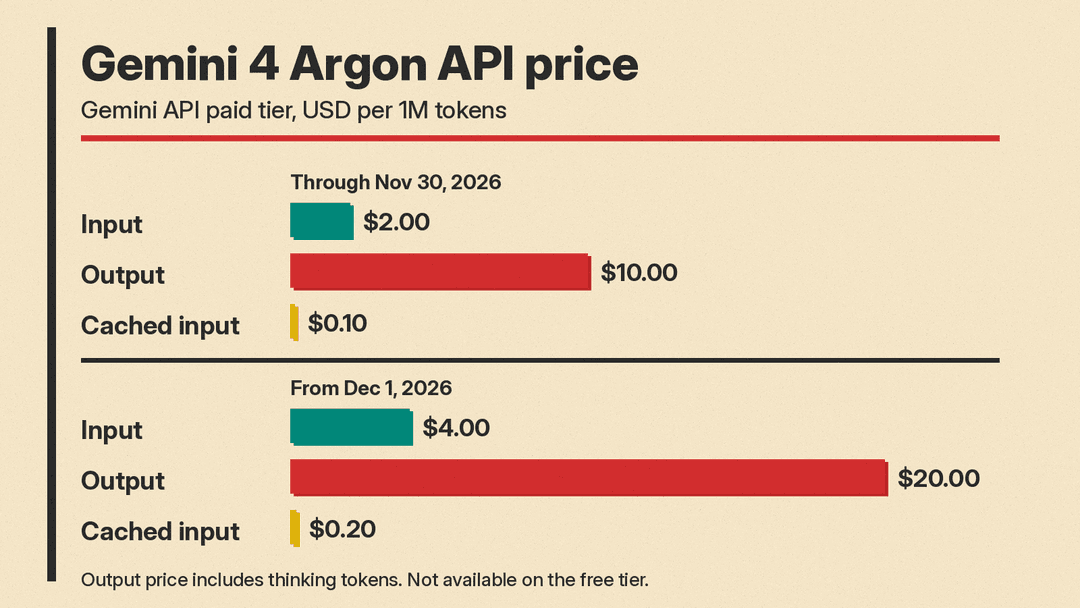
From the Gemini Developer API pricing page (paid tier, per 1M tokens, USD):
- Input: $2.00 through November 30, 2026. $4.00 starting December 1, 2026.
- Output, including thinking tokens: $10.00 through November 30. $20.00 starting December 1.
- Cached input (implicit caching): $0.10 through November 30. $0.20 starting December 1.
- Batch and Flex: half the standard rate, $1.00 input and $5.00 output through November 30, then $2.00 and $10.00.
- Grounding with Google Search: 5,000 free requests per month shared across Gemini 3 and newer models, then $14 per 1,000 requests.
- Free tier: not available. Argon requires the paid tier of the Gemini API.
On Google Cloud, the Gemini Enterprise Agent Platform pricing page lists the same $2 and $10 global-endpoint rates through November 30 and $4 and $20 after. Non-global (regional) endpoints cost 10% more: $2.20 and $11 during the promotion, $4.40 and $22 after. Google Cloud says the promotional price is delivered as "50% credits back on net spend" and does not apply to a separate Gemini 4 Argon Cyber Permissive model. The same page notes that starting November 13, 2026, completions longer than 32K tokens will be billed for retrievable tokens even if the request later fails due to a client or server timeout.
What the price means in practice
Per-token price is only half the cost story. Argon tends to produce long outputs. Artificial Analysis measured an average of 62k output tokens per task on its Intelligence Index with high reasoning, against 27k for GPT-6 Astra (max). Even so, it put Argon's cost at $1.99 per Intelligence Index task at the discounted price, which it calculated as 60% of GPT-6 Astra (max) at $3.26. At standard pricing that rises to $3.98, about 1.2 times Astra. Artificial Analysis attributes the cost advantage to lower token prices, not lower token use.
Vals AI reports a cost of $15.68 per test on its Vals Index at standard prices, below the three Claude models that follow it on that index ($21.34 to $32.14). Vals also notes that cost climbs on long agentic tasks, reaching $193.78 per test on CUA-bench.
For comparison with Google's previous models, the same pricing page lists Gemini 3.1 Pro Preview at $2.00 input and $12.00 output for prompts up to 200k tokens, and Gemini 3.8 Flash at $0.75 input and $3.75 output through December 31, 2026. During the promotion, Argon's output price is lower than 3.1 Pro Preview's. From December 1 it is higher on both input and output.
Benchmarks
Google's model card compares Argon with GPT-6 Astra, Claude Fable 5.1, and Claude Opus 5.5. These are Google's reported numbers as of October 2026, and Google publishes a methodology page for them. A selection:
- Vals Index (knowledge work): Argon 68.9%, Opus 5.5 67.0%, Fable 5.1 65.8%, GPT-6 Astra 63.1%.
- Vals Finance Agent v2: Argon 65.4%, Fable 5.1 58.9%, Opus 5.5 58.6%, Astra 53.5%.
- Harvey's Legal Agent Benchmark: Argon 19.6%, Fable 5.1 6.7%, Astra 5.4%, Opus 5.5 3.8%.
- DeepSWE v1.1 (agentic coding): Argon 77.9%, Opus 5.5 74.2%, Astra 74.1%, Fable 5.1 67.4%.
- FrontierSWE v2: Astra 65.5%, Opus 5.5 62.3%, Fable 5.1 56.3%, Argon 55.0%.
- Terminal-bench 4.0: Opus 5.5 66.4%, Astra 58.2%, Fable 5.1 57.9%, Argon 57.4%.
- GraphWalks, 256k to 1M tokens (long context): Argon 84.2%, Astra 71.8%, Opus 5.5 66.8%, Fable 5.1 65.0%.
- OSWorld-2.0 (computer use, offline subset): Astra 72.6%, Argon 69.2%.
- CWE-bench v1 (vulnerability remediation): Argon and Astra tied at 68.0%.
The pattern in Google's own table is consistent: Argon leads on knowledge work, finance, legal, and long-context retrieval, and trails Anthropic and OpenAI models on several agentic coding and terminal benchmarks. Google's blog post also reports an 87% score on the Embodied Reasoning (ERQA) benchmark and a 0.7% attack success rate on the Gray Swan Indirect Prompt Injection benchmark across 15 adaptive attempts.
Independent evaluators
Two third parties have published their own runs.
- Vals AI ranks Argon first of 50 models on the Vals Index at 68.90% (plus or minus 0.97), with reasoning effort set to high. Google's blog cites this #1 ranking. Vals also places it first on Finance Agent v2 (65.40%) and second on Vibe Code Bench v1.1 (91.91%).
- Artificial Analysis scores Argon 53 on its Intelligence Index with high reasoning, equal to GPT-6 Astra (max) and one point ahead of GPT-6.1 Sol (max). That is 23 points above Gemini 3.1 Pro Preview (30) and 12 points above Gemini 3.8 Flash (high). It ranks Argon first on AutomationBench-AA at 78%.
Note that Artificial Analysis tested Argon at its highest available reasoning setting. The API default is medium, so default-setting results may differ.
The hallucination claim
Posts on X say Argon has a lower hallucination rate. Google itself does not publish a hallucination rate for Argon. Its model card lists hallucinations as a known limitation, and its blog says only that Argon "answers questions more directly with less hedging."
The figure in circulation comes from Artificial Analysis. On its AA-Omniscience benchmark, Argon has a 15% hallucination rate, the lowest of any model scoring 45 or higher on the Intelligence Index, against 51% for GPT-6 Astra (max) and 54% for GPT-6.1 Sol (max). The definition matters. Artificial Analysis measures how often a model answers incorrectly when it should have declined or said it did not know. Argon's accuracy on the same benchmark was 50%, 5 points lower than Gemini 3.1 Pro Preview and 13 points below GPT-6 Astra (max, 63%). Its overall AA-Omniscience score of 42 is in line with Astra (43) and Sol (42).
In plain terms: Argon is more likely to say it does not know, and less likely to know the answer. That trade suits work where a wrong answer is costly. It does not mean Argon gets more answers right.
Usage limits by tier
This is the area with the most complaints and the least published detail.
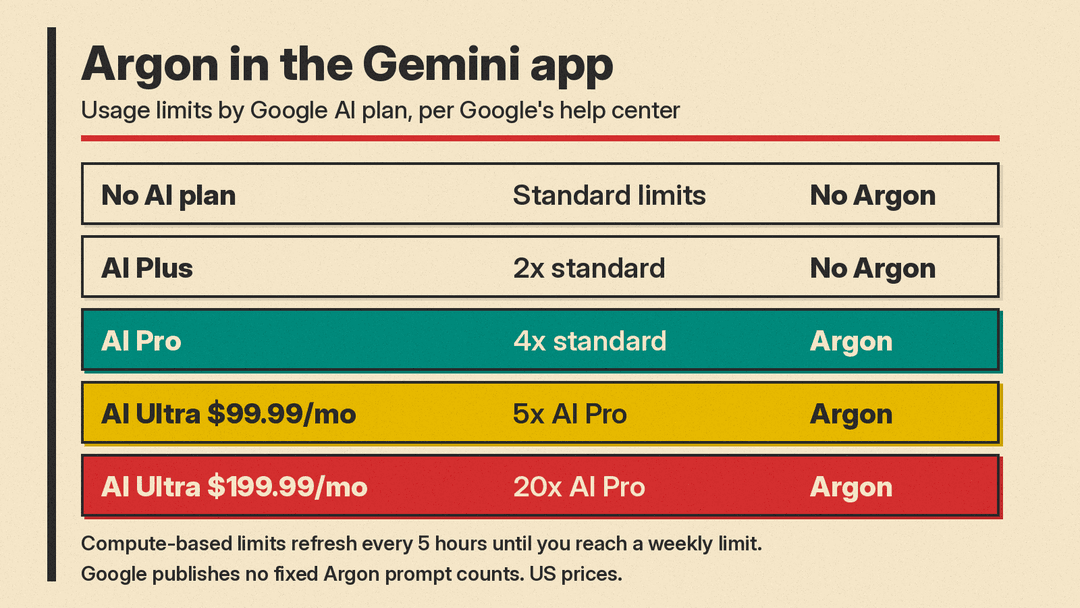
Google's Gemini Apps help page says Gemini app limits are compute-based. They factor in prompt complexity, the models and features used, and chat length. The limit "refreshes every 5 hours until you reach your weekly limit." Google does not publish a fixed number of Argon prompts for any plan. The published multipliers are:
- No AI plan: standard limits. Argon is not included; the free plan lists access to the Flash-Lite model.
- Google AI Plus: 2x standard limits. Argon is not listed for this plan.
- Google AI Pro: 4x standard limits, with access to Gemini 4 Argon.
- Google AI Ultra: 5x or 20x Pro limits, depending on the subscription. On the US plans page, the 5x plan is $99.99 per month and the 20x plan is $199.99 per month.
When a subscriber hits a limit, the help page says the conversation can continue with Flash-Lite. The plans page adds that limits can be extended by buying AI credits. Google also states that limits "may change without notice, including due to capacity constraints."
In Google Antigravity, the plans page lists "entry rate limits" for Pro, "higher" limits for Ultra 5x, and the "highest" for Ultra 20x, again without numbers. The launch post says Argon is available in Antigravity for Ultra subscribers.
What users report on X
These claims are unverified and come from individual accounts, not Google:
- @hakmgpt wrote that asking "Gemini 4.0 Argon (Low) on pro plan in the app to pick a number between 1 and 10" consumed "2% of your 5H usage limits."
- @itsvishaltwt and @xoaanya shared a chart claiming Argon gives about 17x less usage than Opus 5.5 and 7x less than GPT-6 Astra on paid plans. Neither post names the method or source behind the chart.
We could not confirm any of these figures against a Google source. What Google does confirm is the structure: a five-hour window, a weekly cap, and limits that scale with how much compute each prompt uses. A long-reasoning model that averages tens of thousands of output tokens per hard task will use that budget faster than a Flash model.
Availability
Per Google's launch post, Google Cloud post, and model card, Argon became globally available on October 13, 2026 in these places:
- Gemini API and Google AI Studio: paid tier only. Ultra subscribers can also use it in AI Studio.
- Google Cloud: Gemini for business on web, desktop, and mobile, and the API on Gemini Enterprise Agent Platform with Standard PayGo, Priority PayGo, batch, and Provisioned Throughput options.
- Google Antigravity: for Ultra subscribers and enterprises.
- Gemini app and AI Mode in Search: for Google AI Pro and Ultra subscribers.
- Android Studio: listed for developers on the Gemini API paid tier.
- Third-party tools: the developer guide names Vercel, LiteLLM, OpenRouter, Pydantic, OpenCode, LiveKit, BrowserBase, Eigent, and Cua.
A correction to one claim seen online: developer API access did not start around October 16. Google's launch post, Cloud post, and developer guide all say the API was available on October 13. The Gemini API docs were last updated on October 16, which may explain the date.
Two access programs sit alongside the general release. The Fairwind Program gives vetted government, critical infrastructure, and security partners a version of Argon without cyber guardrails; Google said on October 13 it is expanding the program to hundreds of additional partners. Separately, Google is offering 10,000 scientists the highest Antigravity usage tier free for six months, subject to eligibility, capacity, and selection.
Safety notes
Google's model card says it cannot rule out that Argon reached its Frontier Safety Framework critical capability levels for biological information risk and for cybersecurity, and that it cannot rule out the Stealth and Situational Awareness threshold. In each case Google says it applied safeguards that it assesses bring risk below those levels. For general users this mainly shows up as refusals on offensive security tasks such as pentesting and exploitation, which the Cloud post says are blocked in the standard model.
Who should use it
Based on the published data, not on marketing:
- Document-heavy professional work. Finance, legal, tax, and multi-source analysis are where Argon leads in both Google's table and Vals AI's runs. Teams doing this work in English with long inputs have the clearest case.
- Long-context retrieval. Argon's GraphWalks score at 256k to 1M tokens (84.2%) is well ahead of the other models in Google's table. If your workload depends on finding facts inside very long inputs, test it.
- Tasks where a wrong answer costs more than no answer. The AA-Omniscience result suggests Argon abstains more often. Pair it with retrieval or tools if you also need high recall.
- Long autonomous runs. The 1M long decode and background execution suit multi-hour agent jobs, such as the 11-hour ADK optimization run Google documented. Budget for the output tokens.
Where other options may fit better:
- Terminal and agentic coding. On Google's own table, Claude Opus 5.5 leads Terminal-bench 4.0 (66.4% vs 57.4%) and GPT-6 Astra leads FrontierSWE v2 (65.5% vs 55.0%). Coding teams should run their own evals before switching.
- High-volume, simple tasks. Gemini 3.8 Flash costs $0.75 input and $3.75 output through December 31 and is available on the free tier. Google's own developer guide suggests using Argon as an orchestrator with Gemini 3.8 Flash subagents doing parallel implementation work.
- Heavy consumer chat use on a Pro plan. Google publishes no prompt counts, and user reports suggest the weekly cap is reached quickly. Ultra raises the ceiling at $99.99 or $199.99 per month in the US.
- Free-tier experimentation. Argon is not available on the Gemini API free tier or the free Gemini app.
Cost planning should assume the December 1 price. The introductory rate lasts about six more weeks from today, and Artificial Analysis estimates per-task cost doubles when it ends.
Sources
- Google: Gemini 4 Argon is now available for everyone (Oct 13, 2026)
- Google: Introducing Gemini 4 Argon (Sep 30, 2026)
- Google DeepMind: Gemini 4 Argon model card
- Google Cloud Blog: Gemini 4 Argon available on Google Cloud
- Google AI Studio: Gemini 4 Argon developer guide
- Google AI for Developers: What's new in Gemini 4 Argon
- Google AI for Developers: Gemini 4 Argon model page
- Google AI for Developers: Gemini Developer API pricing
- Google Cloud: Agent Platform generative AI pricing
- Gemini Apps Help: Gemini Apps limits and feature availability
- Google: Google AI plans
- Google Developers Blog: Optimizing a 200,000-line Python codebase overnight with Gemini 4 Argon
- Artificial Analysis: Gemini 4 Argon analysis
- Vals AI: Gemini 4 Argon results
- X posts (unverified user reports): @hakmgpt, @itsvishaltwt, @xoaanya
