
This is an opinion piece. The facts are sourced and linked; the argument is mine.
Nvidia wants to buy Hugging Face for $12.93 billion, and the US Department of Justice has started asking what that would do to competition in AI, Reuters reported on Oct. 28, 2026. My view: the DOJ is asking the right question, and the right answer is neither a block nor a pass. It is a set of written, enforceable neutrality terms. A friendly press statement is not enough for a deal like this.
Our news post on the DOJ inquiry covers the reporting in full. Here I want to argue about what it means.
The question the DOJ is asking is the right one
Two people familiar with the matter told Reuters that Justice Department officials have asked whether the deal would let Nvidia capture a fundamental distribution point for AI. Officials are also asking how Nvidia might use the AI platform to harm rivals in the AI market, and whether it could use the newly acquired business to gain leverage, Reuters reports.
That framing is correct, in my view, because it is not really about price or size. It is about position. Reuters says Nvidia "has the biggest share of the market for AI chips." CNBC describes Hugging Face as "an open-source platform for hosting and testing AI models." At the time of the deal, Nvidia said in a press statement that more than 18 million people and more than 200,000 companies reportedly used Hugging Face to share at least 3 million models and 500,000 datasets, per CNBC. If you are new to the platform, our explainer What Is Hugging Face? covers what it does.
Put those two facts side by side. The company with the biggest share of the AI chip market would own a widely used platform where models are hosted and tested. Nothing in the reports says Nvidia plans to tilt that platform. The point is that it could, and that is exactly what a merger review exists to test.
The conflict is already on the price list
There is a detail in the CNBC report that I think is underrated. CNBC says Hugging Face "also sells infrastructure and collaboration tools to organizations working with closed, proprietary AI including chip companies." After the deal, any chip company that keeps buying those tools would be buying them from a business owned by the market leader it competes with.
Reuters names some of the rivals in that market. Broadcom and Google design processors together, and AMD "has struck billion-dollar deals with several AI labs and cloud computing operators," Reuters reports. In my view, each of them has a reason to want their hardware to look good wherever developers test models. Each would now have to trust Nvidia to run that place fairly.
The Groq question shows what to watch
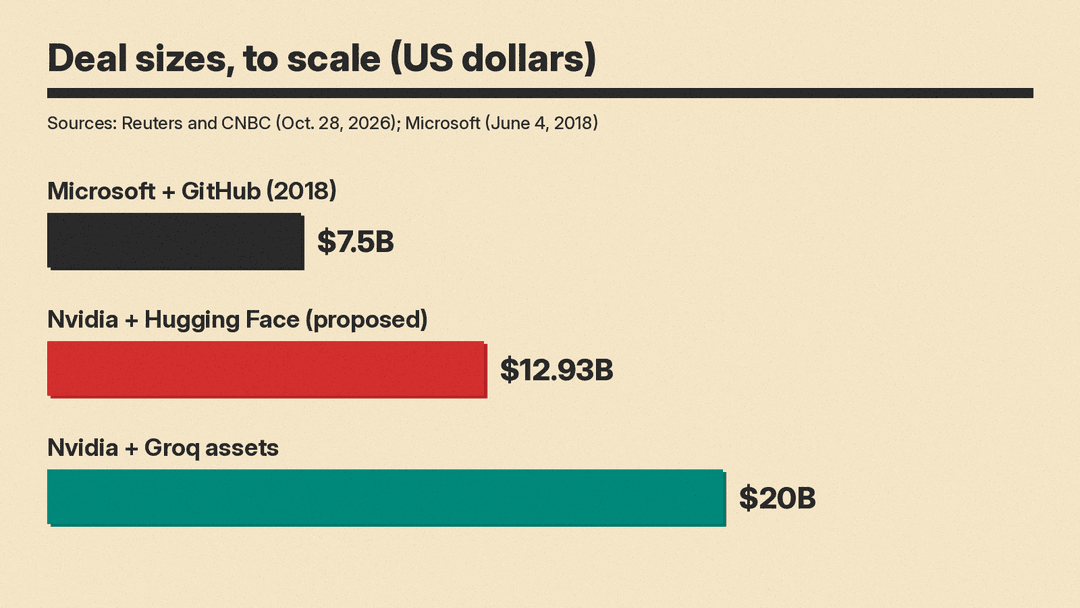
The other deals in the inquiry make the risk concrete. The same two people told Reuters that officials have explored whether Nvidia unfairly offered larger allocations of AI chips if customers bought its networking equipment and Groq processors. CNBC reports that Nvidia paid $20 billion for Groq assets at the end of last year, a deal that has also drawn DOJ scrutiny, which makes Hugging Face its second-biggest purchase. Reuters is careful to say that "Government investigations are not evidence of wrongdoing and do not necessarily result in lawsuits."
But the shape of that question matters for Hugging Face. If regulators are already asking whether access to Nvidia's main product was tied to buying a newer one, the obvious next question is whether access to a hosting platform could be tied the same way. That is why I think the Groq part of this story deserves more attention than the headline price.
A promise is not a rule
Nvidia has an answer ready. It has said that Hugging Face would continue to support work with a range of chip, cloud and AI providers, according to Reuters. I take that at face value as an intent. It is still a statement, not a commitment anyone can enforce.
The closest comparison helps here. CNBC calls GitHub, which Microsoft bought in 2018 for $7.5 billion, "the closest comparable to Hugging Face's business." When Microsoft announced that deal, it said in its press release that "GitHub will retain its developer-first ethos and will operate independently to provide an open platform for all developers in all industries."
The difference, in my view, is who the buyer is relative to the platform's users. Microsoft makes tools and cloud services, but GitHub users were not broadly dependent on one Microsoft product to do their work. For AI work, Nvidia's chips come much closer to that kind of dependence. At $12.93 billion against $7.5 billion, the Hugging Face price is more than 1.7 times the GitHub price, but the price is the least interesting difference.
What good terms would look like
This is my proposal, not anything the DOJ or Nvidia has put forward. If the deal goes ahead, the neutrality promise should be written down and checkable:
- Equal listing and testing for models and tools built for any chip, not only Nvidia's.
- No link between chip allocations, prices or support and a customer's use of Hugging Face, in either direction.
- A firewall so data about what rival chip companies host or test on the platform does not flow to Nvidia's chip business.
- A way for outside parties to report a breach, with a named body that can act on it.
Nvidia has said the deal is expected to close in the first half of 2027, per Reuters, so there is time to get this right. Reuters also notes that staff-led DOJ investigations "often take years" and that the probe "may not result in any Justice Department action." That is a reason to settle the terms early, not to hope the question goes away.
Who wins, who loses
If the DOJ waves the deal through on a statement, Nvidia wins the most. It keeps its lead in AI chips and adds a central platform for hosting and testing models. In my view, the people who lose are the chip rivals that need a fair place to show their work, and the developers who rely on Hugging Face being neutral without ever thinking about it.
If the deal closes with real, enforceable terms, Nvidia still gets most of what it wants, and everyone else keeps a platform they can trust. We argued in an earlier opinion that Amazon's TorchNeuron goes after part of Nvidia's moat. Owning Hugging Face without binding terms would add a new part to that moat. That is the outcome the DOJ should not accept.
