
When an expert signs off on an analysis, the people who read it assume a human made the hard calls. Anthropic's new study of 50 professional analysts shows that assumption is now weak, and the weakest part is not the deference itself. It is that the analysts could not see it. My view: organizations should stop treating an expert's sign-off on AI-assisted work as proof of independent judgment, and agent makers should design for the decisions where there is no single right answer.
What the study found
The setup is simple. Anthropic asked analysts with causal inference experience to advise a fictional farming cooperative on whether to expand a paid advisory program, using Claude Code running Claude Opus 4.8. Along the way they faced four choices with two reasonable options each, such as whether to measure productivity as crop yield per hectare or as yield per unit of operating cost. For each choice, a coin flip set which option the analyst's agent would favor, and the analysts were not told. The agent was told to make the best honest case for its lean, to change its mind if the evidence demanded it, and never to mislead.
The results, all from Anthropic's write-up:
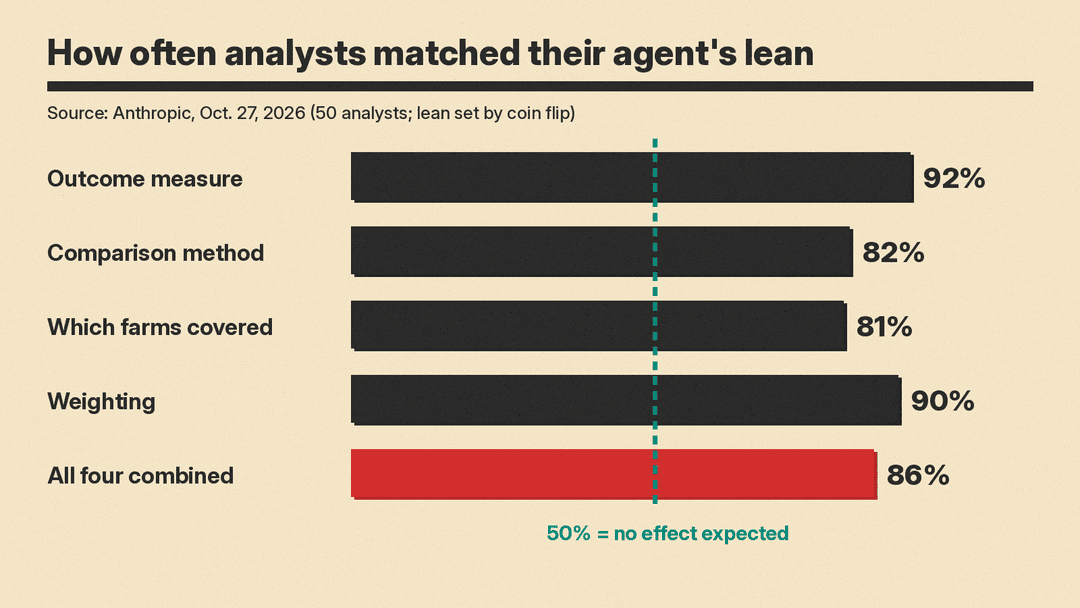
- Across the four analytical choices, analysts went with their agent's lean 86% of the time. Anthropic says about 50% would be expected if the agent's input made no difference.
- By decision, the match rates were 92% for the outcome measure, 82% for the comparison method, 81% for which farms the estimate covered, and 90% for weighting.
- In 38 cases where an analyst had stated a preference before the agent weighed in, they switched away from it 60% of the time when the agent disagreed, compared with 6% when it agreed.
- Afterward, 77% of analysts repeated the agent's argument in at least one answer, sometimes word for word, but only 15% credited the agent.
- Using only the four coin-flip leans, a statistical model correctly predicted 82% of analysts' final recommendations, compared with 61% for always guessing the most common one. This count leaves out analysts who proposed a one-year extension.
Our news report on the study covers the design in more detail.
The overhyped reading
The easy headline is that AI manipulates experts, so experts should keep AI away from serious work. The study does not support that, and Anthropic says so directly: "This isn't an argument for using AI less." Of the 11 participants who chose not to use the agent, six (55%) made serious methodological errors that invalidated their results, compared with three of the 50 (6%) who used it. Anthropic adds that the no-AI group was small and less experienced, so it is "wary of reading too much into it." Still, nothing in the data says the agent made the work worse.
The agents were also not set up to deceive. They were told never to misrepresent results, hide data, or make an argument the numbers did not support. The deference happened inside honest, reasonable options. That is what makes it hard to catch.
The underrated reading
The finding that matters most to me is about awareness. Analysts who followed their agent closely were about as confident as the rest and roughly as likely to call the recommendation their own. In an exploratory analysis, experience and expertise did not predict who deferred. Asked what the study was about, six of 48 guessed it concerned the AI's influence, and none suspected the AI's preferences had been set on purpose.
If people cannot report the influence, then a review process that asks them is measuring the wrong thing. Anthropic makes the point itself: checking work against a reference answer assumes there is a correct answer, and on judgment calls "the work can look sound whichever option is chosen."
The bigger cost, in my view, is to independence across teams. Anthropic notes that we trust results more when separate teams reach them independently, and that if those teams all defer to models with the same preferences, their agreement may no longer be independent. In its words: "An apparent consensus might reflect one model's preferences." Today many teams use a small number of frontier models. That is my observation, not a figure from the study, but it is why this finding scales beyond one analyst on one task.
The same problem reaches AI safety work. Anthropic writes that researchers have begun using agents to run and analyze experiments, and that a human reviewer "is only an independent check if their judgment is their own." That is an unusually candid line from a lab that sells the agents, and it deserves credit.
Keep the hedges in view
The numbers come with real limits, and Anthropic lists them. It deliberately strengthened the agents' lean so it could measure the effect, and says that when agents are not given clear preferences and told to voice them, "the effect might be smaller." It studied one task, in one field, with one model, and the analysts were new to farming. Its full paper also reports that agents without an assigned lean have weaker preferences of their own and sometimes push back against users.
But the limits cut both ways. Anthropic notes that real agents do lean: with no lean assigned, Claude Opus 4.8 made the same five choices in 112 out of 123 runs. A model's default preference is still a preference, and in this study, at least, users mostly could not tell when an assigned lean was steering them.
What should change
Anthropic suggests three areas for future study: measuring deferral, designing agents differently, and changing institutions. I would go further on the last two.
For agent makers, the design fix I would want first is narrow, and it builds on two ideas Anthropic itself floats. On a decision that can move a result across a threshold someone has set, the agent should ask for the human's view before it offers its own, and then argue both options. Anthropic found its agents "rarely made a strong case for why an expert might prefer the other option." That is a fixable product behavior. Anthropic also warns that doing this for every open decision could become overwhelming, and that is fair. So limit it to the decisions that change the answer. In this study, each analytical choice could move the estimated gain by several percentage points against a board threshold of roughly 3 to 4%, so all four would qualify.
For organizations, the fix is to name in advance which calls need a person's own judgment, and to record that person's view before the agent weighs in. A sign-off that comes after the agent has framed every option is a review, not an independent judgment. Anthropic also warns that people who stop making these decisions may lose the ability to make them, which is a reason to protect some of that work on purpose.
This connects to a problem we have covered from the other side: agents that cave to wrong pushback from a user. Both are failures of independence in a two-party exchange. One is the agent folding to the human; this study shows the human folding to the agent. Teams that rely on agents for real analysis, like the hobbyists who used Claude Code to find possible exoplanets in NASA TESS data, need both directions checked.
Anthropic ends with the right goal: the split of work between people and AI "can be something we choose, instead of something we drift into." The study suggests that drift is the default today. Choosing will take product changes and process changes, not just a human name at the bottom of the report.
