
Tavus says its Griffin model is the first model to pass a real-time video Turing test. In a company-run study, 26 of 54 people who had a one-minute video call with it said afterward that they believed their partner was a real person. That is 48%, the headline number on Tavus's launch page. It is worth knowing what the test was, what the model does, and what you can and cannot use today.
Tavus introduced Griffin on October 1 in a long launch post. On October 28, Jesse Rowe, who works on growth at Tavus, posted behind-the-scenes clips from filming the launch video. He says the launch post drew about 21 million views and that Griffin ran live on set during filming.
What Griffin is
Tavus calls Griffin a "Human Interaction Model," which it describes as a new class of model designed to understand and generate face-to-face, real-time human interaction. In practice it is a video call partner. You talk to it on camera, and it answers with a generated face, voice and body, all made on the fly.
The version available today, only to a select group of early testers, is Griffin-Lite, a research preview. Tavus says a wider release of "a more powerful model" will follow.
Tavus lists five abilities, each shown in demo clips on the launch page:
- Behavior and emotion. It laughs, changes its tone and shifts in response to what the other person says and does.
- Full-scene generation. It generates every pixel of every frame in real time from one reference image. That includes the face, arms and fingers, and also the movement of the chair the person sits in, the shadows they cast and the background.
- Full-duplex conversation. It can interrupt, be interrupted, and back-channel (small "mm-hm" signals) without losing its place.
- Perception. It reacts to visual context when appropriate, not only to words. Demos include coaching someone through a Rubik's cube.
- Temporal understanding. It tracks how long a silence has lasted and decides when to speak again on its own.
How it works
Many voice agents are cascades: speech recognition, then a language model, then speech synthesis, one after the other. They wait for you to stop talking before they start. We covered why that design misses tone and pauses in our speech-to-speech vs cascaded voice agents explainer.
Griffin is built differently. Tavus describes a two-part system that runs all the time, while it listens and while it talks:
- A Continuous Conversational Modeling engine takes in your audio and video. At regular sub-second intervals it decides what to say and how to say it, including tone, stance, facial expression and gesture. Because it decides continuously, a pause for thought is not treated as the end of your turn.
- An Audio Visual Generation engine turns those decisions into speech and video. It has two parts, a streaming speech generator and a streaming video generator.
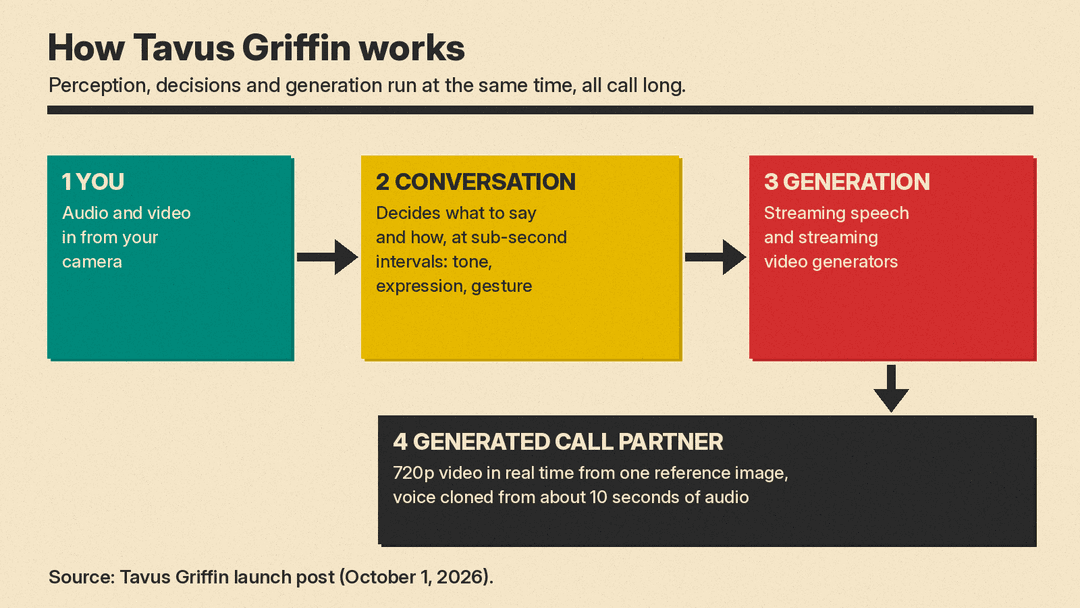
A few details from the post show how this is done:
- Voice. The speech generator can clone a voice from about 10 seconds of audio. It runs on Tavec, a Tavus audio codec that compresses 48 kHz audio into 100 frames per second, with audio packets as small as 10 ms.
- Video. The video generator makes 720p video in real time, one latent (a compressed slice of video) at a time. Tavus built it by distilling a large, many-step diffusion model into a few-step generator, then training it to run for a long time without drifting.
- Lag. On Nvidia H100 GPUs, the delay between audio arriving and its effect appearing on screen averaged 0.43 seconds, which Tavus says is half that of the next fastest method it tested.
Earlier Tavus models relied on extensive 3D priors. The company says that made hand gestures, large body movement and moving backgrounds out of reach. Griffin's new video model is meant to fix that.
The 48% study, and how to read it
Here is how Tavus says the test worked. Participants came from an independent research platform. They were told they would be matched with another participant for a one-minute video call about what they were looking forward to this year. The partner was actually a PAL powered by Griffin-Lite. After the call they filled in a survey and were asked whether they thought their partner was a real person. Only at the end of the survey were they asked whether it had crossed their mind that the partner might not be real, and if so, when. Then everyone was told it had been AI.
The results, per Tavus:
- 48% of Griffin-Lite participants (26 of 54) believed their partner was real.
- On Tavus's older Phoenix-4.5 model, 2.4% (n=41) said the same.
- People were confident either way: about 79% average confidence among those who said "real," about 81% among those who said "AI."
- Over half said the idea that their partner might be AI never crossed their mind during the call. Those who did suspect tended to do so within the first 20 seconds.
- On a 7-point scale, Griffin-Lite averaged 5.4 for seeming natural and 5.8 for whether people would enjoy talking with it again. "Flowing naturally" was its lowest score, at 4.9.
Read the headline number with care. This is Tavus's own study, with 54 people and one-minute calls. Participants expected a human, which matters: a person who is told to spot a bot may behave very differently. A 48% "real" rate also means about half of people still judged it to be AI. The study suggests that many people in a short call can take the model for a person. It is not proof of how the model does in long or high-stakes conversations.
The benchmark numbers
Tavus also reports results on VideoFDB, a full-duplex audio-visual conversation benchmark that Tavus says Nvidia built and scored independently. It has two tracks.
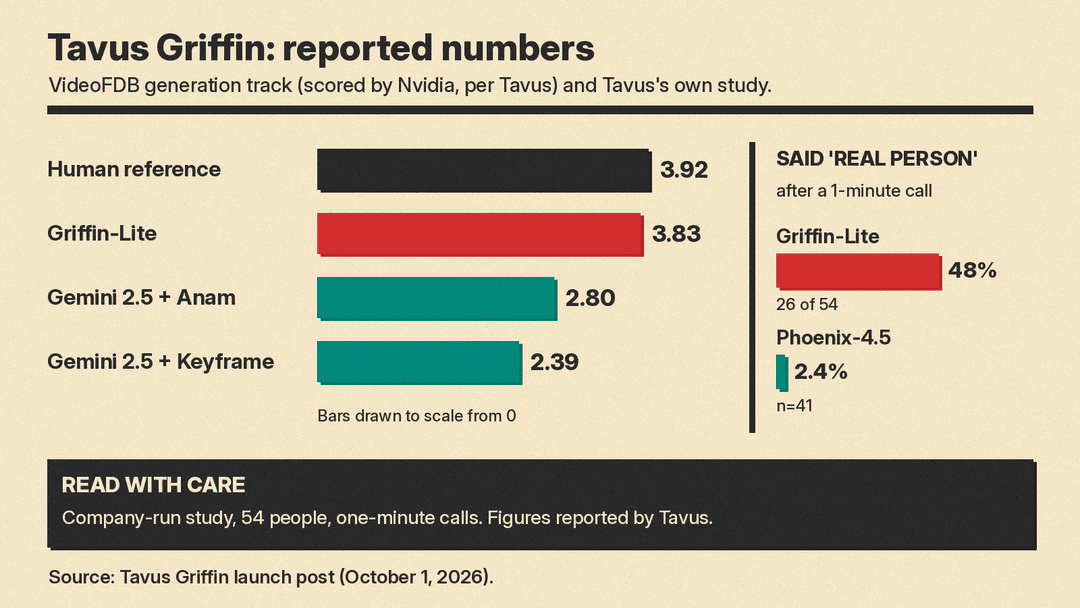
- Generation track (does the model produce the right speech and body language?): Griffin-Lite scored 3.83, against a human reference of 3.92. The next system listed, Gemini 2.5 + Anam, scored 2.80.
- Perception track (does it read the moment, including what it sees?): Griffin-Lite scored 3.73, against a human reference of 4.20. The next best was MiniCPM-o 4.5 (audio-only variant) at 3.44. Tavus says Griffin-Lite led all 15 models evaluated on this track.
Response timing is still slower than people. On the generation track, Tavus lists Griffin-Lite's timing at 1,892 ms against 900 ms for the human reference.
On standard video quality metrics, Tavus says the Griffin-Lite video generator beat four published streaming models on DOVER, FID and THEval. It placed second on the LSE-C lip sync score, at 7.27. If you care about lip sync for recorded video instead of live calls, our guide to AI lip sync tools covers tools you can use now.
Can you use it?
Not yet, for most people. Tavus says Griffin-Lite "will not be available for use for customers at this time." It is open only to select trusted testers as a research preview, with a request form on the launch page. Tavus says it expects to release Griffin "very soon after these safety concerns are addressed."
Tavus's existing product, PAL Maker, keeps shipping features meanwhile. On October 26 Tavus said on X that its Face Studio tool for making faces is now in PAL Maker for everyone.
Why it matters
For creators and businesses, a real-time video call partner opens new uses. Tavus names tutoring, rehearsing a hard conversation, and customer support where you hold a broken part up to the camera.
The risk is the flip side of the same feature. Tavus says it directly: the properties that make Human Interaction Models powerful interfaces also "allow them to deceive a human into believing it is not AI." It says it is working on safe disclosure features and with organizations that work on AI safety, and that it wants further safety work before a wider release. That puts more weight on tools that prove a human is on the other end of a call, like the approach in our World ID for Zoom explainer.
The open questions are practical. Tavus has not published a release date or pricing for Griffin. It has not said how disclosure will work in the product. And we found no outside group that has repeated the 48% study. Until then, treat Griffin as a research result with company-reported numbers, and watch for the full release.
Sources
- Tavus: Griffin, The First Human Interaction Model (launch post, October 1, 2026)
- Jesse Rowe on X: Griffin behind-the-scenes clips (October 28, 2026)
- Tavus on X: Face Studio in PAL Maker (October 26, 2026)
