
Anthropic released Claude Haiku 5.5 on October 7, 2026, with a steep price cut. For prompts up to 100,000 tokens, input costs $0.10 per million tokens and output costs $0.50, a tenth of what Haiku 4.5 charges. Anthropic calls it "the cheapest, fastest, and most capable small model we've ever released."
It joins Claude Opus 5.5 and Sonnet 5.5 in the current Claude lineup. The announcement also brought three other changes: cheaper cache reads on Sonnet 5.5, a monthly API credit for Max and Team subscribers, and computer use and browser use support in the Claude SDKs. This explainer covers what Haiku 5.5 costs, how it scores, what it is for, and where Anthropic says it is the wrong pick.
What Haiku 5.5 is for
Anthropic positions Haiku 5.5 for "high-volume, cost-sensitive tasks." The announcement lists summaries, compactions, database queries and classification requests as the quick and repetitive work it handles well. It also names two other roles:
- Subagent on coding work. Anthropic says Haiku 5.5 "pairs well with Opus 5.5 and Sonnet 5.5 as a subagent on coding work." The pattern is a larger model planning and a smaller one doing narrow lookups or edits.
- Speed-sensitive work. Anthropic calls it its fastest model to date and points to live customer support and browser use. A footnote qualifies the speed claim: Haiku 5.5 is fastest "at each model's standard speed," but it runs slower than Opus models in Fast Mode.
The model ID on the Claude Platform is claude-haiku-5-5. Anthropic says it is available "on all platforms, including Amazon Web Services, Google Cloud, and Microsoft Azure," and it has published a migration guide.
Pricing
Haiku 5.5 has two price tiers based on prompt length. Requests up to 100,000 tokens get the low rate. Longer requests cost five times as much, though still half of Haiku 4.5's price. Anthropic says prompts up to 100,000 tokens made up "around 90% of requests to our previous Haiku model."
Prices per 1 million tokens, from Anthropic's announcement:
| Price per 1M tokens | Haiku 5.5 (up to / over 100k) | Haiku 4.5 | Sonnet 5.5 |
|---|---|---|---|
| Input tokens | $0.10 / $0.50 | $1.00 | $2.00 |
| Output tokens | $0.50 / $2.50 | $5.00 | $10.00 |
| Cache writes | $0.125 / $0.625 | $1.25 | $2.50 |
| Cache reads | $0.01 / $0.05 | $0.10 | $0.10 |
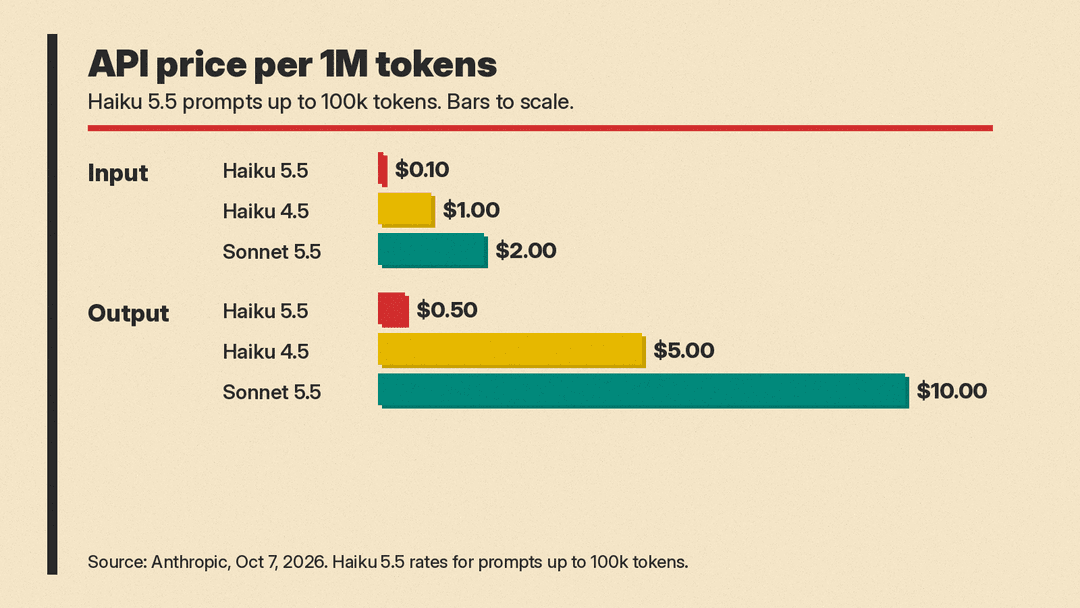
The headline cut is 90% for short prompts and 50% for long ones. Anthropic's average saving is smaller: it says Haiku 5.5 costs "around 75% less to run" than Haiku 4.5. The gap comes from the tokenizer. Haiku 5.5 uses an updated tokenizer, similar to Sonnet 5.5's and Opus 5.5's, which "uses slightly more tokens per task." The 75% figure accounts for that and for the mix of short and long requests.
For a wider view of where these numbers sit against OpenAI, Google and DeepSeek, see our LLM API pricing comparison.
Benchmarks
Anthropic compares Haiku 5.5 with Haiku 4.5 and OpenAI's GPT-6 Luna, with Sonnet 5.5 shown for reference. The scores below are Anthropic's reported results:
| Benchmark | Haiku 5.5 | Haiku 4.5 | GPT-6 Luna | Sonnet 5.5 |
|---|---|---|---|---|
| GDPval-AA v2.1 (knowledge work, Elo) | 1620 | 735 | 1437 | 1840 |
| AA-Briefcase v1.1 (knowledge work) | 1578 | 614 | 1336 | 1824 |
| OSWorld 2.1, offline subset (computer use) | 72.4% | 15.7% | 48.9% | 83.9% |
| Humanity's Last Exam, no tools | 45.9% | 10.2% | not reported | 56.9% |
| Humanity's Last Exam, with tools | 57.4% | 18.7% | not reported | 64.5% |
| Terminal-Bench 4.0 (agentic coding) | 39.2% | 0.0% | 16.4% | 70.6% |
| FrontierCode 1.1 Main (agentic coding) | 46.4% | not reported | 42.4% | 52.1% (Xhigh) |
| Chartography, no tools (visual reasoning) | 46.4% | 6.4% | 29.1% | 61.6% |
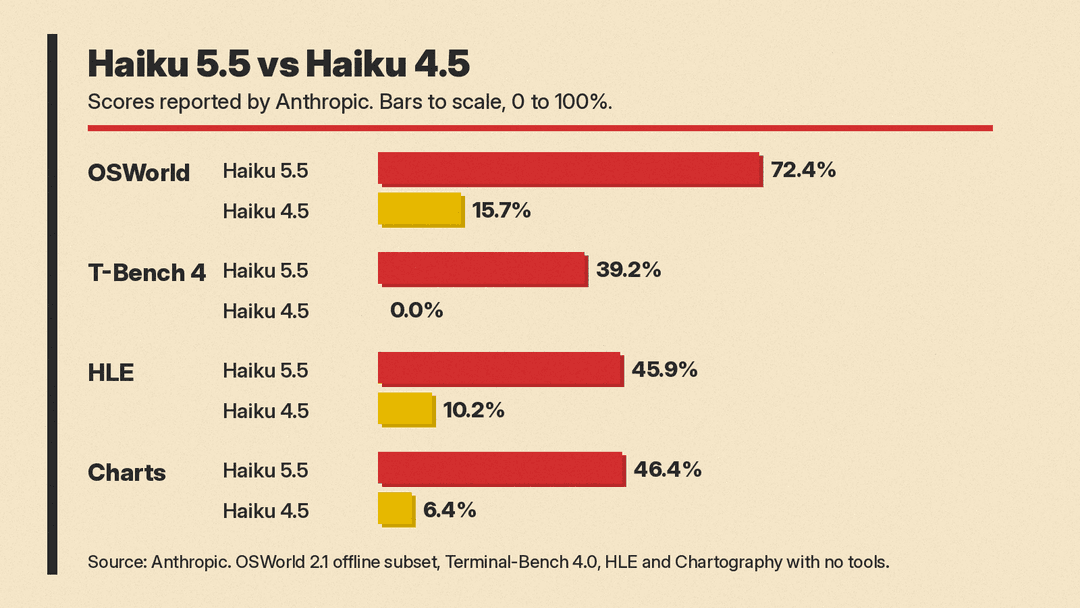
Three things stand out. First, the jump over Haiku 4.5 is large on every test Anthropic reports. On OSWorld's offline subset, Haiku 5.5 scores 72.4% against 15.7%. On Terminal-Bench 4.0, Haiku 4.5 scored 0.0% and Haiku 5.5 scores 39.2%. Second, Haiku 5.5 is ahead of GPT-6 Luna on each benchmark where both have a score. Third, Sonnet 5.5 is still ahead everywhere, and among the percentage scores the gap is widest on Terminal-Bench 4.0: 70.6% against 39.2%.
These are vendor-run numbers. Anthropic points readers to the Haiku 5.5 System Card for how it ran the evaluations.
Effort settings come to Haiku
Haiku 5.5 is "our first Haiku-class model to come with an adjustable effort setting," Anthropic says. As with its larger models, users choose a level to trade cost against intelligence. Anthropic's charts plot Haiku 5.5 at five levels: Low, Med, High, Xhigh and Max, with cost per attempt or per task on a log scale against the score on OSWorld 2.1, GDPval-AA v2.1 and Humanity's Last Exam.
In practice, one model could cover both cheap bulk calls and harder one-off tasks. A team could run classification at Low and save the higher settings for requests that need more reasoning, without switching models.
Where Anthropic says not to use it
The announcement is direct about the limits. Using a Terminal-Bench 4.0 cost chart, Anthropic writes that "Sonnet 5.5 and Opus 5.5 remain better choices for complex agentic coding tasks." Haiku 5.5, it says, "is best suited to more narrowly scoped tasks that might otherwise have been cost-prohibitive with previous versions of Claude," and it names compaction, summarization and subagent work.
For readers weighing the mid-tier option, our Claude Sonnet 5.5 vs GPT-6.1 Sol vs Gemini 3.8 Flash comparison covers that tier.
What early customers reported
Anthropic quotes six early testers. Their numbers are their own, from their own evaluations:
- Asana said that compared with the model it uses today, it saw "over a 30% reduction in latency for task completions and up to 2.5x faster inference per agent turn" in its AI Teammates eval suite.
- HubSpot said Haiku 5.5 "got the best score we've seen on this suite yet, at 92.8% averaged over three runs," on simulated CRM tasks.
- AlphaSense said its Ask in Document feature does "about 8M calls a week in production," and that across 400 queries Haiku 5.5 scored 0.84 against Haiku 4.5's 0.76.
- Box said Haiku 5.5 "scored 11 points higher than Haiku 4.5 at about half the latency" in early testing.
- Rogo described using a Haiku 5.5 subagent to pull a segment revenue line from a 10-K while a bigger model builds the deck.
- Cognition said that with Haiku 5.5 as the sidekick model in Devin Fusion, Fusion "holds a top-tier FrontierCode score of 66.2 while cutting cost and latency." It said users can try it in the Devin CLI with Opus 5.5 as the lead.
Safety and safeguards
Anthropic says Haiku 5.5 "shows major improvements across almost all of our alignment evaluations relative to Haiku 4.5," with "far fewer instances of misaligned behavior, and a lower willingness to cooperate with misuse."
Its cybersecurity safeguards sit in the middle of the lineup. They are more restrictive than Haiku 4.5's but "somewhat less restrictive than those we've applied to other recent models." Anthropic says they permit a wider range of defensive tasks than Sonnet 5.5's safeguards, but still block penetration testing and "other techniques more likely to be used by attackers." Biology safeguards match those for Sonnet 5, Sonnet 5.5 and Opus 5. Organizations with wider needs can apply to the Life Sciences Verification Program or the Cyber Verification Program.
The other changes in the same announcement
- Sonnet 5.5 cache reads cut in half. Cache reads dropped from $0.20 to $0.10 per million tokens. Because cache reads are a large share of token use, Anthropic says this makes Sonnet 5.5 "around 20%" cheaper on most agentic tasks.
- Monthly API credits for subscribers. Anthropic said it would roll out a monthly Claude Platform credit that week: $100 per month for Max 5x, $200 for Max 20x, and up to $500 for Team subscribers, pooled across users. The credits work on any Claude model.
- Computer use and browser use in the SDKs. The Claude Python and TypeScript SDKs gained computer use and browser use support in beta. Anthropic says Haiku 5.5 is "especially well-suited to these tasks" given its speed and price.
Why it matters
Anthropic pitches Haiku at high-volume work such as classification, summaries and subagent calls, and it says about 90% of requests to the previous Haiku were prompts of up to 100,000 tokens. A 90% cut on exactly those prompts changes which jobs are worth automating, and the effort setting lets one model cover more of that range. The API credit also lowers the cost of trying it for people who already pay for Max or Team.
The caveat is Anthropic's own. Haiku 5.5 is a narrow-task model. For long, complex coding runs, the company still points to Sonnet 5.5 and Opus 5.5, and its own Terminal-Bench numbers back that up.
