
Claude Sonnet 5.5, GPT-6.1 Sol, and Gemini 3.8 Flash are the mid-priced models that Anthropic, OpenAI, and Google offer below their top models (Claude Opus 5.5 and Claude Fable 5.1, GPT-6 Astra, and Gemini 4 Argon). This guide compares them as of October 2026 on API price, promotional pricing and end dates, context and output limits, vendor-reported benchmarks, and where you can use each one. Every figure comes from the vendor's own pricing page, model page, or launch post.
For the top models, see our Gemini 4 Argon vs GPT-6 Astra vs Claude Opus 5.5 comparison. For how GPT-6.1 Sol fits in OpenAI's own lineup, see GPT-6.1 Sol vs GPT-6 Sol vs Luna vs Astra. For prices across all models, see our LLM API pricing guide.
Model names and IDs
All three names are real and match the vendors' pages:
- Claude Sonnet 5.5: API ID
claude-sonnet-5-5, per Anthropic's models overview. Anthropic launched it on September 28, 2026, and calls it "the second model in the Claude 5.5 family" in its launch post. - GPT-6.1 Sol: model ID
gpt-6.1-sol, per OpenAI's model page. OpenAI's launch post describes it as "an upgrade to GPT-6 Sol." - Gemini 3.8 Flash: model code
gemini-3.8-flash, per Google's model page. Google introduced it on September 2, 2026, in its launch post.
A naming note: GPT-5.6 Sol is a different, older OpenAI model that is still on the OpenAI pricing page. It costs $4.00 per million input tokens and $20.00 per million output tokens, and the page says "GPT-5.6 Sol's promotional pricing is available at least through November 21, 2026." Do not confuse it with GPT-6.1 Sol.
API prices per million tokens
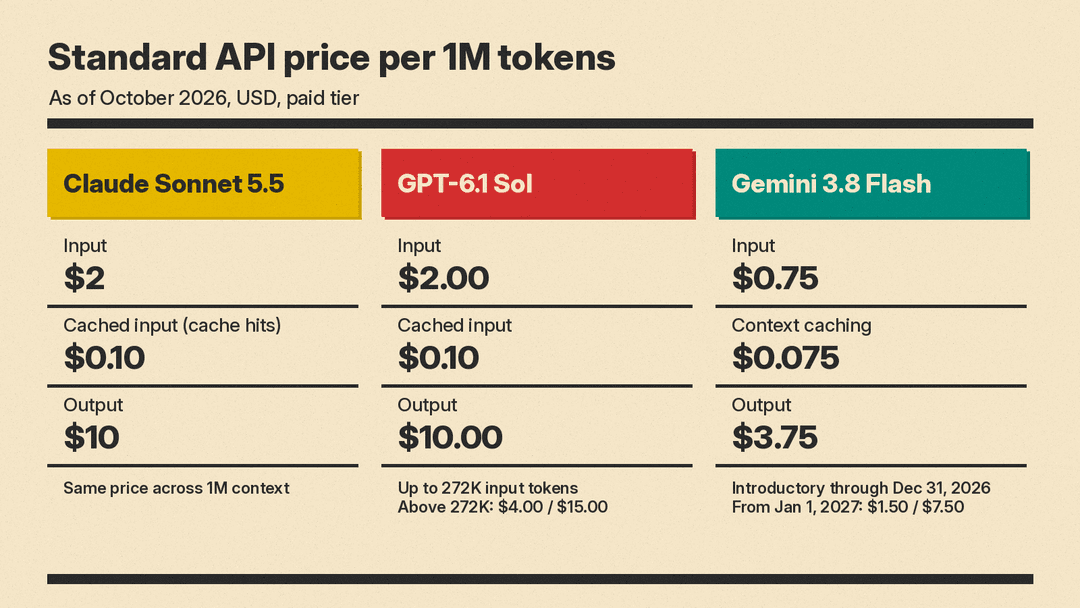
Claude Sonnet 5.5
From Anthropic's pricing page:
- Input: $2 per million tokens
- Output: $10 per million tokens
- Cache hits and refreshes: $0.10 per million tokens
- 5-minute cache writes: $2.50; 1-hour cache writes: $4
- Batch: $1 input and $5 output. Anthropic says the Batch API gives "a 50% discount on both input and output tokens."
- Long context: Anthropic says Claude 4.6 and later models, except Haiku 5.5, "include the full 1M token context window at standard pricing."
- US-only inference: a 1.1x multiplier "on all token pricing categories."
The launch post says Sonnet 5.5 "is priced the same as Sonnet 5" and that cache reads cost "half of Sonnet 5's $0.20." Anthropic lists no promotional price for Sonnet 5.5.
GPT-6.1 Sol
From OpenAI's pricing page and model page:
- Input: $2.00 per million tokens (short context, 272K input tokens or fewer)
- Cached input: $0.10
- Cache writes: $2.50
- Output: $10.00
- Long context (more than 272K input tokens): $4.00 input, $0.20 cached input, $5.00 cache writes, $15.00 output. The model page says these prompts "are priced at 2x input and cache rates and 1.5x output for the full request."
- Batch and Flex: $1.00 input and $5.00 output (short context). The model page says "Batch and Flex prices are 50% lower than Standard."
- Fast mode: $4.00 input and $20.00 output. Ultrafast: $12.00 input and $60.00 output.
- Regional processing "adds a 10% premium where available."
The launch post says cached input at $0.10 is "95% less than standard input pricing and 50% less than GPT-6 Sol's cached input pricing." OpenAI lists no promotional price for GPT-6.1 Sol.
Gemini 3.8 Flash
From Google's Gemini API pricing page, paid tier, Standard:
- Input: $0.75 per million tokens through December 31, 2026, then $1.50 starting January 1, 2027
- Output (including thinking tokens): $3.75 through December 31, 2026, then $7.50 starting January 1, 2027
- Context caching: $0.075 through December 31, 2026, then $0.15 starting January 1, 2027, plus a storage price of $0.50 per million tokens per hour (rising to $1.00 on January 1, 2027)
- Batch: $0.375 input and $1.875 output through December 31, 2026
- Grounding with Google Search: "5,000 free search requests per month (shared across all Gemini 3 and newer models), then $14 per 1,000 requests"
- Free tier: input and output are "Free of charge." On the free tier, content is "Used to improve our products."
The $0.75 and $3.75 rates are promotional. Google's launch post calls them an "introductory price" and says: "Introductory price expires on December 31, 2026. Starting January 1, 2027, $1.50/1M input tokens and $7.50/1M output tokens will apply." The model card lists the same rates as "$0.75 ($1.50 regular)" and "$3.75 ($7.50 regular)."
Google's pricing page lists no separate long-context rate for Gemini 3.8 Flash.
Context window, output limit, and inputs
Claude Sonnet 5.5
From Anthropic's models overview:
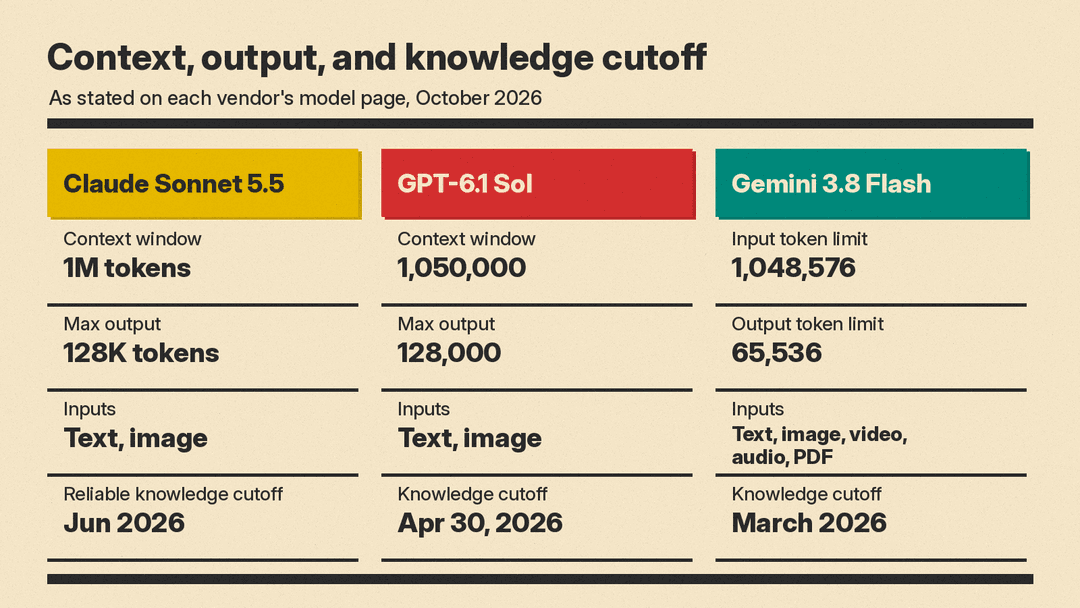
- Context window: 1M tokens
- Max output: 128K tokens on the synchronous Messages API. The Sonnet 5.5 model page adds that on the Message Batches API, Sonnet 5.5 supports "up to 300k output tokens with the output-300k-2026-03-24 beta header."
- Input: text and image; output: text
- Reliable knowledge cutoff: June 2026
- Thinking: "Adaptive." Default effort on the Claude API:
high. - Retirement: "Not sooner than September 28, 2027"
GPT-6.1 Sol
From OpenAI's model page:
- Context window: 1,050,000 tokens
- Max output: 128,000 tokens
- Input: text and image; output: text. Audio and video are not supported.
- Knowledge cutoff: April 30, 2026
- Reasoning effort:
low,medium(default),high,xhigh, andmax. OpenAI says "Thenoneandminimalreasoning efforts are not supported." - Tool calling: "Use the Responses API for tool calling. Chat Completions is supported without tool calling."
Gemini 3.8 Flash
From Google's model page and model card:
- Input token limit: 1,048,576. The model card describes this as "a token context window of up to 1M."
- Output token limit: 65,536. The model card says "a 64K token output."
- Input: text, image, video, audio, and PDF; output: text
- Knowledge cutoff: March 2026, per the model card
- Thinking: "Supported (low, medium, high)." Google says "
minimalis not supported and returns an error." - Computer use: "Supported (Preview)"
Benchmarks, as each vendor reports them
The three vendors do not publish one shared benchmark table. Each launch post compares its model with a different set of rivals, often at different effort settings and with different test harnesses. Treat the numbers below as each vendor's own claims, not as a direct ranking.
Claude Sonnet 5.5 (Anthropic's figures)
From the Sonnet 5.5 launch post (September 28, 2026):
- Terminal-Bench 4.0: 70.6% (Sonnet 5: 10.3%; Opus 5.5: 66.4% at Xhigh effort)
- FrontierCode 1.1 (Main): 46.2% at Max effort and 52.1% at Xhigh (GPT-6 Sol: 49.3%)
- CursorBench 4.0: 55.5% (Opus 5.5: 57.8%)
- GDPval-AA v2.1: 1844 (Opus 5.5: 1846; GPT-6 Sol: 1487)
- AA-Briefcase v1.1: 1811
- Humanity's Last Exam: 64.5% with tools
- OSWorld 2.1: 80.1% partial
- Chartography: 61.6% no tools
Anthropic adds that "Opus 5.5 remains clearly stronger at complex, open-ended work requiring sustained judgment." It also says Sonnet 5.5 "generates outputs 30%+ faster than Sonnet 5, making it our fastest Sonnet model to date." Anthropic's comparison column is GPT-6 Sol, not GPT-6.1 Sol, and it does not include Gemini 3.8 Flash.
GPT-6.1 Sol (OpenAI's claims)
OpenAI's launch post (September 29, 2026) presents most results as charts and relative claims rather than as a score table. The text says:
- DeepSWE v1.1: GPT-6.1 Sol "matches GPT-6 Astra at roughly one-fifth of the cost," while "eclipsing GPT-6 Sol's best score by 6.4 percentage points at a lower reasoning effort and cost."
- AutomationBench: it "scores 2.2 percentage points above Opus 5.5 at medium reasoning effort, at roughly a third of the cost."
- OSWorld 2.0 (offline set): it "comes within 2.1 percentage points of Astra's score at maximum reasoning effort at roughly one-seventh the cost per task."
- Terminal-Bench Science 0.1: at maximum effort, "GPT-6.1 Sol costs $5.47 per task on average, compared with $23.21 for Opus 5.5 and $23.80 for Astra."
- Factuality: at low effort, it "reduces the share of responses containing a factual error from 11.4% to 7.7%" compared with GPT-6 Sol.
The post's text does not give GPT-6.1 Sol's own percentage scores on these benchmarks, so we do not list any. It does not compare with Claude Sonnet 5.5 or Gemini 3.8 Flash.
Gemini 3.8 Flash (Google's figures)
From the Gemini 3.8 Flash model card, results "as of September, 2026":
- DeepSWE v1.1: 73.7%
- GDPVal-AA v2: 1545 (Elo)
- Vals Finance Agent v2: 61.4%
- Harvey's Legal Agent Benchmark: 10.0% all pass rate
- Terminal-bench 2.1: 89.4%
- Terminal-bench 4.0: 19.1%
- GDP.PDF: 35.0% all pass rate
- CharXiv Reasoning: 86.2% no tools
- HLE-Verified: 54.9%
- OSWorld-2.0: 59.0% partial score, batch tool enabled
Google's comparison columns are Gemini 3.7 Flash, Claude Opus 5, Claude Sonnet 5, GPT-5.6 Sol, and GPT-5.6 Terra. They do not include Claude Sonnet 5.5 or GPT-6.1 Sol. Google's evaluation methodology page says the Gemini DeepSWE result is "self computed, and use[s] a mini-swe agent harness with high thinking."
Where the numbers overlap
Two benchmark names appear in more than one vendor's table, but the setups differ:
- Terminal-Bench 4.0: Anthropic reports 70.6% for Sonnet 5.5. Google reports 19.1% for Gemini 3.8 Flash and says its Terminal-Bench 4.0 figures are "reported from the official public leaderboard." The two numbers come from different sources and settings.
- GDPval-AA: Anthropic reports 1844 for Sonnet 5.5 on v2.1. Google reports 1545 for Gemini 3.8 Flash on v2. These are different versions of the test.
Google's launch post also says Gemini 3.8 Flash "works harder" and "might use more tokens to maximize performance, especially at higher effort levels." Token use affects your real cost per task, not only the per-token price.
Where you can use each model
Claude Sonnet 5.5
The launch post says it "is now available on all platforms, including Amazon Web Services, Google Cloud, and Microsoft Azure," with zero data retention available. The models overview lists IDs for Amazon Bedrock, Google Cloud, Microsoft Foundry, and Claude Platform on AWS. Anthropic's plans page lists Sonnet on the Free plan and on paid plans. Anthropic says "every plan has usage limits that reset on a rolling five-hour session window, and paid plans add weekly limits on top."
GPT-6.1 Sol
At launch on September 29, 2026, OpenAI said GPT-6.1 Sol was "available starting today to all Plus, Pro, Business, Enterprise, and Edu users in ChatGPT Work and Codex" and "not yet available in Chat." The ChatGPT pricing page now marks GPT-6.1 Sol as "Yes" for Plus and "Expanded" for Pro, and "No" for Free and Go. In the API, OpenAI lists these Standard rate limits on the model page:
- Build tier: 5,000 RPM and 1,000,000 TPM
- Launch tier: 10,000 RPM and 4,000,000 TPM
- Grow tier: 15,000 RPM and 40,000,000 TPM
The model page also says GPT-6.1 Sol "supports US and EU data residency, including with Fast and Ultrafast modes."
Gemini 3.8 Flash
The model card lists the Gemini app, Gemini Enterprise Agent Platform, Google AI Studio, the Gemini API, Google AI Mode, and Google Antigravity. Google's launch post says: "3.8 Flash is available to Google AI Pro and Ultra subscribers across the Gemini app, AI Mode in Google Search and Gemini in Google Sheets." The API model page lists Batch API, Flex inference, and Priority inference as supported.
Which one should you pick?
These suggestions follow what each vendor says the model is for and the figures above. They are not results of our own testing.
Pick Claude Sonnet 5.5 if
- You want one price across the full 1M token context. Anthropic charges standard rates for the whole window.
- Your work matches what Anthropic says it is "strongest at": "well-scoped everyday tasks, fixing bugs, and creating polished documents, slides, and spreadsheets."
- You already use Claude Code or the Claude apps, where the launch post says default effort "is set to Medium."
- You need long outputs from batch jobs (up to 300k output tokens with the beta header).
Pick GPT-6.1 Sol if
- You want a model that OpenAI says "nearly matches GPT-6 Astra's intelligence on agentic coding, computer use, and professional work" at "one-fifth of Astra's standard input and output token prices."
- Your prompts reuse a lot of context. Cached input is $0.10 per million tokens.
- You need Fast or Ultrafast modes, or US and EU data residency with those modes.
- Your prompts stay at or below 272K input tokens. Above that, input and cache rates go up 2x and output goes up 1.5x for the full request.
Pick Gemini 3.8 Flash if
- Per-token price matters most. Its listed rates are $0.75 input and $3.75 output through December 31, 2026, and $1.50 and $7.50 from January 1, 2027.
- You need video, audio, or PDF input. Google lists all three; OpenAI and Anthropic list text and image input for their models.
- You want to start on a free API tier, and you accept that free-tier content is used to improve Google's products.
- Your work matches Google's description: "long-horizon software engineering, autonomous agents, and complex enterprise workflows."
Plan your budget for the January 1, 2027 price change if you choose Gemini 3.8 Flash for a long project.
Summary
- Claude Sonnet 5.5 (
claude-sonnet-5-5): $2 input and $10 output per million tokens, 1M context at standard price, 128K max output. No promotion listed. - GPT-6.1 Sol (
gpt-6.1-sol): $2.00 input and $10.00 output at 272K input tokens or fewer, $4.00 and $15.00 above that. 1,050,000 context window, 128,000 max output. No promotion listed. - Gemini 3.8 Flash (
gemini-3.8-flash): $0.75 input and $3.75 output through December 31, 2026 (introductory), then $1.50 and $7.50. 1,048,576 input tokens, 65,536 output tokens.
Benchmarks are vendor-reported and use different rivals and setups. Test the models on your own tasks before you commit.
Sources
- Anthropic: Introducing Claude Sonnet 5.5
- Anthropic: Models overview
- Anthropic: API pricing
- Anthropic: Plans and pricing
- OpenAI: Introducing GPT-6.1 Sol
- OpenAI: GPT-6.1 Sol model page
- OpenAI: API pricing
- OpenAI: ChatGPT pricing
- Google: Introducing Gemini 3.8 Flash and 3.8 Flash Cyber
- Google DeepMind: Gemini 3.8 Flash model card
- Google DeepMind: Gemini 3.8 Flash evaluation methodology
- Google: Gemini 3.8 Flash model page
- Google: Gemini Developer API pricing
- llms.blog: GPT-6.1 Sol vs GPT-6 Sol vs Luna vs Astra
- llms.blog: Gemini 4 Argon vs GPT-6 Astra vs Claude Opus 5.5
- llms.blog: LLM API Pricing Compared (October 2026)
