
There is no shortage of AI courses. The hard part is finding ones that are actually free, still online, and worth the hours. We opened every course page below in October 2026 and checked what it says about cost, length, and prerequisites. Where a course is free to watch but charges for a certificate, we say so. Anything not stated on the course page is left out.
The list is grouped by where you are starting: no technical background, some Python, or ready to build with LLMs and agents. A suggested order is at the end.
How we checked
Every link here returned a live page when we fetched it. For each course we noted three things from the page itself:
- Whether the page says the course is free, and what (if anything) costs money
- The length or structure the page lists
- Any stated prerequisites
Prices and policies change, so treat everything below as accurate as of October 2026 and confirm on the course page before you enroll.
Start here if you have no technical background
Elements of AI (University of Helsinki and MinnaLearn)
Elements of AI describes itself as "a series of free online courses created by MinnaLearn and the University of Helsinki." It has two parts. Introduction to AI requires "no complicated math or programming." Building AI covers "the actual algorithms that make creating AI methods possible," and the site recommends some basic Python. Both are self-paced. The site also sells a separate AI literacy program for companies, which is not the free course.
Google: Introduction to Generative AI
Google's Introduction to Generative AI on Google Skills (the platform formerly called Google Cloud Skills Boost) is listed as a 45 minute introductory microlearning course. It explains what generative AI is, how it differs from traditional machine learning, and which Google tools you can use to build with it. Google's AI learning hub tags this course "No charge" and notes that some of its other learning resources are paid. Completing it earns a badge. The same hub lists Introduction to Large Language Models and Introduction to AI Image Generation, also tagged "No charge."
OpenAI Academy
OpenAI Academy runs self-paced courses grouped into four tracks: Apply AI at Work, Build with AI, Lead AI Adoption, and Teach and Learn with AI. OpenAI's help center article says plainly: "Yes. Academy courses are free." You need a ChatGPT account to start a course and save progress. The article lists 14 courses, with estimated times such as 60 to 75 minutes for AI Foundations and 100 minutes for Build with Retrieval-Augmented Generation. Passing a course assessment with 80% or higher earns a badge. OpenAI notes that badges and pathway certificates "are not certifications."
Anthropic Academy
Anthropic Academy hosts Anthropic's courses on Skilljar. The catalog includes Claude 101, Claude Code 101, AI Fluency: Framework and Foundations, Building with the Claude API, and Introduction to Model Context Protocol, plus AI Fluency versions for educators, students, and nonprofits. The Claude 101 page shows "Register | FREE" and ends with a certificate of completion. You need a Skilljar account, not an Anthropic account.
Anthropic's older notebook-based courses repository on GitHub is still readable, but it was archived on September 15, 2026 and is now read-only. It covers API fundamentals, prompt engineering, real world prompting, prompt evaluations, and tool use. Running the notebooks uses the Claude API, which is billed separately.
AI For Everyone (Andrew Ng, Coursera)
AI For Everyone is a non-technical introduction; the Coursera page shows more than 2.6 million learners enrolled. It lists 4 modules, about 7 hours, beginner level, no prior experience required. It is not fully free. Coursera's FAQ on the page says that to access course materials and assignments and earn a certificate "you'll need to purchase the Certificate experience," that eligible learners may start with a free trial, and that some courses offer a "Full Course, No Certificate" option. Financial aid is available in select programs. If you want a free option with the same instructor, see DeepLearning.AI below.
If you know some Python
Google Machine Learning Crash Course
Google's Machine Learning Crash Course (MLCC) is described as "Google's fast-paced, practical introduction to machine learning," with animated videos, interactive visualizations, and exercises. The refreshed version covers linear and logistic regression, classification, working with numerical and categorical data, neural networks, embeddings, an intro to large language models, production ML systems, AutoML, and fairness. Each module is self-contained. The course pages open on the web without signing in or paying. Google's ML glossary sits alongside it and is useful as a reference.
Kaggle Learn
Kaggle Learn says its courses "are provided at no cost to you, and you can now earn certificates." Courses include Intro to Programming, Python, Pandas, Intro to Machine Learning, Intermediate Machine Learning, Intro to Deep Learning, Computer Vision, Intro to AI Ethics, and Machine Learning Explainability. Kaggle frames them as practical courses that teach "usable skills in a few hours." The same page links self-paced guides from Kaggle's 5-Day Generative AI and 5-Day AI Agents intensives with Google.
Microsoft: ML for Beginners
Microsoft's ML for Beginners is a GitHub curriculum from Microsoft Cloud Advocates: "a 12-week, 26-lesson curriculum all about Machine Learning," with 52 quizzes. It focuses on classic machine learning rather than deep learning or LLMs. The repository is public and released under the MIT license, so the lessons cost nothing to read and run on your own machine.
fast.ai: Practical Deep Learning for Coders
Practical Deep Learning for Coders calls itself "a free course designed for people with some coding experience." Part 1 has 9 lessons of around 90 minutes each and covers computer vision, natural language processing, tabular data, collaborative filtering, random forests, and deployment, using PyTorch, fastai, and Hugging Face libraries. The course is based on a book that "is freely available online." The page says you don't need special hardware or "university math," and shows how to use free resources for building and deploying models. Part 2, described as a more than 30 hour course, goes from foundations to Stable Diffusion.
MIT 6.S191: Introduction to Deep Learning
MIT 6.S191 is MIT's short deep learning program, with applications in vision, language, biology, and more. The site says "All materials are open-sourced to the world for free" under the MIT license. The 2026 in-person edition ran January 5 to 9, 2026, and lectures, slides, and labs were released online weekly starting March 30. Stated prerequisites are calculus and linear algebra, with Python "helpful but not necessary."
If you want to build with LLMs and agents
Hugging Face LLM Course
The Hugging Face LLM Course teaches large language models and NLP using Transformers, Datasets, Tokenizers, Accelerate, and the Hugging Face Hub. The intro page says: "It's completely free and without ads." Chapters run from transformer basics and fine-tuning to curating datasets, fine-tuning LLMs, and a newer chapter on building reasoning models.
Hugging Face AI Agents Course
The Hugging Face Agents Course is described as a "free course" that takes you from the basics of agents to building them with smolagents, LlamaIndex, and LangGraph. Later units cover agentic RAG, a final project, and bonus units on function-calling fine-tunes, observability and evaluation, and agents in games. You can follow it in audit mode or do the assignments for a certificate, and the page says "the certification process is completely free."
Hugging Face also runs a free Deep Reinforcement Learning course, which says "Both paths are completely free" and is self-paced with no deadlines.
DeepLearning.AI short courses
DeepLearning.AI lists 107 short courses at the time of writing, many built with partners such as OpenAI, Anthropic, Google, Hugging Face, and LangChain. Topics include prompt engineering, RAG, agents, evaluation, fine-tuning, and vector databases.
The free versus paid line matters here. On ChatGPT Prompt Engineering for Developers (Isa Fulford and Andrew Ng, listed at 1h40m with 9 video lessons and 7 code examples), the page shows a "Learn for Free" button and says "Course access is free for a limited time during the DeepLearning.AI learning platform beta." Earning an accomplishment requires the paid PRO membership. In short: you can watch these courses for free during the beta, but certificates are a paid PRO feature, and the free access is described as temporary.
Microsoft: Generative AI for Beginners and AI Agents for Beginners
Microsoft maintains two open curricula on GitHub, both under the MIT license:
- Generative AI for Beginners has 21 lessons, split into "Learn" lessons on concepts and "Build" lessons with code samples. Basic knowledge of Python or TypeScript is listed as helpful.
- AI Agents for Beginners has 18 lessons, starting with an intro to agents and moving through agentic frameworks and design patterns.
The lessons are free to read. Running the code needs a model: the generative AI repo lists Azure OpenAI Service, Microsoft Foundry Models, or the OpenAI API, which may cost money, or Foundry Local, which it says runs models offline "no cloud subscription required." The repo also notes that GitHub Models was retiring at the end of July 2026, so older instructions that point to it are out of date.
Andrej Karpathy: Neural Networks, Zero to Hero
Neural Networks: Zero to Hero is a video series by Andrej Karpathy that builds neural networks from scratch in code, from backpropagation up to a GPT. The videos are on YouTube. The syllabus lists lectures such as building micrograd (2h25m), building makemore (1h57m), "Let's build GPT: from scratch, in code, spelled out" (1h56m), and "Let's build the GPT Tokenizer" (2h13m). Stated prerequisites are solid Python and intro-level math, such as derivatives and the Gaussian.
Quick reference: what is free and what is not
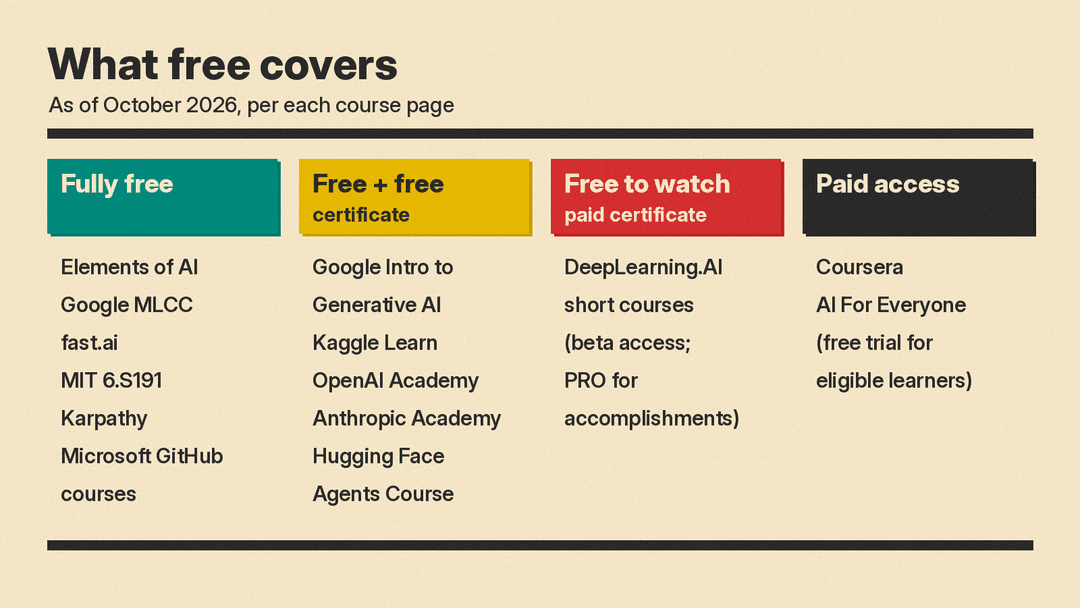
As of October 2026, based on each course page:
- Fully free, no certificate fee mentioned: Elements of AI, Google MLCC, fast.ai, MIT 6.S191, Karpathy's Zero to Hero, Hugging Face LLM and Deep RL courses, Microsoft's three GitHub curricula (API usage for exercises may cost money)
- Free, with a free certificate or badge: Google Introduction to Generative AI (badge), Kaggle Learn (certificates), OpenAI Academy (badges, ChatGPT account required), Anthropic Academy (certificate of completion), Hugging Face Agents Course (free certification)
- Free to watch, certificate is paid: DeepLearning.AI short courses (free during the platform beta, PRO for accomplishments)
- Paid to access fully: Coursera AI For Everyone (paid certificate experience, free trial for eligible learners, some courses offer a no-certificate option)
A suggested learning path
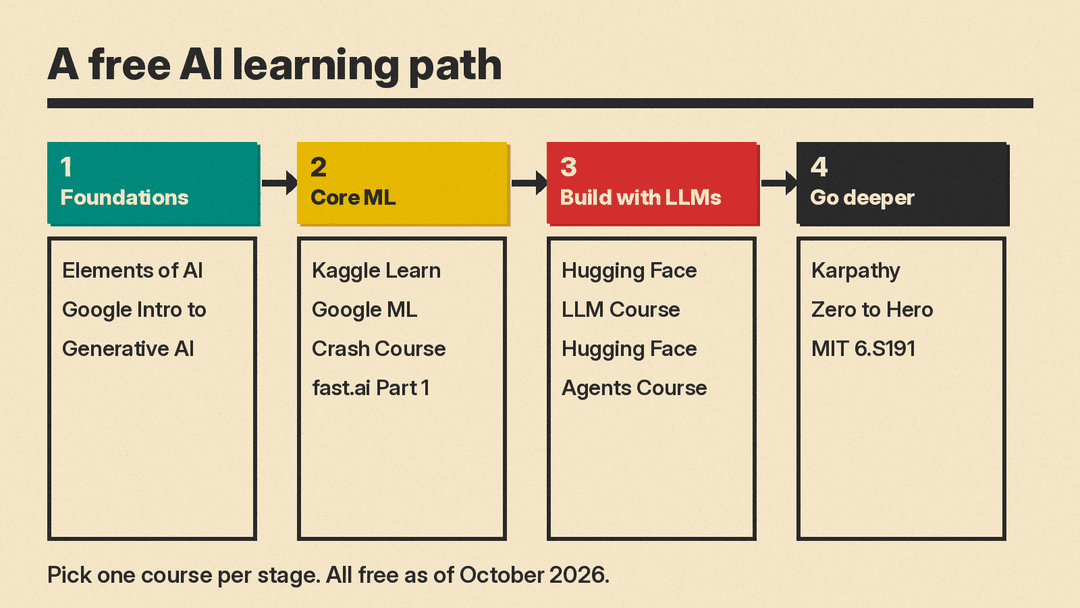
If you want one sequence instead of a list, this order uses only free material from above:
- Foundations: Elements of AI (Introduction to AI), then Google's 45 minute Introduction to Generative AI. If you use ChatGPT or Claude at work, add OpenAI's AI Foundations or Anthropic's Claude 101.
- Core machine learning: Kaggle's Python and Intro to Machine Learning courses, then Google's Machine Learning Crash Course. Move on to fast.ai Part 1 once you are comfortable writing Python.
- Build with LLMs: the Hugging Face LLM Course, then the Hugging Face Agents Course or Microsoft's AI Agents for Beginners. Use DeepLearning.AI short courses for narrow topics like RAG or evaluation.
- Go deeper: Karpathy's Zero to Hero if you want to understand how a GPT works internally, or MIT 6.S191 for a structured deep learning survey.
You do not need to finish every course. Pick one per stage and build a small project before moving on. For a career plan that uses these courses, see our AI engineer roadmap. For courses on building apps with AI coding agents, see our list of vibe coding courses for beginners. For data to practice on, see our list of free datasets for machine learning projects.
Do free certificates help with AI jobs?
Treat them as a signal of effort, not a credential. OpenAI states that its Academy badges and pathway certificates are not certifications. Google draws a similar line on Google Skills between free skill badges and Google Cloud certifications, which require a proctored exam. What tends to carry more weight in a portfolio is something you built: a fine-tuned model shared on the Hugging Face Hub, a Kaggle notebook, or an agent from the Hugging Face course's final project.
Sources
- Elements of AI
- Google Skills: Introduction to Generative AI
- Google Skills home
- Google AI: Learn AI skills
- Google Machine Learning Crash Course
- OpenAI Academy
- OpenAI Help Center: OpenAI Academy courses
- Anthropic Academy
- Anthropic Academy: Claude 101
- anthropics/courses on GitHub
- Coursera: AI For Everyone
- Kaggle Learn
- Microsoft ML for Beginners
- fast.ai: Practical Deep Learning for Coders
- MIT 6.S191 Introduction to Deep Learning
- Hugging Face LLM Course
- Hugging Face AI Agents Course
- Hugging Face Deep RL Course
- DeepLearning.AI courses
- DeepLearning.AI: ChatGPT Prompt Engineering for Developers
- Microsoft Generative AI for Beginners
- Microsoft AI Agents for Beginners
- Andrej Karpathy: Neural Networks, Zero to Hero
