
Every machine learning project starts with the same question: what data do I train on? The good news is that you do not need to scrape the web or label thousands of images yourself to learn. A handful of free, well-documented datasets have taught a generation of practitioners, and a few large hubs make it easy to find thousands more.
This guide lists the best free datasets for machine learning projects as of October 2026, grouped by data type, with what each one contains and who it suits. Every link goes to the dataset's own page, and every size or count below comes from that page. Before you build anything you plan to sell, read the license line for each pick. "Free to download" is not the same as "free for any use".
If you are still learning the basics, pair this list with our best free AI courses guide. Most of those courses use the datasets below in their exercises.
How to pick a dataset for your project
Three questions narrow the field quickly.
- What do you want to learn? Classification on a small table teaches the full workflow (clean, split, train, evaluate) in an afternoon. Image or speech data teaches deep learning but needs a GPU sooner.
- How big can your machine handle? A 150-row table fits anywhere. A 30 GB speech archive does not fit in a free notebook session. Start small, then move up.
- What does the license allow? Some datasets are open for any use with credit. Others allow only non-commercial research. Check before you publish a model or ship a product.
Where to search: the big dataset hubs
These sites index or host very large numbers of datasets. Use them when the named picks further down do not cover your topic.
- Hugging Face Datasets: the hub listed 1,096,984 datasets when we checked on October 19, 2026. Datasets load in Python through the
datasetslibrary, for exampleload_dataset("cornell-movie-review-data/rotten_tomatoes", split="train"), as shown in the Hugging Face loading guide. Best for text, audio, and anything LLM-related. - Kaggle Datasets: Kaggle's dataset catalog, which sits alongside its competitions. The Titanic competition tells newcomers to "Start here" and "get familiar with ML basics". Best for beginners who want a guided first project.
- UCI Machine Learning Repository: the site says it maintains 689 datasets "as a service to the machine learning community". Best for small, clean tabular data with clear variable descriptions.
- OpenML: an open source platform where, per its documentation, you can discover, download, and upload datasets on the website or work with them through its APIs and libraries, including Python and R clients. Best for benchmarking many models on many tables.
- Google Dataset Search: a search engine for datasets hosted elsewhere. When it left beta, Google said on January 23, 2020 that it had indexed almost 25 million datasets, and that you can filter results by type and by whether the dataset is free.
- Registry of Open Data on AWS: large public datasets hosted on AWS. The registry notes that most are provided and maintained by third parties "under a variety of licenses", so check each one.
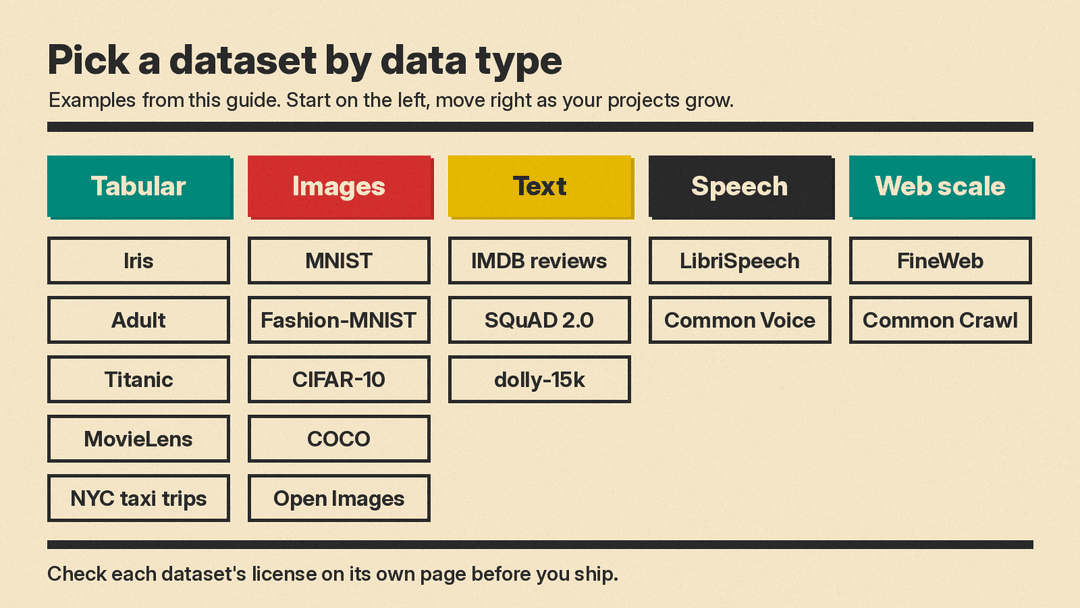
Tabular datasets for your first project
Tables are the best place to start. You can open them in a spreadsheet, see every column, and train a model in seconds.
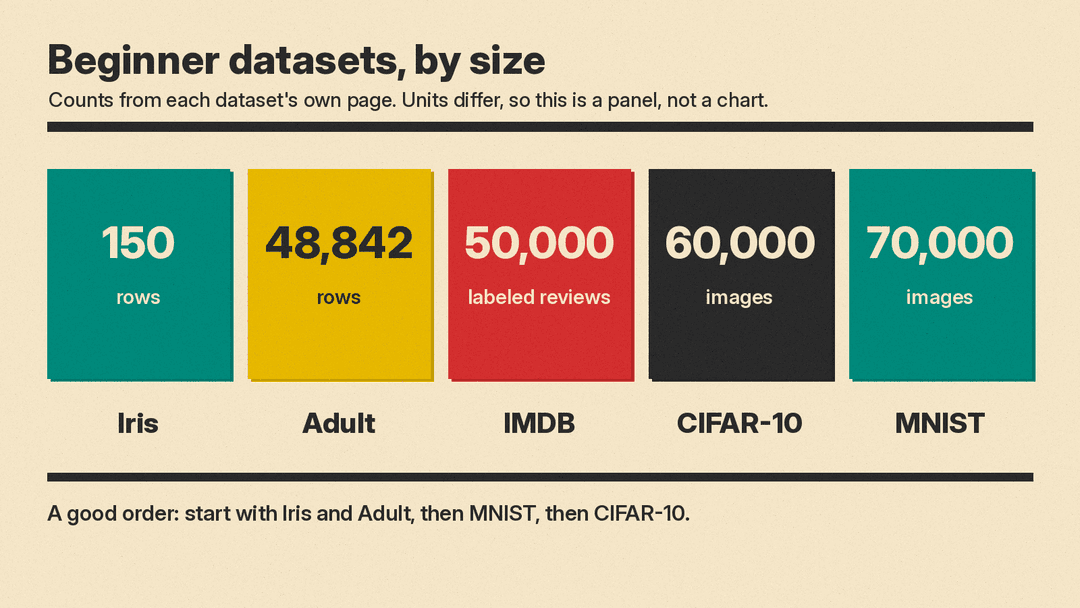
- Iris (UCI): 150 instances, 4 features. UCI calls it "a small classic dataset from Fisher, 1936" and one of the earliest datasets used to evaluate classification methods. Use it to learn the scikit-learn workflow end to end.
- Adult, also called Census Income (UCI): 48,842 instances and 14 features, extracted from the 1994 Census database. The task is to predict whether a person's income is over $50,000 a year. It has missing values, which makes it good practice for data cleaning.
- Titanic (Kaggle): predict which passengers survived. Kaggle pitches it as the place to start.
- MovieLens (GroupLens): the MovieLens 32M release has 32 million ratings and two million tag applications for 87,585 movies by 200,948 users, released in May 2024 as a 239 MB zip. Use it to build a recommender system. GroupLens asks you to read the terms in each README, and says it typically does not permit public redistribution.
- NYC TLC Trip Record Data: New York taxi and for-hire vehicle trips. Yellow and green taxi records include pickup and drop-off times and locations, trip distances, itemized fares, payment types, and passenger counts. Good for regression (fare or trip time) and for learning to handle large, messy files.
Image datasets
Image data is how most people learn neural networks. Start with the small grayscale sets, then move to color and real-world photos.
- MNIST: 70,000 black-and-white 28x28 images of handwritten digits, 60,000 for training and 10,000 for testing, according to its Hugging Face dataset card. The "hello world" of deep learning.
- Fashion-MNIST: Zalando's article images, with 60,000 training and 10,000 test examples, each a 28x28 grayscale image in one of 10 classes. Zalando built it as "a direct drop-in replacement" for MNIST, with the same image size and the same split sizes. The repository is MIT licensed.
- CIFAR-10 and CIFAR-100: CIFAR-10 has 60,000 32x32 color images in 10 classes, with 50,000 training and 10,000 test images. Created by Alex Krizhevsky, Vinod Nair, and Geoffrey Hinton. The usual next step after MNIST.
- ImageNet: an image dataset organized by the WordNet hierarchy, with a goal of about 1,000 images for each concept. Access for researchers and educators is for non-commercial research or educational purposes, under the site's terms. Too large for a first project.
- COCO (Common Objects in Context): its site lists tasks for object detection, keypoints, panoptic segmentation, DensePose, and captioning. Use it when you move from "what is in this image" to "where is it".
- Open Images V7 (Google): 15,851,536 bounding boxes on 600 classes, 2,785,498 instance segmentations on 350 classes, and 61,404,966 image-level labels on 20,638 classes, per the dataset page. Good for detection projects that need more variety than COCO.
Text and NLP datasets
- IMDB Large Movie Review Dataset (Stanford): 50,000 labeled movie reviews, split 25,000 for training and 25,000 for testing, plus 50,000 unlabeled reviews. The download is about 84 MB. It also loads from Hugging Face with
load_dataset("stanfordnlp/imdb"). The page calls it one of the standard text-classification benchmarks in NLP. - SQuAD 2.0 (Stanford): reading comprehension on Wikipedia articles. It combines the 100,000 questions from SQuAD 1.1 with over 50,000 unanswerable questions, so a model must learn when not to answer. The training set is 40 MB under the CC BY-SA 4.0 license. Useful background if you are building question answering or RAG systems.
- databricks-dolly-15k: about 15,000 instruction-following records written by thousands of Databricks employees, covering categories such as brainstorming, question answering, and summarization. Licensed CC BY-SA 3.0. A small, readable starting point for instruction fine-tuning. Our comparison of Unsloth, Axolotl, LLaMA-Factory, and torchtune covers the tools you would train with.
Speech and audio datasets
- LibriSpeech (OpenSLR): about 1,000 hours of read English speech from LibriVox audiobooks, licensed CC BY 4.0. The 100-hour "clean" training subset is a 6.3 GB download, which is a manageable size for a first speech-recognition project.
- Mozilla Common Voice: Mozilla's multilingual voice dataset. The project's GitHub page says the latest datasets are downloaded from the Mozilla Data Collective, in the browser, through its API, or with its Python SDK. It now publishes scripted speech and spontaneous speech as separate dataset types. Best when you need languages other than English.
Web-scale data for LLM projects
You will not train a frontier model at home, but these are worth knowing, and samples of them fit on a laptop.
- FineWeb (Hugging Face): more than 18.5 trillion tokens of cleaned and deduplicated English web text from Common Crawl, under the ODC-By license. It ships with smaller sample subsets, the smallest being a 10-billion-token sample, which is far easier to work with than the full set.
- Common Crawl: the web archive that FineWeb and other training sets are filtered from. The corpus "contains petabytes of data, regularly collected since 2008", and access to the copy hosted by Amazon is free. Best for researchers who want to build their own filtered dataset.
Government and public data
Public data is a good source of original project ideas, because fewer people have already built the obvious model.
- Data.gov: the US government's open data site, listing 586,904 datasets when we checked.
- World Bank Open Data: "free and open access to global development data", including the World Development Indicators by country.
A simple path from first dataset to real project
If you want an order to work through, this one moves from easy to hard and teaches a new skill at each stage.
- Learn the workflow: Iris, then Adult. You will practice loading, cleaning missing values, splitting, training, and measuring accuracy.
- Learn neural networks: MNIST, then Fashion-MNIST, then CIFAR-10.
- Learn NLP: IMDB sentiment, then SQuAD question answering.
- Learn to fine-tune an LLM: dolly-15k on a small open model.
- Build something original: pick a Data.gov, World Bank, or NYC taxi dataset and answer a question nobody has posted a notebook for yet. That project is the one worth putting on a resume.
Check the license before you ship
Licenses differ even among the free picks above. Some examples from the dataset pages:
- CC BY 4.0 (LibriSpeech) allows sharing and adapting, including commercially, as long as you give credit.
- CC BY-SA (SQuAD 2.0 uses 4.0, dolly-15k uses 3.0) adds a share-alike rule: if you distribute something built from the material, it must use the same license.
- ODC-By (FineWeb) is the Open Data Commons Attribution License.
- ImageNet access is for non-commercial research and education.
- MovieLens has its own terms in each README, and GroupLens typically does not allow public redistribution.
On the hubs, the license is set per dataset by the uploader. Read it on each dataset's page, not just the hub's homepage.
Sources
- Hugging Face Datasets hub
- Hugging Face: Load a dataset from the Hub
- Kaggle Datasets
- Kaggle: Titanic competition
- UCI Machine Learning Repository
- UCI: Iris
- UCI: Adult
- OpenML and OpenML documentation
- Google Dataset Search
- Google: Discovering millions of datasets on the web
- Registry of Open Data on AWS
- GroupLens: MovieLens datasets
- NYC TLC Trip Record Data
- MNIST dataset card
- Fashion-MNIST on GitHub
- CIFAR-10 and CIFAR-100
- ImageNet: About
- COCO dataset
- Open Images V7
- Large Movie Review Dataset (IMDB)
- SQuAD 2.0
- databricks-dolly-15k
- LibriSpeech on OpenSLR
- Common Voice datasets on GitHub
- Mozilla Data Collective
- FineWeb
- Common Crawl overview
- Data.gov
- World Bank Open Data
- Creative Commons: CC BY 4.0
- Creative Commons: CC BY-SA 4.0
- Open Data Commons: ODC-By
