
The bill changed hands
Sometime in 2026, the AI invoice quietly changed payers. OpenRouter, the router that carries developer traffic to hundreds of models, classifies every API key as agentic, human, or mixed using seven signals including tool-call rate and turns per request. A year ago, agentic keys took 8% of tokens. In October they took 76% of the 790 trillion tokens that crossed the platform, roughly 600 trillion tokens in one month. Most of the tokens flowing through the AI economy are no longer produced by a person typing. They are produced by software calling a model in a loop.
Most teams still budget for that loop as if it were chat. The published numbers now make it possible to price it properly: what one agent task consumes, where the tokens go, and which levers actually move the bill.
A ladder of multipliers
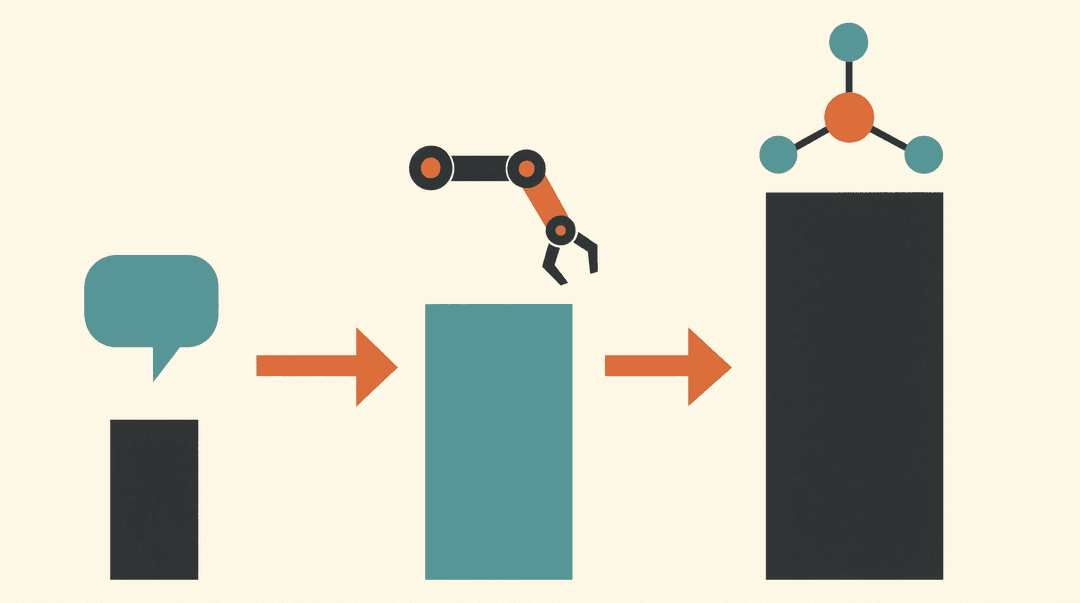
Three published estimates describe the jump from chat to agent, in increasing order of detail.
Anthropic's engineering post on its multi-agent research system gives the most-quoted baseline: agents typically use about 4x more tokens than chat interactions, and multi-agent systems about 15x more than chats. Gartner's March 2026 analysis, as summarized in enterprise infrastructure writing, places agentic tasks at 5 to 30 times the tokens of a standard chatbot exchange. And the academic floor is much lower and the ceiling much higher: a Stanford-led study that analyzed trajectories from eight frontier LLMs on SWE-bench Verified found agentic coding tasks consume roughly 1,000x more tokens than code reasoning or code chat, with input tokens, not output tokens, driving the cost.
None of these numbers contradict each other. They measure different loops. A support agent with five tool calls and a coding agent that reads a repository for ninety turns are both "agents," and they differ by three orders of magnitude in what they send to the model.
Where the tokens go
The studies agree on the mechanism, which is worth knowing because it determines what you can fix.
Context re-feeding. Every tool call returns the whole conversation to the model, so the transcript grows with each turn and is re-read each time. Epoch AI, which runs standardized SWE-bench Verified evaluations, caps models at 2 million uncached tokens plus 20 million cached reads per task and notes plainly that token usage grows quadratically with each model call. The entire trajectory, including thousands of lines of terminal output, goes back into the prompt every round.
Spawn overhead. Fanning out subagents costs tokens before any work happens: system instructions, tool schemas, role framing. Practitioner measurements vary widely. Amit Kothari's audit of Claude Code put the per-spawn load at roughly 20,000 tokens in October 2025, then re-measured on July 30, 2026 against a 28,620-word instruction hierarchy and found a general-purpose subagent that made zero tool calls still reporting 111,253 tokens for the turn. These are single-practitioner measurements, not vendor benchmarks, but the direction is consistent: the floor scales with your instruction files, and ten spawns is ten floors.
Redundant exploration. The Stanford study found high-cost runs are often driven by agents repeatedly viewing and editing the same files. The extra tokens are looping, not insight.
Spending more does not buy better
The same paper's most uncomfortable findings are about variance. Runs on the identical task differed by up to 30x in total token use. Accuracy peaked at intermediate cost and degraded or saturated beyond it, meaning the most expensive attempts were often the worse ones. Model choice moves consumption more than task difficulty does: Kimi-K2 and Claude Sonnet 4.5 averaged more than 1.5 million additional tokens per task compared with GPT-5 on the same work. And human expert ratings of task difficulty only weakly predicted actual token costs, so the ticket that looks simple can be the expensive one.
If you budget by ticket complexity, you are budgeting by a variable the data says is nearly uncorrelated with the bill.
When the multiplier pays
The token furnace is not a defect. It is the architecture buying coverage: more tokens explored, more files read, more hypotheses tried. Anthropic's own analysis of the BrowseComp benchmark found token usage alone explained 80% of performance variance (with tool calls and model choice, the three factors explained 95%), and its multi-agent research system beat a single-agent Claude Opus 4 baseline by 90.2% on an internal research evaluation. That is what 15x buys.
Anthropic also states the limit: multi-agent systems are economically viable only for tasks whose value pays for the increased performance, and tasks requiring shared context or heavy inter-dependencies are a poor fit. Cognition, the maker of Devin, argued the complementary case in a post published the same month, warning that parallel agents make incompatible implicit decisions and recommending single-threaded agents with full context traces for coding work. One year later, its founder softened the position to "some setups work," which is a fair summary of the field: the multiplier is real, the payoff is task-specific, and nobody has a published table of which tasks cash out.
For calibration on the cheap end: the official SWE-bench leaderboard lists per-instance inference costs for lean single-loop scaffolds as low as $0.27 (GPT 5.2) to $0.96 (Gemini 3 Pro) per solved issue. The difference between $0.50 per task and hundreds of dollars is scaffold design and how much context you make the model re-read, not some intrinsic property of "agents."
The meter moved twice
Two trends pull the bill in opposite directions.
Unit prices are falling fast. OpenRouter's blended effective price per million tokens dropped 57 to 70% between January and October 2026, from $1.21 to $0.52 for closed-weight models. Caching, the answer to re-feeding, now does most of the work: providers served cached prefixes for 85 to 97% of agentic prompt tokens in October, and the median cache hit rate rose from 76.1% in June to over 90%. Anthropic bills a cache read at 0.1x its base input price, against 1.25x for the write.
But capability at the frontier is getting more expensive to evaluate, not less. The Price of Progress paper (arXiv, November 2025) found that even as per-token prices decline, the inference cost of running the best-performing model on GPQA-Diamond, SWE-bench Verified, and AIME has grown at roughly an exponential rate, because frontier agents read more, call more tools, and re-read more. Cheaper tokens, costlier answers.
What enterprises learned the hard way
Uber is the canonical cautionary tale of 2026. Claude Code adoption across its 5,000-engineer org jumped from 32% in December 2025 to 84% by March, pushing per-engineer costs to $150-250 monthly on average and $500-2,000 for power users, and the company burned its entire 2026 AI tools budget by April. An internal leaderboard that ranked teams by usage volume accelerated the burn; nobody had set a cap on consumption, only on seats. Accenture went the other way in October, capping employee Claude spending at about $29 a month.
Both responses are rationing tools, not cost models. Neither tells you what an agent task should cost.
What this means for an agent budget
- Budget per task, not per seat. The seat was never the constraint; the loop is.
- Cap tokens per run and kill overruns. Epoch does it at 2 million uncached tokens per benchmark task; production harnesses deserve the same discipline.
- Log the distribution, not the average. With up to 30x run-to-run variance on identical tasks, the p95 is the number that shapes your bill.
- Cache the static prefix. System prompt, tool definitions, and repo maps should be cache writes paid once, then read at roughly a tenth of input price.
- Pick the cheapest architecture that clears quality: one agent before two, a small worker model before a frontier one, and a scaffold that trims old tool output instead of re-feeding it forever.
- Distrust difficulty estimates. Human ratings of how hard a task is correlate weakly with tokens consumed. Measure, then route.
The honest summary is that "an agent" spans five to a thousand times the consumption of "a chat," and the market prices neither yet. Subscriptions meter seats, APIs meter tokens, and the gap between them is where the surprise invoices live. The teams that treat token-per-task as a first-class metric, with caps and distributions, get predictable bills out of an unpredictable machine. Everyone else finds out in April that their budget was really a Q1 budget.
Sources
- Anthropic Engineering, How we built our multi-agent research system: https://www.anthropic.com/engineering/built-multi-agent-research-system
- How Do AI Agents Spend Your Money? Analyzing and Predicting Token Consumption in Agentic Coding Tasks (arXiv 2604.22750): https://arxiv.org/abs/2604.22750
- OpenRouter, October 2026 data recap: https://openrouter.ai/data/october-2026
- Epoch AI, SWE-bench Verified benchmark methodology: https://epoch.ai/benchmarks/swe-bench-verified
- The Price of Progress: Price, Performance, and the Future of AI (arXiv 2511.23455): https://arxiv.org/abs/2511.23455
- SWE-bench leaderboards (per-instance inference cost): https://www.swebench.com
- Cognition, Don't Build Multi-Agents: https://cognition.com/blog/dont-build-multi-agents
- Amit Kothari, Claude Code: Task Tool vs. Subagents: https://amitkoth.com/claude-code-task-tool-vs-subagents
- Cockroach Labs, Managing Agentic AI Costs at Scale (citing Gartner's March 2026 analysis): https://www.cockroachlabs.com/blog/agentic-ai-costs-at-scale
- Forbes, Uber Burns Its 2026 AI Budget In Four Months On Claude Code: https://www.forbes.com/sites/janakirammsv/2026/05/17/uber-burns-its-2026-ai-budget-in-four-months-on-claude-code
- Forbes, Accenture caps employee Claude spending: https://www.forbes.com/sites/ronschmelzer/2026/10/16/accenture-bets-big-on-claude-then-limits-ai-spending
- Anthropic docs, prompt caching pricing: https://docs.anthropic.com/en/docs/build-with-claude/prompt-caching
