
You can learn to build AI agents without paying for a course. This list covers 10 free options as of October 2026, from beginner lessons you can read on GitHub to university lectures on reasoning and planning. Each pick links to its own page, and each detail below comes from that page.
If you want broader AI basics first, see our list of the best free AI courses.
How we picked
- Free to take. Some courses charge for a certificate; we say so when the page does.
- Hands-on. Each one has code, labs or a project, except the university lectures, which are there for depth.
- Current. Every page loaded on October 27, 2026, and we quote the course's own description of what it covers.
Start here: beginner-friendly courses
1. Hugging Face AI Agents Course
The Hugging Face AI Agents Course calls itself a "free course" that takes you "from beginner to expert" in "understanding, using and building AI agents." The syllabus runs from an introduction to agents, through three frameworks (smolagents, LlamaIndex and LangGraph), to a unit on agentic RAG and a final project to "Create, Test, and Certify Your Agent." Bonus units cover fine-tuning a model for function calling, agent observability and evaluation, and agents in games.
You can choose to self-audit or follow the certification process, and the page says you can "earn a certificate of completion by completing assignments." Because it covers three frameworks, it suits readers who want to compare them before they commit to one.
2. Microsoft AI Agents for Beginners
AI Agents for Beginners is an open course that lives in a public GitHub repository. Its README describes it as "a course teaching everything you need to know to start building AI Agents." The lesson table lists 18 lessons, from "Intro to AI Agents and Agent Use Cases" through tool use, agentic RAG, planning, multi-agent design, context engineering, agent memory, computer use agents, local agents and "Securing AI Agents."
The README says each lesson includes "a written lesson located in the README and a short video," Python code samples and links to extra resources, though its lesson table links videos for only the first 13 of the 18 lessons. The code uses Microsoft Agent Framework with Microsoft Foundry, and the README says Foundry needs an Azure account. You can read the written lessons without running the code.
3. Kaggle 5-Day AI Agents Intensive Course with Google
The 5-Day AI Agents Intensive was "originally held live from November 10 - 14, 2025" and is "now available as a self-paced Kaggle Learn guide." Google's ML researchers and engineers built it. The five days are:
- Introduction to Agents
- Agent Tools and Interoperability with Model Context Protocol (MCP)
- Context Engineering: Sessions and Memory
- Agent Quality (observability, logging, tracing and evaluation)
- Prototype to Production, including multi-agent systems with the Agent2Agent (A2A) Protocol
Each day pairs a whitepaper and a summary podcast with codelabs on Kaggle. In the first codelab you build an agent with Google's Agent Development Kit (ADK), powered by Gemini. The guide tells you to "phone verify your Kaggle account before starting," because the codelabs need it. Google's own recap post says all the coursework "has now been transformed into a Kaggle Learn Guide."
4. Multi AI Agent Systems with crewAI (DeepLearning.AI)
Multi AI Agent Systems with crewAI is taught by crewAI founder João Moura. The page lists it as Beginner, 3 hours 1 minute, with 18 video lessons and 7 code examples, and the button reads "Enroll for Free." You give each agent "a specific role, goal, and backstory" and use them to automate tasks such as "tailoring a resume to a job description" and event planning. The page says you "Earn an accomplishment with PRO," DeepLearning.AI's paid plan.
Go deeper: frameworks and coding agents
5. AI Agents in LangGraph (DeepLearning.AI)
AI Agents in LangGraph is taught by LangChain founder Harrison Chase and Tavily founder Rotem Weiss. It is listed as Intermediate, 1 hour 42 minutes, with 9 video lessons. You "build an agent from scratch using Python and an LLM," then rebuild it in LangGraph, so you see "the division of tasks between the LLM and the code around the LLM," in the page's words. It also covers "agentic search." Enrollment is free; the certificate needs PRO.
6. Introduction to LangGraph (LangChain Academy)
If the short course above leaves you wanting more, LangChain's own Introduction to LangGraph is longer, with 55 lessons and 6 hours of video, and the page has an "Enroll for free" button. The curriculum runs through six modules: the basics of graphs, routers and agents; state and memory; "UX and Human-in-the-Loop," with streaming, breakpoints and time travel; building a research assistant with parallelization and sub-graphs; long-term memory; and deployment.
7. Anthropic Academy agent courses
Anthropic's course catalog includes several short courses on agent building, and the course pages we checked are marked "Register | FREE":
- Introduction to agent skills teaches how to build Skills in Claude Code, "reusable markdown instructions that Claude automatically applies to the right tasks at the right time," and how to share them with a team.
- Introduction to subagents covers how to "delegate tasks to isolated assistants" that keep your main conversation focused, and when not to use them.
- Claude Code in Action teaches you to "run long, hands-off Claude Code sessions you can trust," including hooks, skills, scheduled routines and headless mode.
These are narrower than the courses above, but they fit well if you already use a coding agent and want it to do longer jobs.
8. Model Context Protocol courses
The Model Context Protocol (MCP) is "an open protocol that standardizes how LLMs access tools, data, and prompts from external sources," as the DeepLearning.AI course page puts it. Our MCP architecture explainer covers how its hosts, clients and servers fit together. Three free courses cover it:
- The Hugging Face MCP Course, "built in partnership with Anthropic," goes "from beginner to informed" and includes a use case where you build a pull request agent on the Hub. It offers a certificate of completion for finished assignments.
- MCP: Build Rich-Context AI Apps with Anthropic on DeepLearning.AI, taught by Elie Schoppik, runs 1 hour 58 minutes. You build and deploy an MCP server with tools, resources and prompts, and an app that hosts several MCP clients.
- Anthropic's Introduction to Model Context Protocol teaches you to build MCP servers and clients "from scratch using Python."
For depth: university lectures and the newest topic
9. UC Berkeley LLM Agents MOOC
The Berkeley LLM Agents course, taught by Dawn Song and Xinyun Chen with a long list of guest speakers, covers reasoning, planning and tool use, agent infrastructure, retrieval-augmented generation, code generation, multimodal agents and robotics, evaluation, and safety. The page says "video lectures can still be found in the syllabus below." The follow-on Advanced Large Language Model Agents course from Spring 2025 goes into inference-time reasoning, post-training, search and planning, and LLM agents for code and math, with recordings linked from its syllabus. These are lectures, not a guided project, so pair them with one of the hands-on courses above.
10. Google: Harness Engineering (live session)
Google's event page defines harness engineering as "the discipline of building the infrastructure that wraps, controls, and guides agents." Google's Harness Engineering: Crucial scaffolding that makes AI agents work is a live session, not a self-paced course. The page lists it for November 3, 2026, from 11 a.m. to noon PT, with speakers Andrew Biernat, Dale Markowitz and YK Sugi. It says the session covers context management, safety guardrails, automated backpressure and memory, with hands-on techniques in Google Antigravity. The page lists no fee, and you sign in or create an account to register. For a written take you can read now, see the Google Developers Blog post The Anatomy of Harness Engineering, which says "behavioral evaluations are often a better measure of confidence" than a composite benchmark score.
One paid course worth knowing
DeepLearning.AI's Agentic AI, taught by Andrew Ng, runs 9 hours 55 minutes with 31 video lessons and 8 graded assignments and covers four design patterns: reflection, tool use, planning and multi-agent workflows. Unlike the short courses above, its page shows "Enroll Now" rather than "Enroll for Free," and the certificate comes "with PRO," the paid plan. Check the page for current access before you sign up.
A simple order to take them
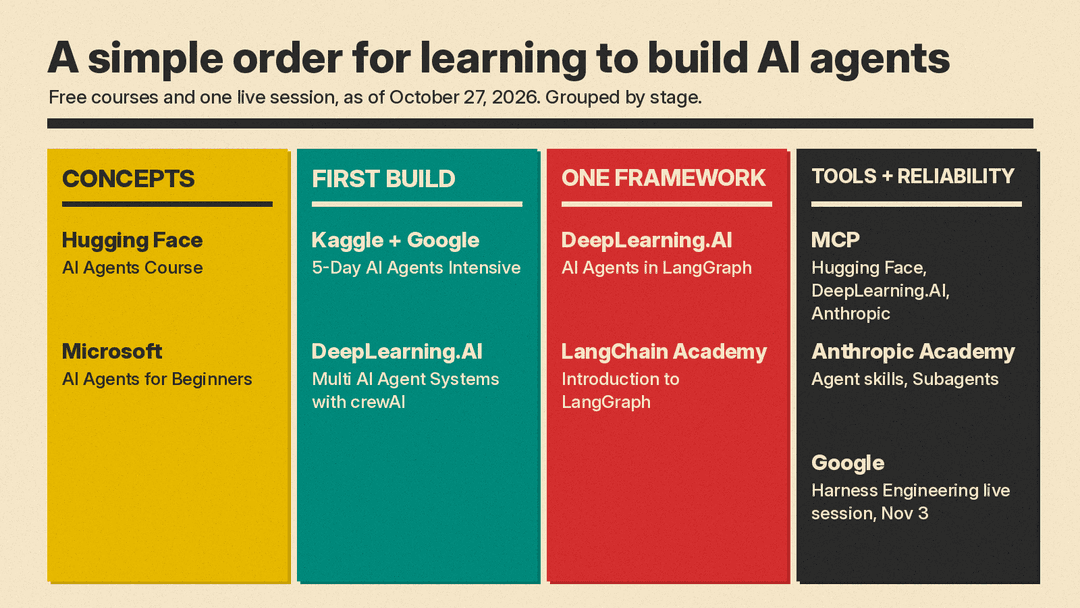
- Concepts: Hugging Face AI Agents Course or Microsoft AI Agents for Beginners.
- First build: the Kaggle 5-Day Intensive, or crewAI if you want the gentlest start.
- One framework in depth: AI Agents in LangGraph, then Introduction to LangGraph.
- Tools and reliability: an MCP course, the Anthropic agent courses, and Google's harness engineering session and blog post.
Add the Berkeley lectures whenever you want the research view. You do not need all ten. One plan is to pick two or three courses from this list and build one small agent of your own.
What you need before you start
- Python. The Microsoft code samples, both LangGraph courses and Anthropic's MCP course all name Python, so learn its basics first.
- An API key or free tier for a model. Kaggle's setup asks for a Google AI Studio account that can generate an API key for Gemini. Check each course's setup page for the model it uses. Our guide to free GPU and cloud credits covers free compute.
- Accounts. Kaggle asks for phone verification, Google's harness session asks for a sign-in, and DeepLearning.AI and Anthropic Academy ask you to register.
If you want to turn this into a job, our roadmap on how to become an AI engineer shows where agent skills fit.
Sources
- Hugging Face AI Agents Course
- Microsoft AI Agents for Beginners (GitHub)
- Kaggle 5-Day AI Agents Intensive Course with Google
- Google Blog: Inside Kaggle's AI Agents Intensive Course with Google
- DeepLearning.AI: Multi AI Agent Systems with crewAI
- DeepLearning.AI: AI Agents in LangGraph
- LangChain Academy: Introduction to LangGraph
- Anthropic Academy course catalog
- Hugging Face MCP Course
- DeepLearning.AI: MCP: Build Rich-Context AI Apps with Anthropic
- UC Berkeley LLM Agents (Fall 2024)
- UC Berkeley Advanced Large Language Model Agents (Spring 2025)
- Google: Harness Engineering event page
- Google Developers Blog: The Anatomy of Harness Engineering
- DeepLearning.AI: Agentic AI
