
AI safety work hires engineers, researchers and policy people, and several of the ways in cost nothing. The catch is that the pages are spread across nonprofits, labs and fellowship sites. This guide puts the main ones in one place, with what each one asks for and what it pays or costs, as listed on each program's own page on October 29, 2026.
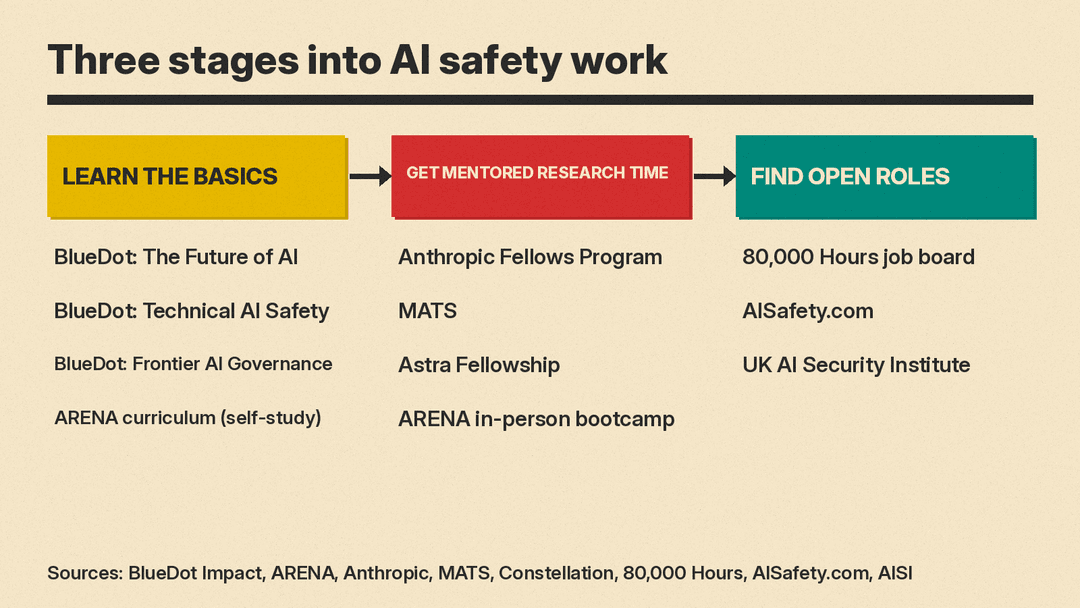
It covers three stages: learning the basics for free, getting mentored research time through a fellowship, and finding open roles. Each item links to its own page, so check that page before you apply, because dates and cohorts change.
What AI safety work covers
BlueDot Impact's Technical AI Safety course lists the topics it teaches as "alignment and RLHF, mechanistic interpretability, evaluations and red-teaming, AI control, and scalable oversight."
There is also a policy side. The UK's AI Security Institute careers page says it is "looking for ambitious researchers, engineers, policy analysts and operators from a wide range of backgrounds." BlueDot runs a separate Frontier AI Governance course for people who want to work on policy, coordination and institutions rather than code.
On the technical side, the career review from 80,000 Hours (last updated August 2024) splits roles into research leads and research contributors. It says "research contributors need to be very good at programming and software engineering," while research lead roles "need stronger research taste and theoretical understanding." It also says that a strong software engineer "could apply for empirical research contributor roles right now (even if you don't have a machine learning background, although that helps)."
Learn the basics for free
These courses cost nothing. Two run in live cohorts with a facilitator; two are self-paced.
- The Future of AI (BlueDot Impact). A self-paced course of about 2 hours. BlueDot says "No prerequisites. No technical knowledge required." It is free and gives a certificate when you finish. Start here if you are new to the topic.
- Technical AI Safety (BlueDot Impact). A cohort course in two formats: an intensive of about 6 days at about 5 hours a day, or a part-time run of about 6 weeks at about 5 hours a week. Each day or week you do 2 to 3 hours of reading and writing and join about 8 peers in a 2-hour Zoom discussion. The page says you should already understand the basics of how LLMs are trained and fine-tuned and that "the reward function for neural networks is optimised through gradient descent." It also says "Completely free. No hidden costs." Next dates on October 29, 2026: an intensive from November 9 to 14, 2026, with applications closing November 1 at 23:59 anywhere on earth; a second intensive from November 30 to December 5 (applications close November 22); and a part-time run from December 7, 2026 to January 17, 2027 (applications close November 29).
- Frontier AI Governance (BlueDot Impact). About 40 hours across six units, each with 4 to 5 hours of readings and exercises plus a two-hour live discussion. The page says "No previous BlueDot course or technical qualification is required." It also says the course "is not a course on corporate compliance or internal AI-use policies." Free. The next six-day intensive runs November 23 to 28, 2026 and the next six-week part-time run starts November 23, 2026 and ends January 3, 2027; applications for both close November 15, 2026 at 23:59 anywhere on earth.
- ARENA curriculum (self-study). ARENA, the Alignment Research Engineer Accelerator, puts all of its course content online. Its curriculum page lists chapters on fundamentals (PyTorch, CNNs and ResNets), transformer interpretability, reinforcement learning including RLHF, LLM evaluations, and alignment science. This is the hands-on coding path; for its in-person bootcamp, ARENA wants applicants who can code well in Python and know some of the maths behind modern AI (linear algebra, calculus and probability).
Get mentored research time
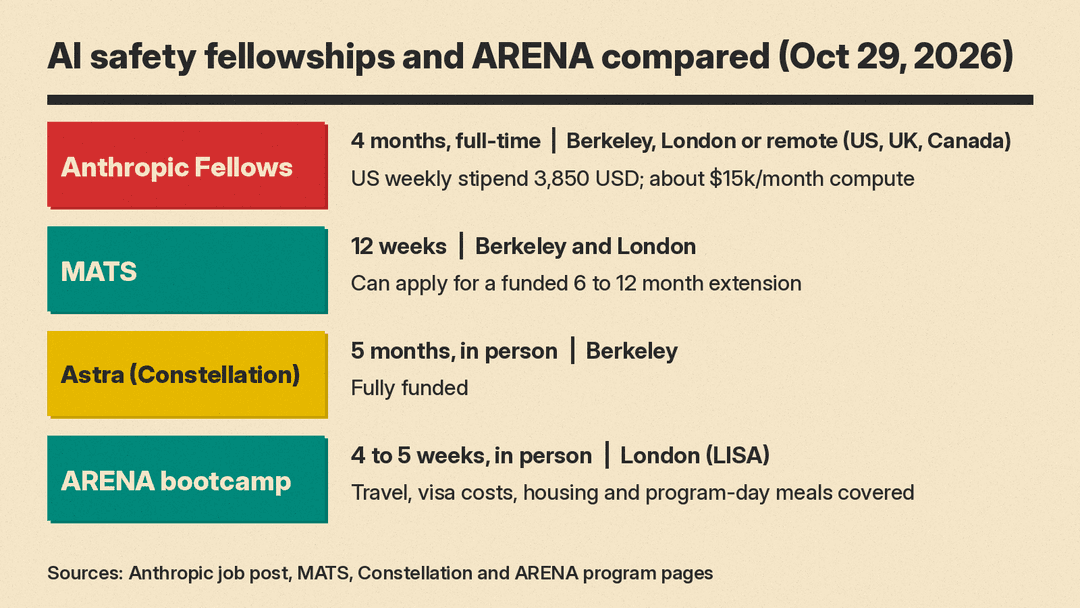
Fellowships give you full-time research or training time with mentors. BlueDot calls them "competitive." Funding differs by program, as noted below. All four were checked on their own pages on October 29, 2026.
- Anthropic Fellows Program. Four months of full-time research with Anthropic mentors. The job post lists a weekly stipend of "3,850 USD / 2,310 GBP / 4,300 CAD" plus benefits, and compute funding of about $15k a month. Fellows work from shared spaces in Berkeley or London, or remotely in the US, UK or Canada. You must be "Fluent in Python programming" and need work authorization in the US, UK or Canada and be located in that country during the program; the post says Anthropic is "not currently able to sponsor visas for fellows." Anthropic's program announcement says "You don't need a PhD, prior ML experience, or published papers." Applications are reviewed on a rolling basis. Deadline: on October 29, 2026, the job post said "apply here by October 30" for the January cohort, so the date to meet is October 30, 2026. The announcement gave an earlier October 18 date; the job post is the newer page. Later cohorts will have their own dates.
- MATS. MATS describes itself as an independent research fellowship that connects researchers with mentors in alignment, transparency and security. Fellows research for 12 weeks at its offices in Berkeley and London, and can apply for a funded extension of 6 to 12 months. Its Winter 2027 page lists a stipend of $1,600 a week ($19,200 for the full 12 weeks), plus travel to and from Berkeley or London, housing, office space, and lunch and dinner on weekdays. Applicants must be 18 or older by the start date, both US and non-US citizens can apply, and prior AI safety experience is not required. Winter 2027 runs January 19 to April 10, 2027. Its final application deadline was September 6, 2026, and on October 29 the site said applications for that cohort are closed.
- Astra Fellowship (Constellation). A fully funded, five-month, in-person program at Constellation's Berkeley research center, with an empirical research stream and a strategy and governance stream. The page says "Prior AI safety experience is not required." It lists a monthly stipend of $8,400 for the length of the program, about $15K a month in compute for each empirical research fellow, and support for international applicants with the visa process. It also says over 80% of the first cohort now work full-time in AI safety roles. There is an interest form to hear when the next cohort opens.
- ARENA in-person bootcamp. ARENA runs 2 to 3 bootcamps a year, each 4 to 5 weeks, at the London Initiative for Safe AI. It says it covers travel to and from London, visa costs, accommodation for the full program, and meals on program days. ARENA 9.0 runs October 5 to November 6, 2026, and its applications are closed; there is an expression of interest form for future rounds. The application has three stages: a form, a coding test of six questions in one hour, and a 30-minute interview.
Many of these programs say a course helps. BlueDot's technical course page names MATS, Astra, Anthropic Fellows, LASR, ERA, Pivotal, ARENA and SPAR, and says alumni from its courses "have gone on to all of them."
Find open roles
When you are ready for a job, these three places list open roles.
- 80,000 Hours job board. Its tagline is "Handpicked to help you tackle the world's most pressing problems with your career." You can filter by salary and set up email alerts. 80,000 Hours also offers free one-to-one career advice; its career review says "If you want to become a technical researcher, our team probably wants to talk to you."
- AISafety.com. A directory "Maintained by AI safety community-builders" that lists jobs, training programs, events, communities, funders and advisors who offer free one-to-one calls. On October 29 its menu listed 564 jobs and 100 training programs; those counts change.
- UK AI Security Institute careers. AISI describes itself as a research organisation within the UK's Department for Science, Innovation and Technology. Its page says technical hiring includes a CV and short written statement, 1 to 2 skills assessments such as technical interviews and take-home coding tests, and 2 to 4 interviews. For technical roles it says "we can hire almost all nationalities and sponsor visas." Non-technical roles must meet civil service nationality rules.
How to pick a path
Start from the skills you already have.
- No technical background. Take The Future of AI, then the Frontier AI Governance course. Both are free and neither needs code. For other AI roles that do not ask for a degree, see our guide to AI jobs without a CS degree.
- Software engineer. Work through the ARENA curriculum on your own, take the Technical AI Safety course, then apply to the Anthropic Fellows Program or the next MATS or Astra round. 80,000 Hours says strong engineers can apply for empirical contributor roles now.
- ML researcher or PhD student. BlueDot's technical course names researchers with an ML, CS or maths background as one of its target groups, to help them choose which safety problems to work on. Fellowships come after that.
- Policy, law or national security. The governance course, then the AI Security Institute's policy roles and the 80,000 Hours board.
80,000 Hours is direct about the difficulty: it says these roles "can be very hard to get," and that you will likely need to build up skills and experience first. It also says it has seen "exceptionally talented people move into AI safety from other quantitative fields, sometimes in less than a year."
For more free learning beyond safety, see our guides to the best free AI courses and how to build an AI portfolio that gets interviews.
Sources
- BlueDot Impact: Technical AI Safety
- BlueDot Impact: The Future of AI
- BlueDot Impact: Frontier AI Governance
- ARENA: AI Safety Education
- ARENA Curriculum
- Anthropic Fellows Program, AI Safety & Security (job post)
- Anthropic Fellows Program for AI safety research: applications open for our next cohorts
- MATS Research Program
- MATS Winter 2027 program
- Constellation: Astra Fellowship
- 80,000 Hours: AI safety technical research career review
- 80,000 Hours job board
- AISafety.com
- UK AI Security Institute: Careers
