
AI ethics courses range from a 15-minute course to a university course with assignments and peer review. They also differ on what you get at the end: a certificate, a badge, a pass mark on a profile, or nothing. This page lists seven courses and modules, and for each one says what the provider's own page states about cost, time and credentials.
We read each page in November 2026. Where a page says something, we follow its wording. Where we draw a conclusion of our own, we mark it as "our reading." Courses change, so check each provider's page before you enroll. Related lists on this site that use the same method: free LLM courses and free AI courses for teachers.
The University of Helsinki: Ethics of AI
The Ethics of AI page calls it "a free online course created by the University of Helsinki" for "anyone who is interested in the ethical aspects of AI." It has seven chapters: Introduction, Non-maleficence, Accountability, Transparency, Human rights, Fairness and AI ethics in practice. You can finish it at your own pace.
The course FAQ says you need to do 90% of the assignments and get 80% of them accepted as passed. The final assignment in the last module is mandatory, and so is the course feedback form.
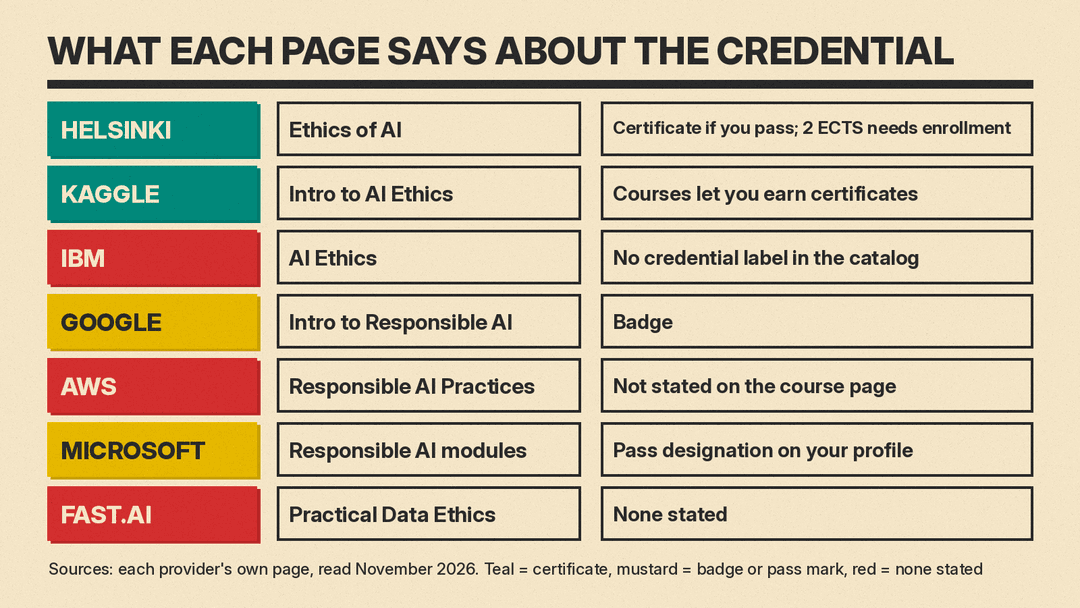
On credentials, the FAQ says the course certificate is available to all who pass, and that you download it from your mooc.fi profile. No Open University enrollment is required for the certificate. The course is worth 2 ECTS credits, and Open University enrollment is required for the credits. ECTS is the European credit system used by universities.
One practical warning from the FAQ: some exercises use peer review, and it "can take multiple weeks to receive enough peer reviews before you pass the course." If you want the certificate by a deadline, start early.
Kaggle: Intro to AI Ethics
The Intro to AI Ethics course on Kaggle has five lessons: Introduction to AI Ethics, Human-Centered Design for AI, Identifying Bias in AI, AI Fairness and Model Cards. The page estimates 4 hours and lists the cost as "No cost, like all Kaggle Learn Courses."
The lessons are hands-on. In the bias lesson you investigate a simple model that identifies toxic text. In the fairness lesson you learn four types of fairness and assess a toy model trained to judge credit card applications. The last lesson covers model cards, which the page describes as a way to communicate key information about machine learning models and increase transparency.
For credentials, the Kaggle Learn page says the courses "are provided at no cost to you, and you can now earn certificates." The Intro to AI Ethics page itself lists 4 hours (estimated) under "Hours to earn certificate" but does not describe other certificate rules, so check the course page after you finish the exercises.
IBM SkillsBuild: AI Ethics
IBM SkillsBuild lists a course called AI Ethics in its learning catalog. The catalog page title reads "Free AI, Cybersecurity, Data & Technology Courses." The entry says you will learn the five pillars of AI ethics: fairness, robustness, explainability, transparency and privacy, through real-world examples. It is listed at 1-3 hours and Intermediate level.
The credential label matters here. The catalog marks other programs with an "Earn a digital credential" label but the AI Ethics entry carries no such label. The catalog does show ethics content inside programs that do. "Getting Started with Generative AI," which the catalog labels as earning a digital credential, includes a module called Ethical Considerations for Generative AI, which covers transparency, accountability and fairness and introduces the IBM AI Risk Atlas. It is listed at 3-10 hours, Foundational level.
The same catalog lists other ethics-focused modules, including "Decoding Responsible AI: Upholding Pillars of Trust" (3-10 hours, Advanced) and "Responsible AI Use in Education." Our reading: if a credential matters to you, pick the program with the credential label and treat the standalone AI Ethics course as the lighter option.
Google Skills: Introduction to Responsible AI
Google's Introduction to Responsible AI is listed as a 15-minute introductory microlearning course. Its description says it explains what responsible AI is, why it is important and how Google implements responsible AI in its products. The page invites you to earn a badge.
There is a small inconsistency to know about. The Google Skills description says the course introduces Google's 3 AI principles. Google's Grow with Google AI skills page describes the same course as exploring Google's 7 AI Principles, and the Coursera listing says 7 as well. We could not tell from the pages which count is current, so check the course content itself.
The Grow with Google page labels it a "Free course" where you "Learn on YouTube and earn a Google Cloud badge by taking a short quiz." Coursera also lists Introduction to Responsible AI from Google Cloud Training. That page has an "Enroll for free" button and lists a "Shareable certificate," but we could not confirm from the page whether the certificate is free, so we do not count it as a free certificate.
AWS Skill Builder: Responsible Artificial Intelligence Practices
Amazon's Responsible Artificial Intelligence Practices is a one-hour digital course at Fundamental level. Its page lists "Access: Free" and a last update of September 23, 2026. The intended audience is "individuals interested in machine learning and artificial intelligence, independent of a specific job role."
The objectives include describing responsible AI, explaining biases in AI models, identifying the risk of generative AI and describing transparent and explainable models. It also covers the tools AWS offers for responsible AI, and the page names Amazon Bedrock, Amazon SageMaker and Amazon Augmented AI as the AWS services involved.
The course page text we read does not mention a certificate or badge. AWS's training badges page says badges are earned by enrolling in select modules that offer them, such as Knowledge Badge Readiness Paths and Cloud Quest, and completing the assessment with at least an 80% score. That page also says badges are free to earn and share, and its FAQ adds that most badges are free to earn while some require membership in a specific program or have other requirements.
Microsoft Learn: responsible AI modules
Microsoft Learn has beginner modules on responsible AI. We read two. Introduction to Microsoft's Responsible AI Approach has six units and a module assessment. Its page says: "Sign in and answer all questions correctly to earn a pass designation on your profile." Its learning objectives cover the principles behind the Microsoft Responsible AI Standard Playbook and how clearly stated capabilities build user trust.
Embrace Responsible AI Principles and Practices has nine units and lists Business Leader and Business Owner as its roles. It covers Microsoft's six guiding principles and how to design a governance system that turns principles into policies and controls. Prerequisites listed are a basic understanding of AI concepts and of business concepts.
On cost, the Microsoft Learn FAQ says "Microsoft Learn training is free and available to anyone who has an interest to learn about Microsoft products." The FAQ also separates achievements, which recognize completing a single training module, from credentials, which recognize a broader set of skills across multiple modules or learning paths. Our reading: a single module like these matches the FAQ's description of an achievement, not a credential.
fast.ai: Practical Data Ethics
Practical Data Ethics lists no credential on its page, and the page does not state a price. It has videos, a syllabus and a reading list. It was originally taught in person at the University of San Francisco Data Institute in January and February 2020 as an evening certificate course, and the page was last generated on October 21, 2020. That makes it older than the other six, so treat any specifics about technology as dated.
The page says there are no prerequisites. It starts with two real-world areas, disinformation and bias, then covers the foundations of data ethics and practical tools, then privacy and surveillance, the role of the Silicon Valley ecosystem and algorithmic colonialism. Its stated outcomes include identifying different types of bias and building a toolkit of ethical techniques for the workplace.
What the credential types mean
The seven pages use four different words, and they are not interchangeable.
- Certificate: Helsinki says it is available to all who pass, after the assignment and feedback requirements. Kaggle says its courses let you earn certificates.
- Badge: Google's course page invites you to earn a badge, and Grow with Google says you earn a Google Cloud badge by taking a short quiz. AWS describes badges for select learning plans.
- Pass designation or achievement: Microsoft Learn records it on your profile after a module assessment.
- Digital credential: IBM SkillsBuild uses this phrase for specific programs in its catalog.
Our reading: a certificate with graded assignments, like Helsinki's, asks more of you than a quiz-based badge, and a 15-minute course covers less ground than a 4-hour one. The pages do not rank these credentials, and we do not either. Whether any of them helps in a job search depends on the employer, and none of the pages we read make that claim.
What the course lengths look like
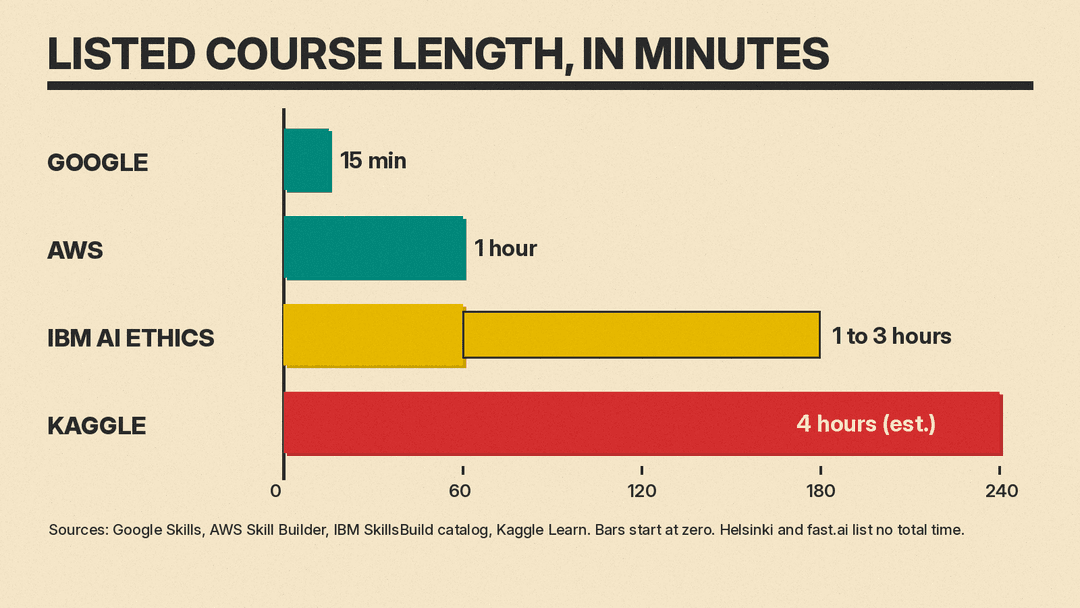
The bar chart earlier on this page shows the lengths the pages list, drawn to scale from zero. Google lists 15 minutes, AWS lists 1 hour, IBM lists 1-3 hours for AI Ethics, and Kaggle estimates 4 hours. Helsinki's page lists seven chapters and no total time, and Microsoft lists six units for its introduction module and nine for the second. fast.ai does not list a time either.
Questions to ask before you enroll
- Does the credential cost anything? Six of the seven pages we read call the training free, and fast.ai's page states no price. A credential on another platform can differ. The Coursera listing is the example: free to enroll, with the certificate cost not stated on the page.
- How long does the credential take? Helsinki's peer review can take multiple weeks, per its FAQ.
- Is the credential tied to this course or to a bigger program? IBM's catalog and AWS's badges page both tie credentials to programs or learning plans, not always to a single course.
- Is the material current? The fast.ai page was last generated in 2020. The AWS page shows a September 2026 update date.
- Which topic do you need? Helsinki covers ethical principles such as accountability and human rights. Kaggle and fast.ai work through bias and fairness in data. Google, AWS and Microsoft teach each company's own responsible AI approach, as their descriptions say.
If you are weighing a bigger career move into AI work, our guide to the AI product manager career names the Google PAIR and Microsoft HAX design guides for that role.
Sources
- University of Helsinki, Ethics of AI
- Ethics of AI FAQ
- Kaggle, Intro to AI Ethics
- Kaggle Learn courses
- IBM SkillsBuild learning catalog, AI topic
- Google Skills, Introduction to Responsible AI
- Grow with Google, AI skills
- Coursera, Introduction to Responsible AI
- AWS Skill Builder, Responsible Artificial Intelligence Practices
- AWS Training badges
- Microsoft Learn, Introduction to Microsoft's Responsible AI Approach
- Microsoft Learn, Embrace Responsible AI Principles and Practices
- Microsoft Learn FAQ
- fast.ai, Practical Data Ethics
