
YouTube has free AI lessons for every level, from animated math intros to full university lecture series. This guide sorts 14 channels by what you want to learn, and describes each one using the channel's own About text or the course page it links to. Every channel page was checked in October 2026.
If you want structured courses with certificates instead, see our list of the best free AI courses. If you would rather listen than watch, see the best AI podcasts to follow.
How we picked
- Free to watch. Every pick posts its lessons publicly on YouTube.
- Teaching first. We favored channels that explain how AI works or how to build with it, over channels that only react to news.
- Checked against the source. Each description below uses the channel's About text or the official course page it links to. We left out view counts and subscriber numbers because they change daily.
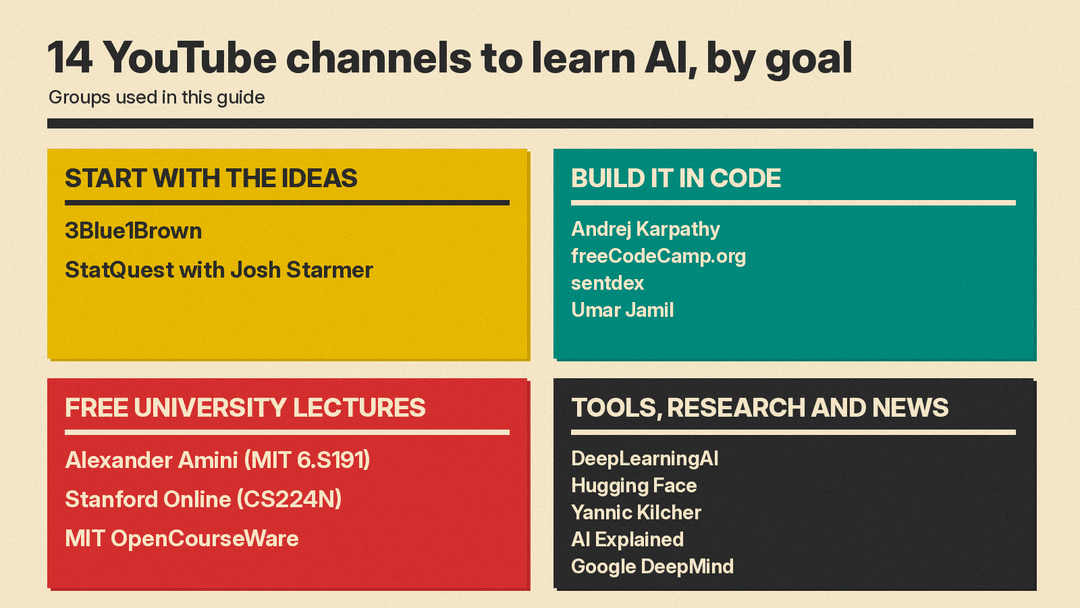
Start with the ideas
3Blue1Brown
3Blue1Brown is Grant Sanderson's channel. Its About text says the videos "cover a variety of topics in math, or adjacent fields like physics and CS, all with an emphasis on visualizing the core ideas."
For AI, start with the neural networks lessons. The first, But what is a Neural Network?, is described as "an overview of what a neural network is, introduced in the context of recognizing hand-written digits." A later lesson, Transformers, the tech behind LLMs, is "a visual introduction to transformers."
Best for: anyone who wants to see what a neural network does before writing any code.
StatQuest with Josh Starmer
StatQuest with Josh Starmer covers statistics, machine learning, data science and AI. Its About text says "each technique is really just a combination of small and simple steps," and that the goal is "to break down the major methodologies into easy-to-understand pieces." It also says: "I don't dumb down the material." A video index lives at statquest.org.
Best for: learners who want the statistics behind machine learning explained one step at a time.
Build it in code
Andrej Karpathy
Andrej Karpathy's channel hosts Neural Networks: Zero to Hero, which its course page calls "a course by Andrej Karpathy on building neural networks, from scratch, in code." The page says: "We start with the basics of backpropagation and build up to modern deep neural networks, like GPT."
The syllabus opens with "The spelled-out intro to neural networks and backpropagation: building micrograd," then a series on makemore, which starts as "a bigram character-level language model." It continues to "Let's build GPT: from scratch, in code, spelled out" and "Let's build the GPT Tokenizer." The listed prerequisites are "solid programming (Python), intro-level math (e.g. derivative, gaussian)."
Best for: programmers who want to understand language models by building one.
freeCodeCamp.org
freeCodeCamp.org describes itself as a channel to "learn math, programming, and computer science for free," run by "a 501(c)(3) tax-exempt charity." It also runs the interactive learning platform at freecodecamp.org.
Best for: beginners who also need programming and math basics before AI topics.
sentdex
sentdex offers "Python Programming tutorials, going further than just the basics," with topics that include machine learning, finance, data analysis and robotics. The About text says the channel has "~1000 videos" and points to pythonprogramming.net for searching them.
Best for: Python learners who want hands-on machine learning projects.
Umar Jamil
Umar Jamil's About text reads, with a joke at the end: "I'm a Machine Learning Engineer from Milan, Italy, teaching complex deep learning and machine learning concepts to my cat, 奥利奥."
Best for: learners who already code and want detailed explanations of deep learning concepts.
Free university lectures
Alexander Amini (MIT 6.S191)
Alexander Amini's channel is the YouTube home of MIT 6.S191 Introduction to Deep Learning, which the course site links to. The site calls it "MIT's introductory program on deep learning methods" and says students gain "understanding of cutting-edge topics including large language models and generative AI."
The prerequisites "assume calculus (i.e. taking derivatives) and linear algebra (i.e. matrix multiplication)," and the site adds: "Experience in Python is helpful but not necessary." Its FAQ says: "All materials are open-sourced to the world for free and are copyrighted under the MIT license."
Best for: learners who want a short, structured deep learning course with labs.
Stanford Online (CS224N)
Stanford Online is, in its own words, "the Stanford School of Engineering's portal for academic and professional education." For language models, the CS224N course page covers Natural Language Processing with Deep Learning. It says "complete videos for the CS224N course are available" for free on the CS224N 2024 YouTube playlist. The page also links playlists from earlier years.
Best for: learners who want a full university course on how language models handle text.
MIT OpenCourseWare
MIT OpenCourseWare calls itself "a free and open online publication of educational material from thousands of MIT courses." Its About text notes that "some courses also have videos," and that "there's no signup or enrollment."
Best for: learners who want the math and computer science courses that sit under AI.
Tools, research and news
DeepLearningAI
DeepLearningAI is the official channel of DeepLearning.AI, which its About text says "was founded in 2017 by machine learning and education pioneer Andrew Ng." The channel has "videos from our Coursera programs on machine learning as well as recorded events." The company also lists courses, including short ones, at deeplearning.ai/courses.
Best for: learners who want clips from DeepLearning.AI's Coursera programs and recorded events.
Hugging Face
Hugging Face describes itself as "the platform where the AI community collaborates on models, datasets, research papers and applications." The channel pairs well with Hugging Face's free LLM Course, one of several courses on its Learn pages.
Best for: people who want to use open models and the Hugging Face tools.
Yannic Kilcher
Yannic Kilcher says he makes "videos about machine learning research papers, programming, and issues of the AI community, and the broader impact of AI in society."
Best for: readers who want a guide through new research papers. For background on one common technique, see our RAG explainer.
AI Explained
AI Explained describes its focus as "covering the biggest news of the century - the arrival of smarter-than-human AI." The About text also calls the host "the author of Simple Bench, exposing the remaining human-LLM reasoning gap."
Best for: viewers who want to follow new models and benchmarks.
Google DeepMind
Google DeepMind is the lab's official channel. Its About text says: "We're a team of scientists, engineers, ethicists and more, working to build the next generation of AI systems safely and responsibly."
Best for: viewers who want to hear about research directly from the lab.
A simple order to watch them in
- Ideas first. Watch the 3Blue1Brown neural networks lessons, and use StatQuest when a statistics term is new.
- Then code. Work through Neural Networks: Zero to Hero if you know Python. If you do not, start with freeCodeCamp.org.
- Then a full course. Pick MIT 6.S191 for deep learning or the CS224N playlist for language.
- Then stay current. Add Yannic Kilcher, AI Explained or Google DeepMind for research and news.
If your goal is a job, our roadmap for becoming an AI engineer shows how these skills fit together.
Sources
- 3Blue1Brown on YouTube
- 3Blue1Brown: But what is a Neural Network?
- 3Blue1Brown: Transformers, the tech behind LLMs
- StatQuest with Josh Starmer on YouTube
- Andrej Karpathy on YouTube
- Neural Networks: Zero to Hero course page
- freeCodeCamp.org on YouTube
- sentdex on YouTube
- Umar Jamil on YouTube
- Alexander Amini on YouTube
- MIT 6.S191 Introduction to Deep Learning
- Stanford Online on YouTube
- Stanford CS224N course page
- CS224N 2024 YouTube playlist
- MIT OpenCourseWare on YouTube
- DeepLearningAI on YouTube
- DeepLearning.AI courses
- Hugging Face on YouTube
- Hugging Face LLM Course
- Yannic Kilcher on YouTube
- AI Explained on YouTube
- Google DeepMind on YouTube
