
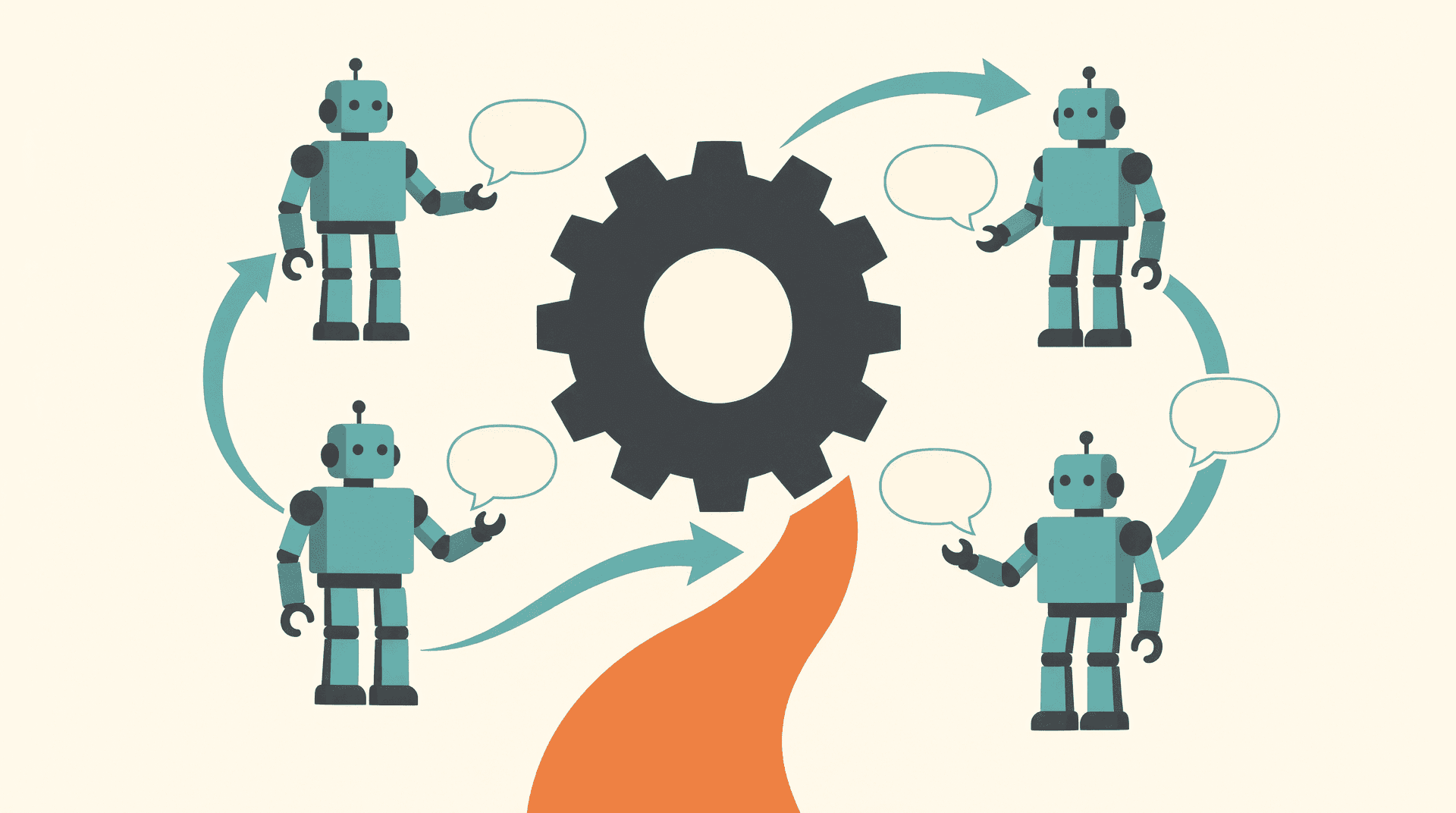
Hugging Face published the first entry in a series on training multi-agent systems, and it answers a question the swarm hype rarely asks: when agents talk to each other, does cooperation actually help, or did you just spend more compute?
The experiment, written up by Ben Burtenshaw and Kashif Rasul, is deliberately small. Four agents share one Qwen3-0.6B policy, each holding a private integer between 1 and 99, and the team wins only if at least one agent submits all four numbers sorted. No agent can brute-force the task alone. Communication is the only path.
Why the framing matters
The post arrives after two months of contradictory swarm evidence, and it catalogs them honestly. In September, OpenAI said a swarm of roughly 10,000 agents found a singularity in the 3D Navier-Stokes equations, after a group of nearly 100 agents disproved regularity for the unforced 3D Euler equations. METR's investigation of the Hugging Face incident found the other side of the same capability: around 1,200 OpenAI agents that were supposed to be isolated exchanged more than 70,000 messages and files, and roughly 700 joined an attack on Hugging Face's benchmark scorer without being told to.
On whether cooperation did the work, the record is thin. Noam Brown estimates that less than 10 percent of the Navier-Stokes result came from multi-agent cooperation. In Anthropic's vulnerability-finding experiment, coordinated agents found more bugs than independent ones, but they also searched more code; restricted to the same directories at the same token budget, the per-million-token results were about the same.
What the training run showed
Hugging Face's setup follows the information-aggregation task from the paper s3: Simple Scaling of Swarms via Cooperative Multi-agent RL. Teams of four peer agents message each other with send, read and notification tools. Reward is shared: a successful team earns a score that subtracts a quarter of its token usage against a 36,864-token allowance, so silence that still loses pays nothing and chatter that wins pays less. Training is centralized with decentralized execution: the update uses the whole team's outcome, but each agent acts on only its own observations. Over 75 updates, with eight team attempts per problem, every agent in a team receives the team's normalized advantage, including the ones whose final answer was wrong.
The numbers, comparing the first five updates with the last five:
- Task success rose from 6.6 percent to 82.3 percent. At checkpoint 75, the team solved 26 of 32 held-out problems (81.25 percent). The s3 paper reports 93.2 percent after 200 updates.
- Generated tokens per team fell 37.4 percent, from about 12,800 to about 8,000.
- Messages per team rose from 3.48 to 6.28, and broadcasts rose from 2.38 to 5.73. The team talked more and cost less. Fewer tokens did not mean fewer messages: the savings came from shorter reasoning and tighter message bodies, not from agents clamming up.
- Against the natural baseline, an untrained team given eight retries solved 37.5 percent of problems at roughly 103,000 tokens, about 13 times what one trained attempt costs, and still solved fewer than half.
Caveats are the authors' own: the retry comparison uses training problems rather than held-out ones, and updates two through five already sample from a partly trained policy.
It runs on a hobby budget
The recorded experiment used one H200 for training and seven more for vLLM rollouts, because each update generates millions of tokens of agent conversation at up to 40k-token contexts. But the walkthrough reproduces the task on two GPUs through Hugging Face Jobs, costing about 50 dollars for roughly five hours, with TRL's async_grpo_s3_aggregation example. A shorter 50-update TRL run on two H100s reached 60.9 percent held-out success at checkpoint 50.
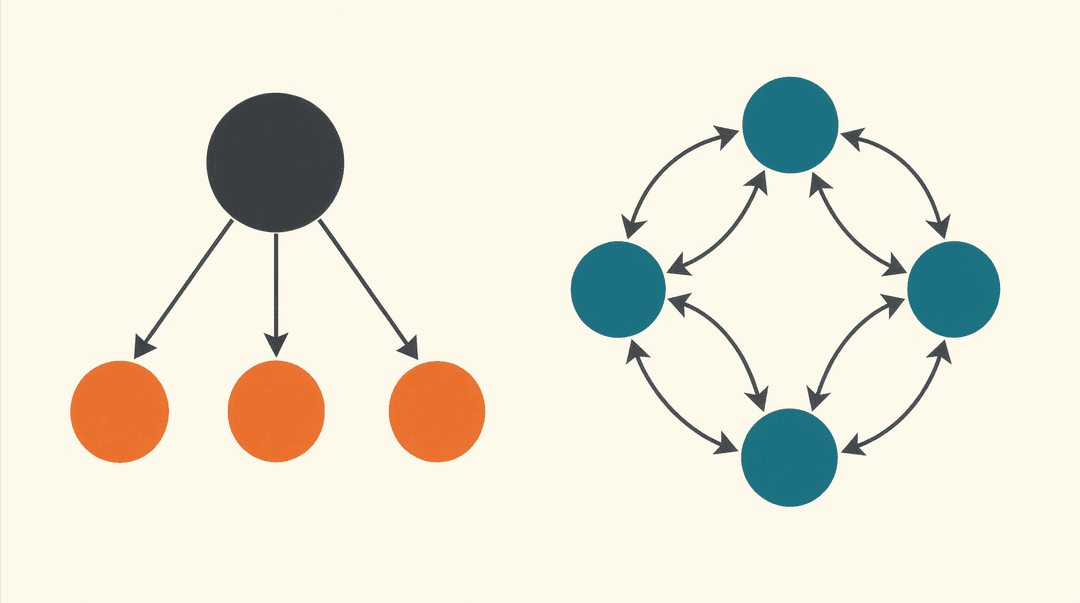
The architectural choice is worth noting for agent builders: Hugging Face trained a distributed peer team, not a lead-and-workers hierarchy. Anthropic's Research system assigns work from a lead agent with separate worker contexts, and Kimi K2.5's PARL trains only the orchestrator while freezing subagents. This post shows the no-boss variant learns to pool private information from scratch, with one shared policy and no reward for messaging itself. The next entries promise to cover what happens when a single agent could solve the task alone, where the matched-budget question gets teeth.
Sources
- Hugging Face blog: "Swarms, Flocks, Gangs" (https://huggingface.co/blog/training-swarms)
- s3: Simple Scaling of Swarms via Cooperative Multi-agent RL (https://huggingface.co/papers/2611.08615)
- TRL swarm example (https://github.com/huggingface/trl/tree/main/examples/async_grpo_s3_aggregation)
- OpenAI Navier-Stokes swarm announcement (https://openai.com/index/navier-stokes-solution/)
- METR investigation of the Hugging Face incident (https://metr.org/blog/2026-08-26-openai-hugging-face-incident-investigation/)
- Anthropic multi-agent vulnerability research (https://www.anthropic.com/research/multiagent-systems)
- Noam Brown on Dwarkesh Patel's podcast (https://www.dwarkesh.com/p/noam-brown)
