
Abu Dhabi has partnered with OpenAI to speed up access to government services by automating checks for business permits and certificates, AGBI reported on Nov 2, 2026. The framework is called Machine-Readable Government, or MRG. The AI can complete routine policy checks in minutes rather than days, AGBI was told.
The partnership was among four documents signed after Sam Altman met Crown Prince Sheikh Khaled bin Mohamed bin Zayed Al Nahyan, covering government, energy and investment, according to AGBI. Altman was in Abu Dhabi on Monday, Nov 2, for the opening of Adipec, AGBI reported. "Abu Dhabi and the UAE are setting a bold, global standard for AI integration across both the public and private sectors to make sure the benefits of AI reach everyone," Altman said in a statement quoted by The Next Web.
Altman also said in a statement, AGBI reported: "By making certain laws machine-readable, while keeping people in control of decision-making, Abu Dhabi has set a new standard for AI-enabled public services."
Ahmed Tamim Hisham Al Kuttab, chair of Abu Dhabi's Department of Government Enablement, said: "When we set out to build the world's first AI-native government, we knew that applying AI to old processes would only take us so far," and "The harder task was making policy itself intelligent, and that is what a Machine-Readable Government does," according to AGBI.
What Machine-Readable Government does
The first application supports food import product registration at the Abu Dhabi Agriculture and Food Safety Authority (ADAFSA), AGBI reported. That process handles around 20,000 new registrations annually and draws on 1,400 policy documents, some more than 700 pages long.
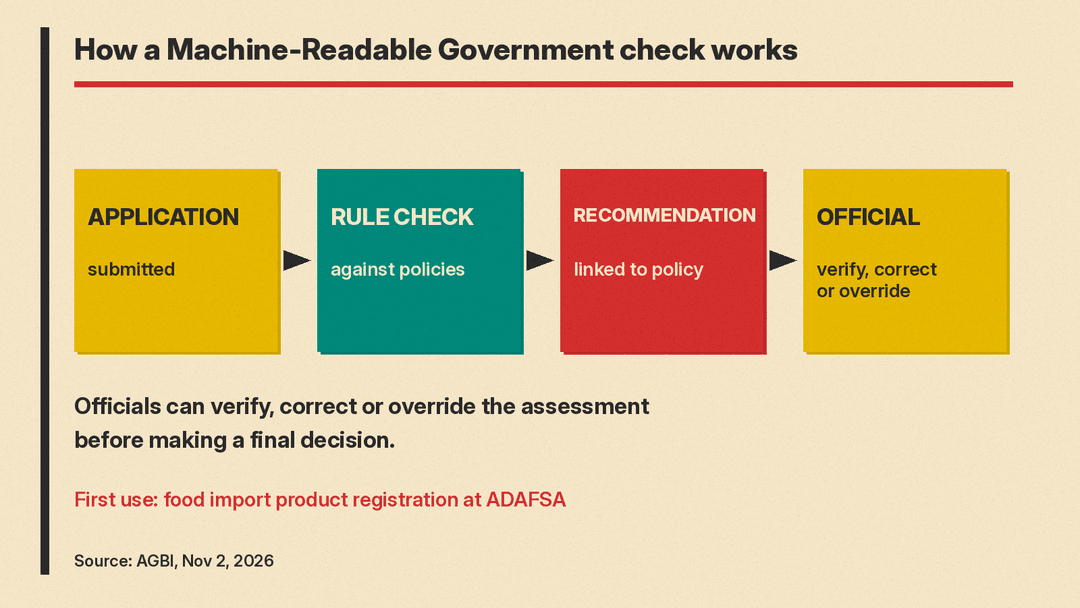
The checks establish whether applicants supplied the required information and documents, help classify products and assess risk, and compare submissions against relevant rules, AGBI said. Each recommendation is linked to the policy provisions behind it, so officials can verify, correct or override the assessment before a final decision.
A statement described by Gulf Business and Gulf News said the pilot was developed with Inception42, a G42 company, and tested a "Policy Adoption Engine" that converts written government policies into automated compliance checks. Abu Dhabi's ambition is to become the world's first AI-native government by 2027, according to the statement.
Officials set standards, review complex applications and keep responsibility for final decisions, the statement said. Routine cases can be processed around the clock. The framework is not intended to make autonomous decisions in areas affecting individuals' rights and access to essential services, the government and OpenAI said. Initially it changes how existing rules are applied rather than rewriting legislation, Gulf News reported.
Planned extensions include construction permits, business and freelance licensing and procurement, AGBI reported. MRG is led by the Department of Government Enablement and is expected to help departments identify overlapping or conflicting requirements and test proposed policy changes before they are introduced, the government said.
Abu Dhabi is also in talks to license its Tamm digital services platform to US cities, AGBI reported. Tamm brings together more than 1,200 public and private services and is intended to integrate with MRG.
Where it runs and who owns the data
AI processing takes place within UAE data centres, under Abu Dhabi law, AGBI reported. Data remains government-owned and will not be used to train AI models.
According to the statement, processing runs through OpenAI's UAE inference residency, meaning real-time model computation on GPUs in UAE data centres, under a "fail-closed" security architecture governed by UAE cybersecurity standards and subject to Abu Dhabi law.
G42 is also building OpenAI's Stargate data centre in the UAE, The Next Web reported. For how OpenAI describes its obligations to the places that host its campuses, see OpenAI's pledges for its new data center campuses.
The other three deals
Adnoc will deploy OpenAI's advanced AI models across its operations in collaboration with G42 subsidiary Inception42, supporting operational, investment and commercial decision-making, AGBI reported. The agreement makes ADNOC the first energy company to use OpenAI's Frontier platform, The Next Web reported.
Mubadala signed an agreement with OpenAI and Inception42 to use AI to analyse investments, identify opportunities and assess risk, AGBI reported.
Inception42 and OpenAI agreed a five-year partnership to support AI adoption across UAE government, businesses and education, according to AGBI.
Why it matters
The MRG arrangement puts GPT models inside a government's own permitting workflow, checking applications against the rules the government wrote, with each recommendation tied to specific policy provisions and a human official signing off. The stated design keeps final decisions with officials, and the partners say the framework is not meant to make autonomous decisions that affect individuals' rights or access to essential services.
The governance questions are less settled. Accuracy, appeals, and how errors get caught have not been answered publicly in the material reported so far. The reports also do not say how an applicant could challenge an assessment they think misreads a rule.
The signings also came as OpenAI raises new money. OpenAI is raising up to $20bn in a new funding round that investors from the UAE co-lead, CNBC reported, according to The Next Web. Bloomberg has since reported a first close, covered in OpenAI's $11B first close.
What is still unknown
tbreak noted that it is unclear how many cases the pilot handles and said it has not seen an independent assessment of how well it works. The reports did not say when the planned extensions for construction permits, licensing and procurement will begin, or whether the talks to license Tamm to US cities will conclude.
Sources
- AGBI: Abu Dhabi partners with OpenAI to speed up business approvals
- The Next Web: Altman signs four Abu Dhabi deals, from permits to Mubadala investments
- Gulf Business: OpenAI and Abu Dhabi join forces to build the world's first AI-native government
- Gulf News: Abu Dhabi, OpenAI launch AI-native government initiative
- tbreak: Abu Dhabi and OpenAI launch Machine-Readable Government
