
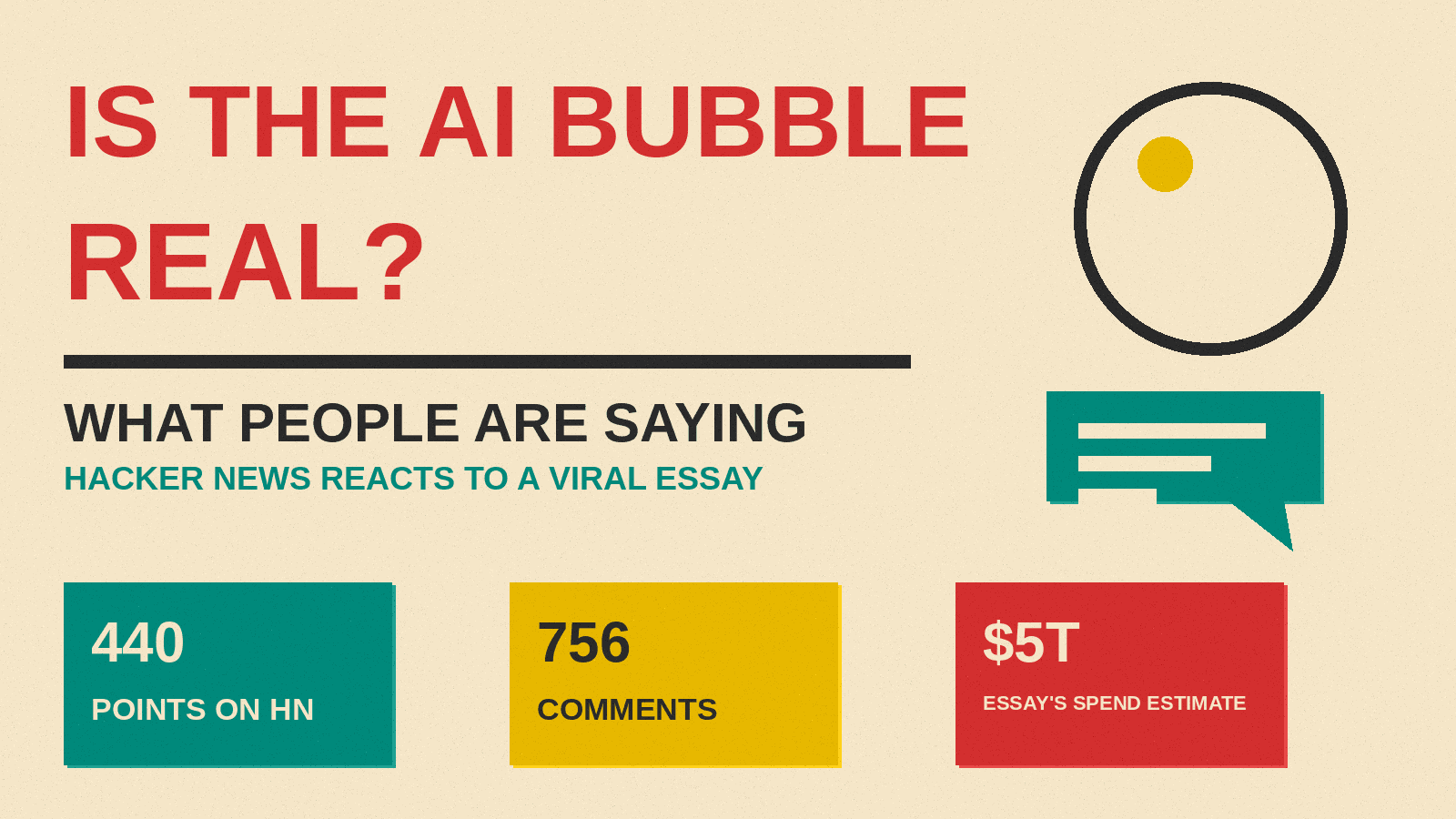
Matteo Raso published the essay I'm Not Convinced The AI Bubble Exists on November 8, 2026. It reached the front page of Hacker News, with 440 points and 756 comments as of about 7:30 AM PT on November 9. The thread was submitted by matteoraso, who answers questions there as the author.
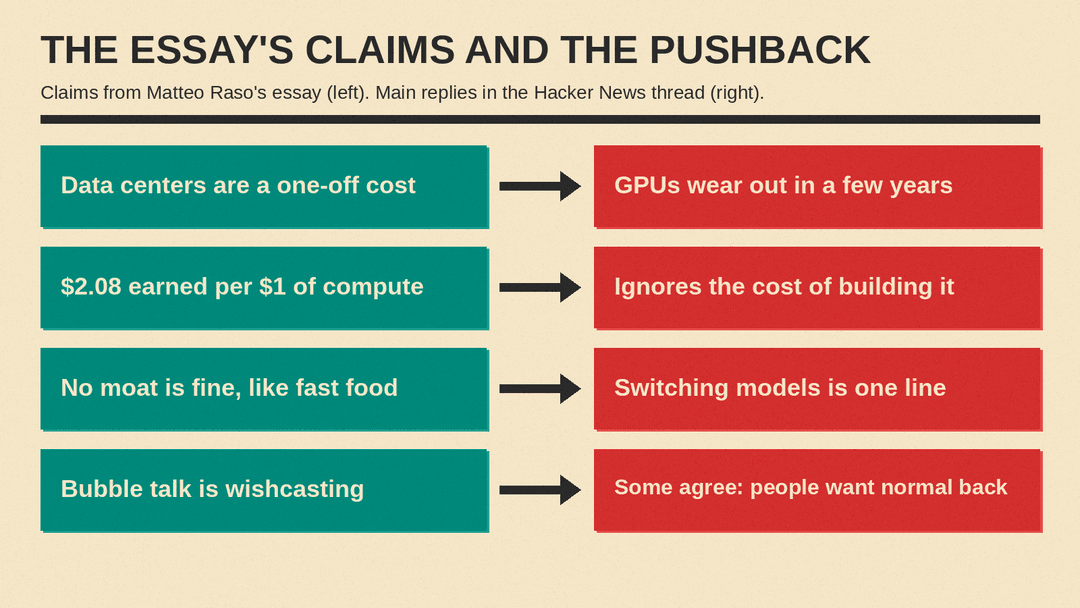
The thread matters because "AI bubble" is often treated as a given. Commenters push back on three points: that data centers are a one-time cost, that Anthropic's compute margin proves profitability, and the fast food analogy about moats. Some commenters agree with the closing idea that bubble talk is wishful thinking.
What does the essay argue?
Raso writes that AI companies have committed to spending "at least 3 trillion dollars", that an estimated 1.9 trillion has been spent, and that the total is around 5 trillion. Data centers, he argues, are "one-off purchases, not regular operating expenses", and "Once all the data centres are built, AI spending is going to plummet."
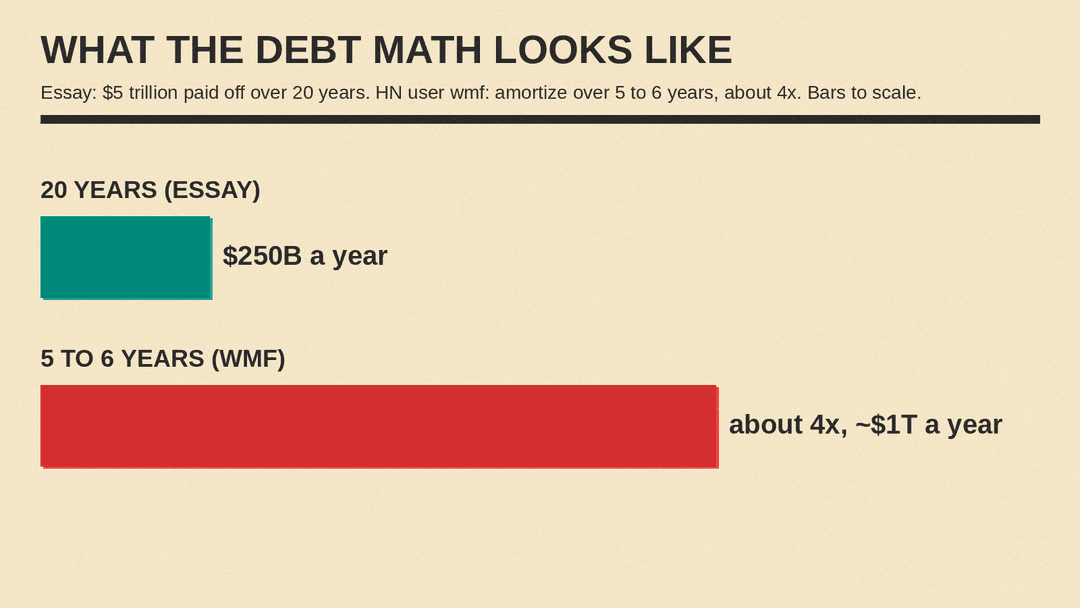
The essay cites Anthropic's S-1 filing as saying Anthropic makes $2.08 for every $1 of compute, with revenue of 41 million in 2023, 386 million in 2024, 4.585 billion in 2025 and 16.3 billion in the first 6 months of 2026. Paying off 5 trillion dollars over 20 years, it says, comes to 250 billion dollars a year.
Raso compares AI labs to the fast food "chicken sandwich war" and writes, "Simply saying that a company doesn't have a moat isn't enough to say that the company can't make money." He says average people will not run local models and that brand loyalty and corporate contracts create lock-in. He says Alphabet, Meta and NVIDIA have P/E ratios in their 20s, unlike dot-com companies.
His caveats are data center backlash, regulation, the risk of an autonomous AI hacker, and the size and complexity of the debt. His advice: "Don't YOLO your life savings on the AI revolution". The closing idea: bubble talk "represents the hope that things can go back to how they used to be" and "So, people wishcast."
Is AI a bubble?
swatcoder, in a comment with about 200 replies, writes: "These bubbles aren't about potential, they're about timing." He lists railroads, semiconductors, plastics and networking as cases where the utility and the potential profit were there.
Are data centers a one-time cost?
adityaathalye writes, "Fatal misunderstanding. Datacenters are not warehouses." He points to GPU depreciation and hardware upgrade cycles. Tuna-Fish says, "The current-gen hardware is expected to have only 2-3 years of useful life."
wmf keeps the arithmetic and changes the term: "The only modification I'd make is to amortize the investments over 5-6 years instead of 20 because most of the cost is GPUs not the buildings. This increases the required revenue by 4x."
kopirgan replies to adityaathalye with the counterpoint: "GPU seem to last lot longer than expected.." The commenter adds that GPUs have good resale value. In late October a reseller listed 9,600 used Nvidia A100 GPUs on eBay for $59.7 million; see our report on that A100 supercomputer listing.
Does Anthropic make money?
vannevar: "If you ignore the cost of building cars, they are also very profitable." The same compute-bill argument ran through the reactions to Anthropic's S-1 in October.
viktorcode says the essay is incomplete: "The author talks about revenue growth on the basis of Anthropic's S-1 filing, but ignores the third quarter results which were posted later." That is the commenter's claim.
On training, dofm wrote that, unless they misread it, the article does not mention training or its cost. The author replied: "Training would fall under "compute and infrastructure investments", which I mention in the 3rd paragraph."
Do AI companies have a moat?
zeroonetwothree objects to the fast food framing: "McDonald’s is considered to have one of the biggest moats of any business." vannevar: "That's why no one is sinking several trillion dollars into a new fast food chain."
4gotunameagain describes a real moat: "A moat is what NVIDIA has with CUDA, against which so much software is written."
Traster says that at their company, "switching model is as simple as changing a line in a json file," and that they have switched about 5 times this year. PinkaDunka replies, "But you are switching between all of the same names. You are not switching away from AI. So why would AI bubble pop?"
jxcole on price competition: "If you don't talk about competition from DeepSeek you haven't really thought it through all the way."
Which bubble are people talking about?
blltprfmnk writes, "The bubble, by the way, specifically refers to the valuations." anonymous908213 writes, "It's more accurate to say that there's an OpenAI-Anthropic-X bubble." simianwords separates model companies (OpenAI, Anthropic) from hyperscalers, data centers and hardware: "When people say the bubble will pop, they usually mean the second one."
Is there enough demand for AI?
hmontazeri writes, "No one seems to worry about the demand of ai." He says his neighbors cannot open a zip file and that small models like Qwen 27b run on a Mac mini. misja111 replies, "I would say your neighbors are the perfect use case for AI."
Who agrees with the essay?
npilk, quoting the wishcasting passage: "I think this is why Ed Zitron gets so many readers - people want someone to tell them things will go back to “normal” someday."
pj_mukh separates usefulness from price: "I dont know if the valuations make sense, but the usability is all there and so are the potential profits."
What are people saying on X?
An X search at 7:35 AM PT on November 9 found 13 posts that link to or name the essay. Four come from automated Hacker News feed accounts, and five are in Chinese or Japanese. One English reaction, from @jreuben1: "I am convinced that the orchestrated FUD either benefits a) Chinese AI rivals of the US AI industry, or b) protectionist AI oligarchs".
What should you watch next?
The objections quoted here are about hardware life, revenue growth, competition and valuations. Watch three things: depreciation assumptions, AI company earnings and filings, and open-weight price competition. The essay's own caveat applies: "Don't YOLO your life savings on the AI revolution".
Sources
- Essay: I'm Not Convinced The AI Bubble Exists by Matteo Raso
- Hacker News thread: news.ycombinator.com/item?id=50418975
- swatcoder on timing
- adityaathalye on data centers
- Tuna-Fish on hardware life
- wmf on amortization
- kopirgan on GPU lifespan
- vannevar on margins and fast food
- viktorcode on the S-1 filing
- dofm on training costs
- Author reply on training
- zeroonetwothree on McDonald's moat
- 4gotunameagain on CUDA
- Traster on switching models
- PinkaDunka reply on switching
- jxcole on DeepSeek
- blltprfmnk on valuations
- anonymous908213 on which bubble
- simianwords on layers
- hmontazeri on demand
- misja111 reply on demand
- npilk on wishcasting
- pj_mukh on usability
- @jreuben1 on X
