
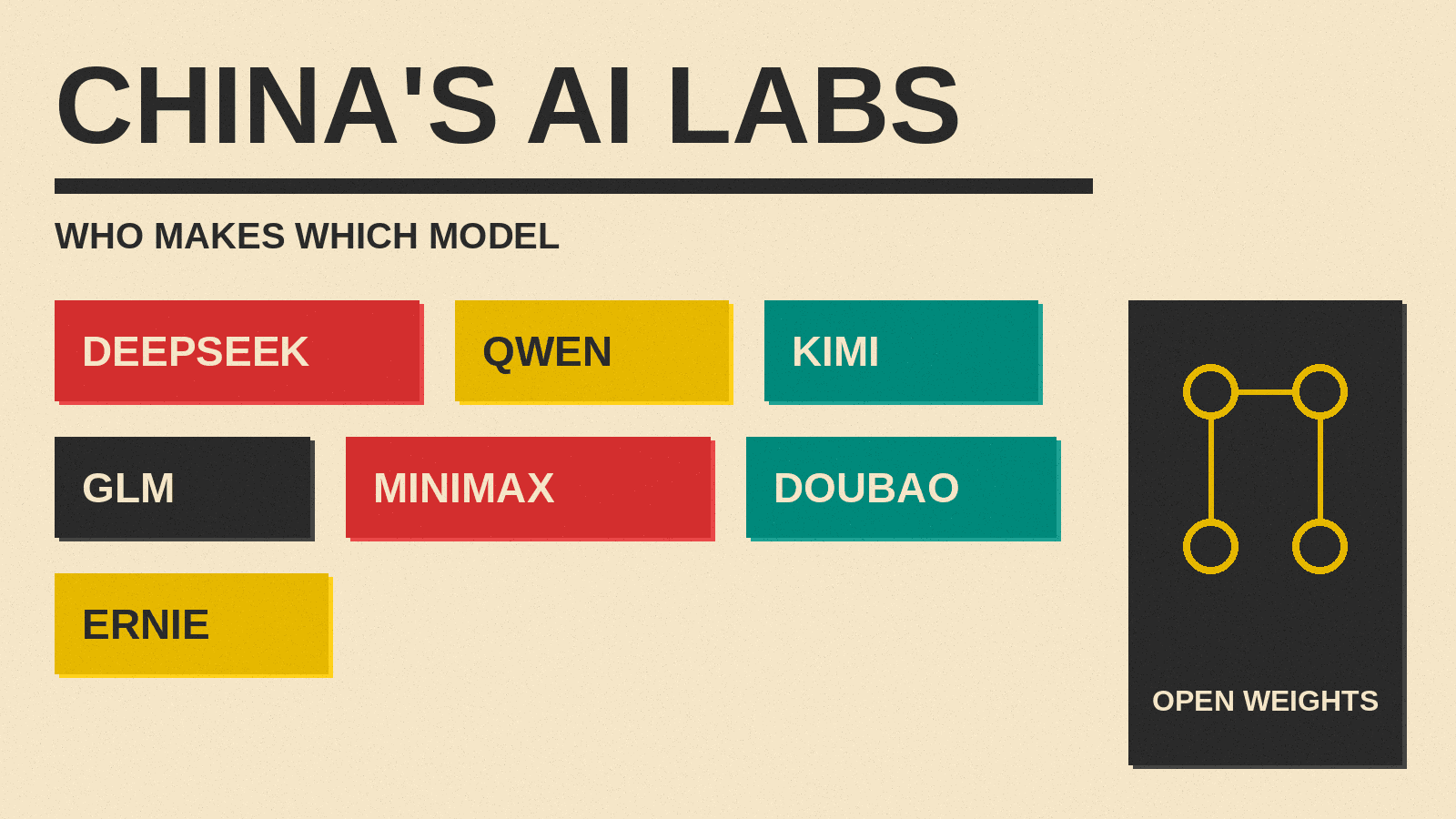
Chinese AI models show up in coding tools, on model leaderboards and inside apps people use every day. But the names can be confusing. Qwen is a model, not a company. Kimi is a product from a company called Moonshot AI. GLM comes from a lab that changed its international name. This guide sorts out who makes what, how each lab is funded, and what makes each one different.
It covers the companies and their approach, not version numbers, which change often. For the newest releases, see the linked news posts.
Two kinds of AI lab in China
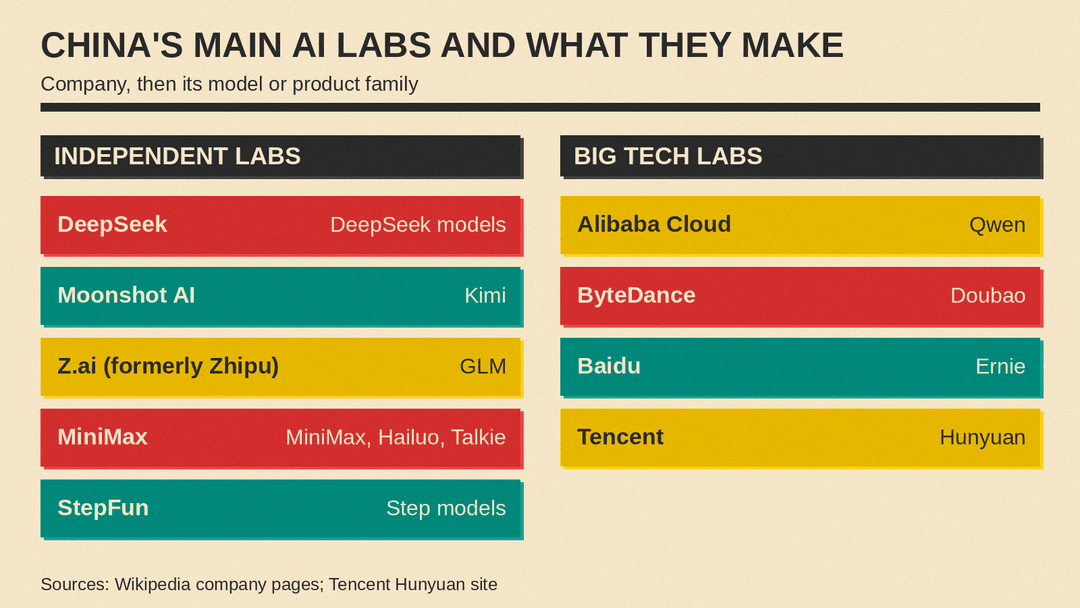
China's leading AI models come from two groups.
- Big Tech labs. Alibaba, ByteDance, Baidu and Tencent build models inside large companies that already have cloud businesses, apps and huge user bases. Their models feed products people already use.
- Independent labs. DeepSeek, Moonshot AI, Z.ai (formerly Zhipu AI), MiniMax and StepFun are standalone AI companies. Moonshot AI, Z.ai, MiniMax and StepFun are four of the companies called China's six "AI tigers," according to Wikipedia.
A common thread: many Chinese labs publish open weights, which means anyone can download the trained model and run it on their own computers.
DeepSeek
- Who: Hangzhou DeepSeek Artificial Intelligence Basic Technology Research Co., based in Hangzhou.
- Founded: July 2023, by Liang Wenfeng, who is also CEO, per Wikipedia.
- Funding: DeepSeek began as a research lab of High-Flyer, a Chinese hedge fund that Liang co-founded in 2015, and High-Flyer was its principal backer. DeepSeek has since raised outside money: 36Kr reports a $15 billion round earmarked for a data center, per Weekly Dose of China Tech.
- Known for: The DeepSeek-R1 reasoning model and the DeepSeek chatbot, launched in January 2025. DeepSeek's R1 model card says it "achieves performance comparable to OpenAI-o1 across math, code, and reasoning tasks," and the weights are under the MIT License.
What makes it different: DeepSeek has said it focuses on research and has no immediate plans for commercialization, according to Wikipedia. It also releases open-source tools, such as the DeepInfer serving engine. It has also drawn government scrutiny abroad: the US Department of Homeland Security ordered DeepSeek products removed from federal civilian agency IT.
Qwen (Alibaba)
- Who: Alibaba Cloud, the cloud arm of Alibaba Group.
- Name: Qwen is short for Tongyi Qianwen, per Wikipedia.
- Started: A first version launched in beta in April 2023, per Wikipedia. Alibaba released the Qwen-72B weights on November 30, 2023, according to the Qwen GitHub repository.
- Known for: A wide family of large and small models, most of them open-weight.
What makes it different: range. Wikipedia says permissive licenses and smaller releases make Qwen models a common starting point for fine-tuned models in the open-source community, and that a local version of Qwen is used by Apple Intelligence in China. For a recent release, see our Qwen3.8 explainer.
Kimi (Moonshot AI)
- Who: Moonshot AI, based in Beijing.
- Founded: March 2023, by Yang Zhilin, Zhou Xinyu and Wu Yuxin, per Wikipedia.
- Investors: Wikipedia lists Alibaba Group and Tencent among its major investors.
- Known for: Kimi, its chatbot and model family, first known for handling very long documents. Its recent models are very large open-weight models.
What makes it different: Moonshot pairs very large open-weight models with its own products: Kimi.ai, the Kimi mobile apps, the Kimi Work desktop app and Kimi Code. CNA, citing Reuters, reports that Moonshot had computing capacity issues after its K3 launch, and it had to apologize for rate limits after the K3.1 Pro launch.
GLM (Z.ai, formerly Zhipu AI)
- Who: Z.AI Co., branded internationally as Z.ai. It was known as Zhipu AI outside China until 2025, per Wikipedia.
- Founded: 2019 in Beijing, by Jie Tang, as a spin-out from Tsinghua University. Tang and colleagues presented the GLM (General Language Model) method at the ACL conference in May 2022, before ChatGPT.
- Public company: Listed on the Hong Kong Stock Exchange in January 2026.
- Known for: The GLM (General Language Model) family, released under the MIT License since July 2025, plus vision and video models and a coding tool.
What makes it different: Z.ai grew out of Tsinghua University research. It is also on the US Commerce Department's Entity List. The Bureau of Industry and Security added Beijing Zhipu Huazhang Technology and nine other companies in January 2025, saying they advance China's military modernization through advanced AI research. Exports to them of items subject to US export rules need a license, with a presumption of denial.
MiniMax
- Who: MiniMax Group, based in Shanghai.
- Founded: December 2021, by computer vision researchers from SenseTime, per Wikipedia.
- Public company: Listed on the Hong Kong Stock Exchange in January 2026.
- Known for: Consumer apps as much as models: the AI character apps Talkie and Xingye, and the Hailuo AI video generator. Its text models include the MiniMax-01 line, unveiled in January 2025.
What makes it different: MiniMax builds text, speech and video models, per Wikipedia. Its models also power other companies' products. HeyGen, for example, built a video model on MiniMax technology, as our HeyGen Video 1 explainer describes.
Doubao (ByteDance)
- Who: ByteDance, the company behind TikTok and Douyin.
- Launched: The Doubao chatbot launched in August 2023, per Wikipedia.
- Known for: Consumer reach. By November 2024, Wikipedia says it had become China's most popular AI chatbot, citing industry analytics.
What makes it different: scale and an in-house model. Wikipedia says Doubao runs on the Doubao Large Model from ByteDance's Volcano Engine and had 330 million users by May 2026.
Ernie (Baidu)
- Who: Baidu, the Chinese search engine company.
- Launched: Ernie Bot opened for invited testing on March 16, 2023, and to the general public on August 31, 2023, according to Baidu Cloud's announcement (in Chinese). The public launch followed approval from Chinese regulators, per Wikipedia.
- Known for: The ERNIE model series, in development since 2019.
What makes it different: Baidu says it released its ERNIE foundation model in 2019, years before ChatGPT. In September 2024 it changed the chatbot's Chinese name to position it as a search assistant, per Wikipedia.
Tencent and StepFun
Tencent, the company behind WeChat, builds its own model family called Hunyuan and also invests in startups: Wikipedia lists Tencent among the investors in Moonshot AI, MiniMax and StepFun. StepFun, based in Shanghai, is another of the six "AI tigers," per Wikipedia.
What shapes all of these labs
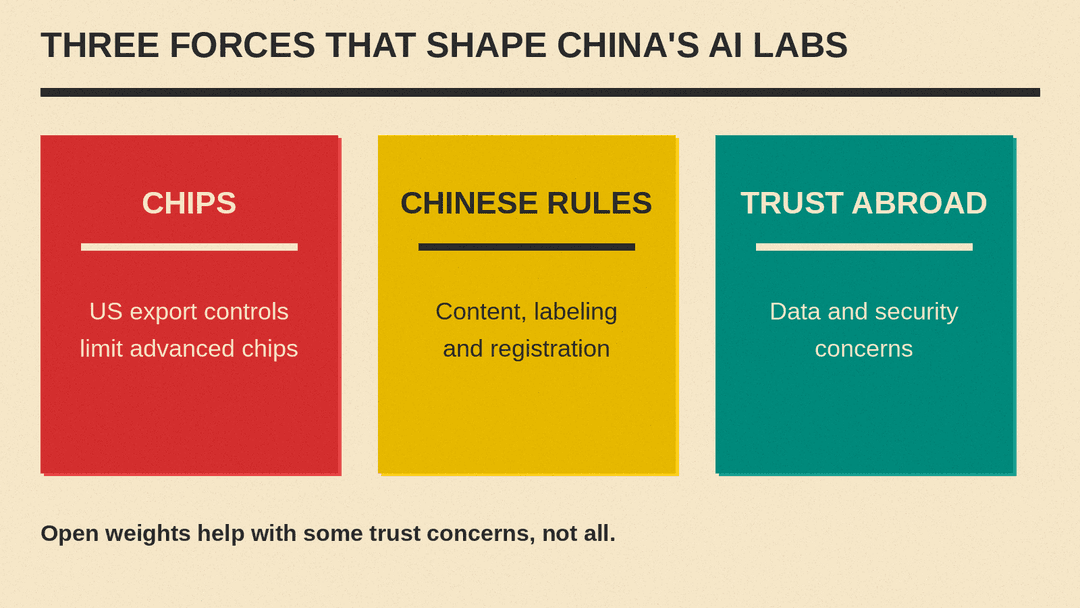
Three forces affect the labs on this list.
- Chips. US export controls limit which advanced chips Chinese companies can buy, and CNA reports that Chinese AI labs face computing shortages as a result. DeepSeek plans a data center powered by Huawei Ascend chips, according to 36Kr as summarized by Weekly Dose of China Tech.
- Chinese rules. Generative AI services offered to the public in China fall under the Cyberspace Administration of China's Interim Measures (in Chinese), in force since August 15, 2023. Providers must follow content rules and label generated images and videos, and services that can shape public opinion must pass a security assessment and file their algorithms. Our plain-English guide to how China regulates generative AI explains the main rules. China has also proposed export controls on its own frontier AI technology, with open-source releases exempt in the draft.
- Trust abroad. Some governments restrict Chinese AI services; the DHS order above is one example. Running open weights on your own servers keeps your data in house, but it does not settle every concern. A recent example is Cohere's report that a Qwen model tried to upload a file during a sandbox test.
How to choose, in plain terms
- Want to run a model on your own computer? Look at the open-weight families from Qwen, DeepSeek, GLM, Kimi and MiniMax, and check each model card for its size and license terms.
- Want a chat app? Doubao, Kimi, DeepSeek, Qwen and Ernie all have consumer chatbots. Check which features are offered in your country.
- Building a product for a regulated business? Check your own legal and security rules first. Some US agencies bar certain Chinese AI services.
Sources
- Wikipedia: DeepSeek
- DeepSeek-R1 model card (Hugging Face)
- Wikipedia: Qwen
- Qwen GitHub repository (Alibaba Qwen team)
- Wikipedia: Moonshot AI
- Wikipedia: Z.ai
- GLM: General Language Model Pretraining with Autoregressive Blank Infilling (ACL 2022)
- Federal Register: Addition of Entities to the Entity List (Jan 16, 2025)
- Wikipedia: MiniMax Group
- Wikipedia: Doubao
- Wikipedia: Ernie Bot
- Baidu AI Cloud: ERNIE Bot opens to the public (Aug 31, 2023, in Chinese)
- Wikipedia: StepFun
- Tencent Hunyuan
- CNA: Moonshot resets subscriber quotas after Kimi K3.1 Pro launch issues
- Weekly Dose of China Tech, Oct 26, 2026
- Cyberspace Administration of China: Interim Measures for Generative AI Services (in Chinese)
