
AI comes with a lot of jargon. This glossary explains 50 terms you will meet in AI news, product pages and job ads, grouped by topic so related ideas sit together.
Every definition below is quoted from Google's Machine Learning Glossary, published on Google for Developers. Each term links to its own entry there, so you can read the full definition and examples. Next to each quote is a short note in plain English, drawn from the same entry. Definitions were checked as of October 2026.
If you want to go from vocabulary to skills, our list of the best free AI courses in 2026 is a good next step.
The basics
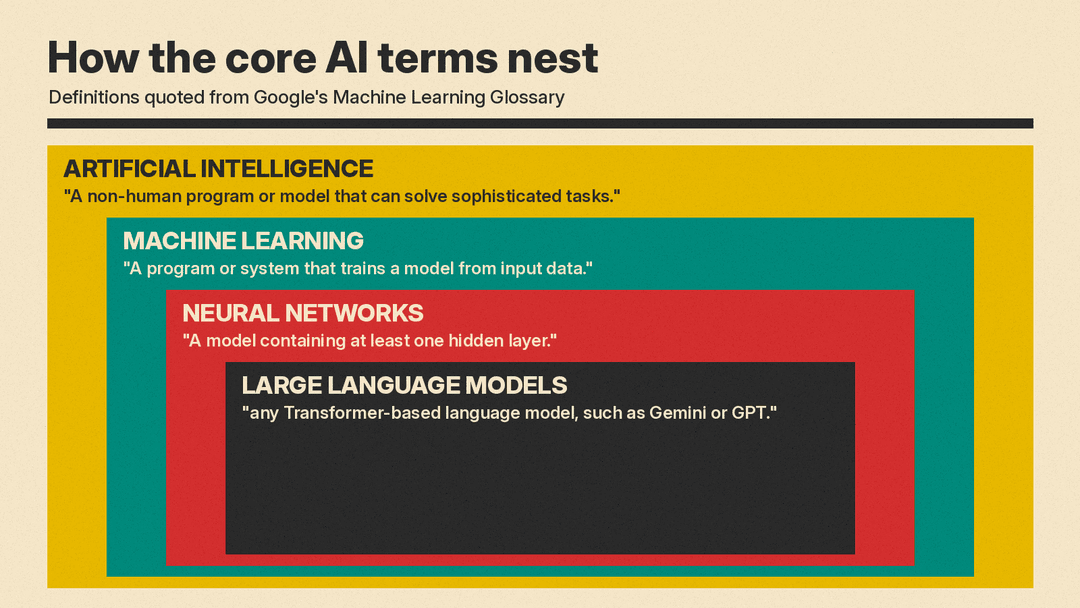
- Artificial intelligence (AI): "A non-human program or model that can solve sophisticated tasks." Google's examples are a program that translates text and one that identifies diseases from radiologic images.
- Artificial general intelligence (AGI): "A non-human mechanism that demonstrates a broad range of problem solving, creativity, and adaptability." The glossary's example is a program that could translate text, compose symphonies, and excel at games that have not yet been invented.
- Machine learning: "A program or system that trains a model from input data." Google adds that machine learning is formally a sub-field of artificial intelligence, though some organizations now use the two terms interchangeably. Our guide to AI vs machine learning vs deep learning shows how the three terms nest.
- Model: "In general, any mathematical construct that processes input data and returns output." Put another way, in Google's words, a model is "the set of parameters and structure needed for a system to make predictions."
- Neural network: "A model containing at least one hidden layer." A deep neural network, also called a deep model, is one with more than one hidden layer. That depth is the "deep" in deep learning, as our comparison of AI, machine learning and deep learning explains.
- Natural language processing (NLP): "The field of teaching computers to process what a user said or typed using linguistic rules." Google notes that almost all modern natural language processing relies on machine learning.
- Generative AI: "An emerging transformative field with no formal definition." Google says most experts agree these models can create content that is complex, coherent and original, and lists large language models and image, audio, music and video generation models as examples.
How models learn
- Dataset: "A collection of raw data." Google says a dataset is commonly, but not only, organized as a spreadsheet or a CSV file. For places to find one, see our list of free datasets for machine learning projects.
- Label: "In supervised machine learning, the "answer" or "result" portion of an example." In a spam detection dataset, Google's example label is either "spam" or "not spam."
- Training: "The process of determining the ideal parameters (weights and biases) comprising a model." During training, a system reads in examples and gradually adjusts those parameters.
- Parameter: "The weights and biases that a model learns during training." Google contrasts these with hyperparameters, the values that you supply to the model, such as the learning rate.
- Weight: "A value that a model multiplies by another value." Training finds a model's ideal weights; inference uses those learned weights to make predictions.
- Loss: "During the training of a supervised model, a measure of how far a model's prediction is from its label." A loss function is what calculates the loss.
- Gradient descent: "A mathematical technique to minimize loss." Per Google, it iteratively adjusts weights and biases, gradually finding the combination that minimizes loss.
- Supervised machine learning: "Training a model from features and their corresponding labels." Google compares it to studying a set of questions and their answers, then answering new questions on the same topic.
- Unsupervised machine learning: "Training a model to find patterns in a dataset, typically an unlabeled dataset." Google says the most common use is to cluster data into groups of similar examples, such as songs grouped by properties of the music.
- Reinforcement learning (RL): "A family of algorithms that learn an optimal policy, whose goal is to maximize return when interacting with an environment." Google's example: in most games the ultimate reward is victory, and RL systems learn from sequences of moves that led to wins and losses.
- Overfitting: "Creating a model that matches the training data so closely that the model fails to make correct predictions on new data." Google lists regularization and training on a large and diverse training set as ways to reduce it.
Language models
- Large language model (LLM): "At a minimum, a language model having a very high number of parameters." More informally, Google says, it is "any Transformer-based language model, such as Gemini or GPT."
- Transformer: "A neural network architecture developed at Google that relies on self-attention mechanisms." Google adds that a Transformer "can be viewed as a stack of self-attention layers."
- Self-attention: "A neural network layer that transforms a sequence of embeddings (for example, token embeddings) into another sequence of embeddings." The "self" part, per Google, means the sequence attends to itself rather than to some other context.
- GPT (Generative Pre-trained Transformer): "A family of Transformer-based large language models developed by OpenAI." Google's entry also lists GPT variants for other modalities, such as ImageGPT and DALL-E.
- Foundation model: "A very large pre-trained model trained on an enormous and diverse training set." Google says it can respond well to a wide range of requests and serve as a base model for further fine-tuning or other customization.
- Pre-trained model: "pre-trained model now typically refers to a trained large language model or other form of trained generative AI model." Google notes the term could refer to any trained model or trained embedding vector.
- Token: "In a language model, the atomic unit that the model is training on and making predictions on." Google says a token is typically a word, a character, or a subword, and gives the example of "dogs" split into the root "dog" and the plural suffix.
- Tokenizer: "A system or algorithm that translates a sequence of input data into tokens." For mixed input, Google's example tokenizer turns text into subwords and images into small patches.
- Context window: "The number of tokens a model can process in a given prompt." Google says the larger the context window, the more information the model can use for coherent and consistent responses.
- Multimodal model: "A model whose inputs, outputs, or both include more than one modality." Google's example takes an image and a text caption and outputs a score for how well the caption fits the image.
- Mixture of experts: "A scheme to increase neural network efficiency by using only a subset of its parameters (known as an expert) to process a given input token or example." A gating network routes each input to the right expert or experts.
Prompting
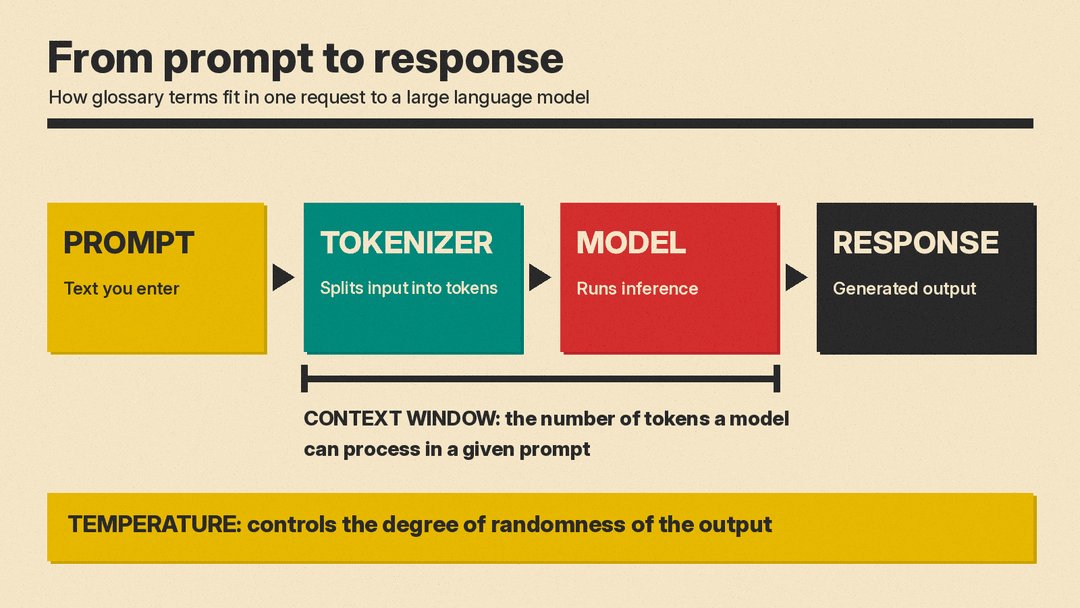
- Prompt: "Any text entered as input to a large language model to condition the model to behave in a certain way." Google says prompts can be as short as a phrase or as long as the entire text of a novel.
- Prompt engineering: "The art of creating prompts that elicit the desired responses from a large language model." Google lists prompt design as a synonym.
- Zero-shot prompting: "A prompt that does not provide an example of how you want the large language model to respond." Asking for the currency of India with no examples is Google's illustration; the model might answer "Rupee", "INR" or "Indian rupee".
- Few-shot prompting: "A prompt that contains more than one (a "few") example demonstrating how the large language model should respond." Google lists in-context learning as a synonym, and says few-shot prompting requires a lengthier prompt.
- Chain-of-thought prompting: "A prompt engineering technique that encourages a large language model (LLM) to explain its reasoning, step by step." Google's example adds "show all relevant calculations" to a physics question.
Customizing a model
- Fine-tuning: "A second, task-specific training pass performed on a pre-trained model to refine its parameters for a specific use case." Google says fine-tuning typically involves hundreds or thousands of examples focused on the task.
- Instruction tuning: "A form of fine-tuning that improves a generative AI model's ability to follow instructions." It trains a model on a series of instruction prompts, typically covering a wide variety of tasks.
- LoRA (Low-Rank Adaptability): "A parameter-efficient technique for fine tuning." Per Google, LoRA "freezes" the model's pre-trained weights and then inserts a small set of trainable weights into the model.
- RLHF (Reinforcement Learning from Human Feedback): "Using feedback from human raters to improve the quality of a model's responses." Google's example is a system that asks users to rate a response with a thumbs up or thumbs down and adjusts future responses.
- Distillation: "The process of reducing the size of one model (known as the teacher) into a smaller model (known as the student) that emulates the original model's predictions as faithfully as possible." Google notes the student's predictions are typically not as good as the teacher's.
- Quantization: "Overloaded term." One of the senses Google lists is reducing the number of bits used to store a model's parameters, for example from 32 bits down to 4, 8 or 16 bits.
Using models with your data
- Inference: "In large language models, inference is the process of using a trained model to generate a response to an input prompt." In traditional machine learning, Google says, it means making predictions by applying a trained model to unlabeled examples.
- Embedding vector: "Broadly speaking, an array of floating-point numbers taken from any hidden layer that describe the inputs to that hidden layer." Google stresses that an embedding vector is not a bunch of random numbers: its values are learned through training. Our EmbeddingGemma 2 explainer shows one embedding model in use.
- Embedding space: "The d-dimensional vector space that features from a higher-dimensional vector space are mapped to." Google adds that the dot product of two embeddings is a measure of their similarity.
- Retrieval-augmented generation (RAG): "A technique for improving the quality of large language model (LLM) output by grounding it with sources of knowledge retrieved after the model was trained." Our plain-English RAG explainer walks through how it works.
- Grounding: "The process of basing all or part of an LLM's response on information retrieved from one or more trusted sources." Google calls RAG a common grounding technique.
- Agent: "Software that can reason about user inputs in order to plan and execute actions on behalf of the user." In reinforcement learning, the same word means the entity that uses a policy to maximize expected return.
Quality and risk
- Hallucination: "The production of plausible-seeming but factually incorrect output by a generative AI model that purports to be making an assertion about the real world." Google's example is a model that claims Barack Obama died in 1865.
- Temperature: "A hyperparameter that controls the degree of randomness of a model's output." Higher temperatures give more random output; lower temperatures give less random output.
- Evals: "Primarily used as an abbreviation for LLM evaluations." More broadly, Google says, it can mean any form of evaluation.
- Bias (ethics and fairness): "Stereotyping, prejudice or favoritism towards some things, people, or groups over others." Google's second sense is systematic error introduced by a sampling or reporting procedure, such as sampling bias or selection bias.
How to use this glossary
- Start with the basics section. Artificial intelligence, machine learning, neural networks and large language models nest inside each other, as the diagram above shows.
- Read the full entry when a term matters for your work. Several Google entries cover more than one meaning. Quantization, inference, agent and bias each have a second sense in the full glossary.
- Pair words with practice. Our guide on how to become an AI engineer shows where these ideas come up in real work.
