
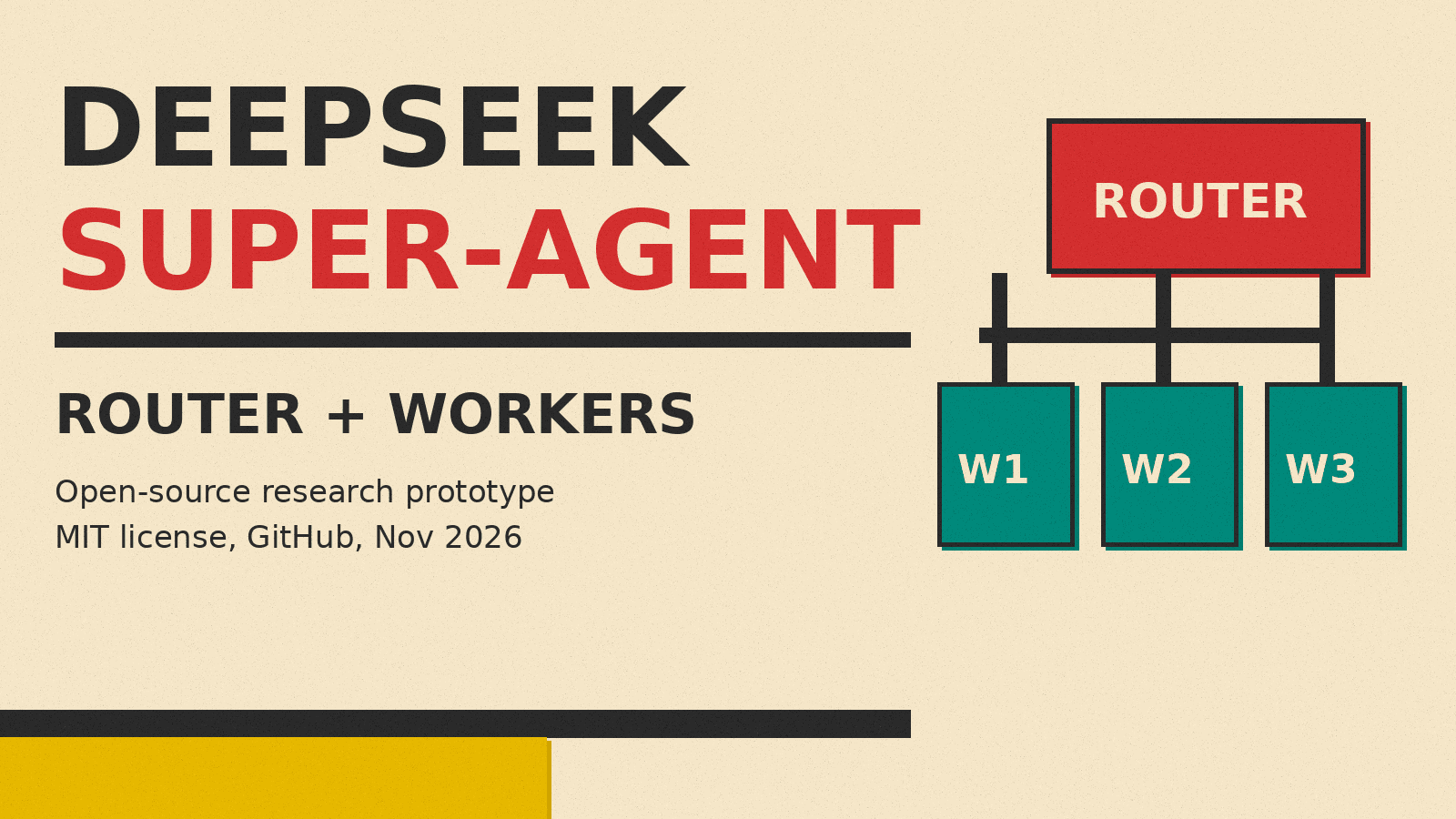
DeepSeek has published a research prototype of an always-on coding agent, plus a long design article that explains how it works. The code is on GitHub under the MIT license. DeepSeek says it is "not an official DeepSeek product." The design idea is the news: one resident "Router" agent talks to people, and many isolated "Worker" agents do the jobs.
What DeepSeek released
The repository is deepseek-ai/dsh-superagent-prototype. GitHub's API shows it was created on October 31, 2026 (UTC) and, at about 8:55 PM PT on November 4, 2026, it had 18,783 stars and 2,107 forks. It is written in TypeScript.
The README calls the code a "research prototype for reference only." It says the code grew out of the team's own work, "with much of the engineering done by coding agents." It also says the published version is not identical to DeepSeek's internal one. Some designs in the article "are directions for future development and are not implemented in this prototype."
The prototype is a bundle for DeepSeek Harness, DeepSeek's open-source agent app. The Harness site describes it as in public preview worldwide, built on an "everything is a plugin" design. The bundle watches one GitHub repository and, optionally, Feishu chat. When an allowed person asks for work, it opens a work item, runs it in its own session, and answers in the same conversation, for example with a pull request.
The design article is "Exploring Super-agent Design: Towards a More Autonomous Agent System." The DeepSeek Harness team published it in Chinese on its WeChat account on October 31, 2026, according to an unofficial English translation. That translation says it was made by AI and not reviewed by a human, so treat details as secondhand until you check the Chinese original.
The Router and Worker idea
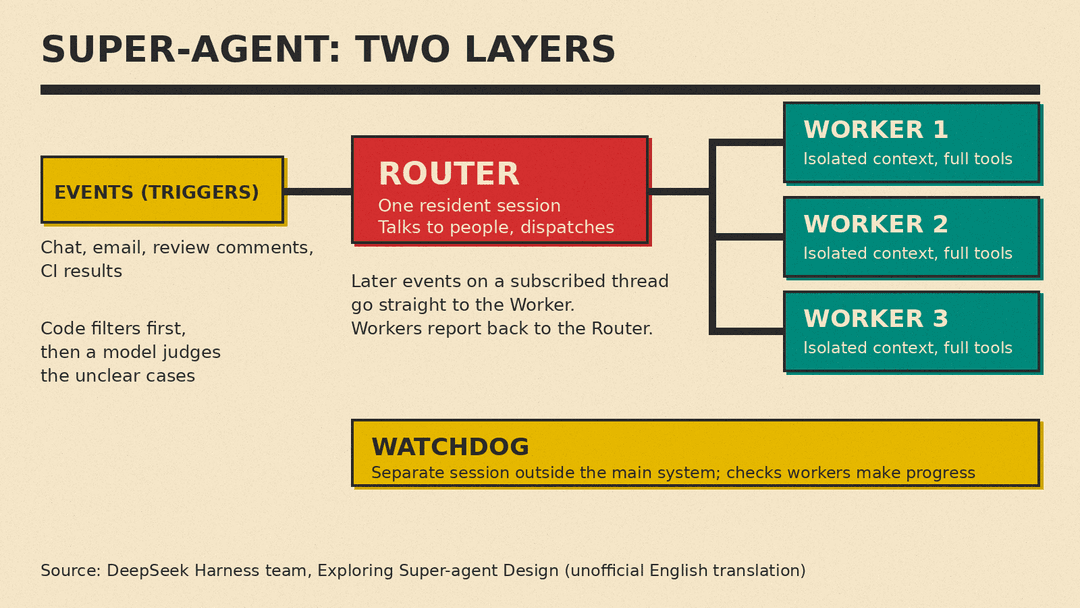
The article argues that most agents use one session as the basic unit. A person who runs several jobs at once must switch between sessions and remember each context. DeepSeek says a person can usually follow only three to five active sessions. Its answer is a "Super-agent" with two layers:
- The Router is one resident session. It handles all talk with people and decides who does what. The article says it may not even have a Bash tool.
- Workers are separate sessions with isolated context and full tools. They do one job each. They do not talk to people directly. They report to the Router, which answers on their behalf.
Three other parts of the design stand out.
- Events, not prompts. Chat messages, emails, review comments and CI results arrive as "Triggers." Code filters most of them first, using rules such as sender allowlists. A model then judges the events that pass that first check.
- Subscriptions. After the Router starts a Worker for a thread, such as one pull request, later events on that thread go straight to the Worker. The Router does not forward them.
- A watchdog. A separate session, outside the main system, checks whether workers make real progress or drift from the goal. The article says process monitors miss failures such as a model stuck in a loop or drifting from its goal.
What the numbers say
The article includes a small test. DeepSeek drove four setups with about 300 chat and CI messages per run, of which about 20 were work requests. Each setup ran five times. The coding work was replaced by a tool that only uses time, so the test measures scheduling, not coding skill. DeepSeek calls the results "preliminary."
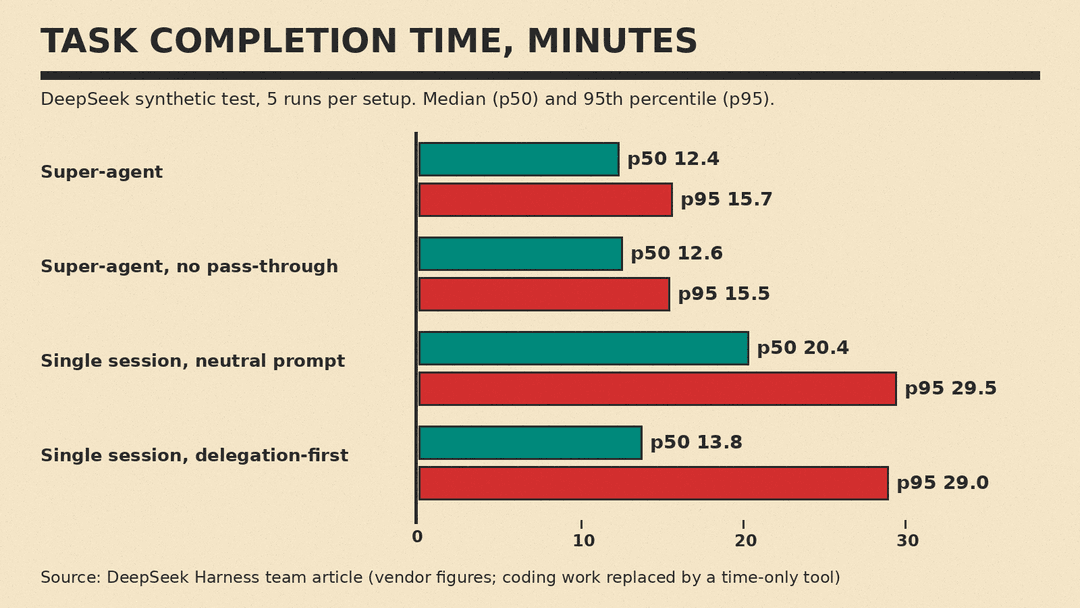
As reported in the article, the Super-agent had a median (p50) completion time of 12.4 minutes and a p95 of 15.7 minutes. Without Router pass-through, the Super-agent took 12.6 and 15.5 minutes and used 31.77 million cache-read tokens. A single session with a subagent tool and a neutral prompt had 20.4 and 29.5 minutes. With a prompt that told the model to delegate first, it had 13.8 and 29.0 minutes. DeepSeek says the neutral-prompt model never called a subagent in five runs. The Super-agent also used more cache-read tokens per run: 23.23 million, against 6.05 million and 10.82 million for the single-session setups. DeepSeek describes this as trading tokens for faster, steadier completion.
These are vendor figures from a synthetic test. They show the design can work. They do not show how it performs on real repositories.
Limits and warnings in the docs
The documents are direct about risk. The philosophy document says the agent "acts only when asked, or when a written rule allows it." Work nobody asked for starts in a mode that only records what the agent would have done. The execution document says that by default the Executor "never enables auto-merge as the agent account."
The deployment guide adds a hard warning. Both the Router and Worker presets run with danger-full-access as the operator's OS user. A worker can run programs and read the operator's home directory. For isolation, the guide advises a dedicated OS account that holds only the agent's credentials. It also says the agent needs its own GitHub user account, not a GitHub App.
The article itself lists open problems: how to scale beyond one Router, how people should work with an agent once sessions are hidden, and security and privacy. It notes that an agent fed by outside events is exposed to untrusted input.
Why it matters
DeepSeek is best known for models. This release is about the system around a model, and it builds on DeepSeek Harness, the open-source agent runtime we covered earlier. It follows other recent DeepSeek stories on this site, such as the report that V5 may train on Huawei Ascend 950 chips and a three-way model comparison that includes DeepSeek V4.1 Flash. For a different approach to agent harness design, see Factory Droid 1.0, where the model writes short scripts that call its tools.
For readers who build agents, the useful part is the written reasoning. It gives names to problems many teams hit: blocked sessions, mixed context and noisy event streams. For everyone else, the practical point is simple. This is a reference prototype with security caveats, not a product to install on a work machine without a dedicated account.
Sources
- deepseek-ai/dsh-superagent-prototype, README and repository (GitHub)
- GitHub API record for the repository (created date, stars, forks, license)
- Philosophy document, docs/000-philosophy.md
- Execution document, docs/003-execution.md
- Deployment guide, docs/006-deployment.md
- DeepSeek Harness product page (DeepSeek)
- DeepSeek Harness team, "Super-agent 设计探索" (WeChat, Chinese original, October 31, 2026)
- Unofficial AI-made English translation of the article (p2lab)
