
SemiAnalysis published a field report on November 7, 2026 about a data center campus in Inner Mongolia that it calls "China's Stargate". The authors are Everlyn Tan, Jeremie Eliahou Ontiveros, Xiaopeng Laoban and Dylan Patel. They visited the site in September. Part of the report is paywalled. The campus is named Galaxy, and its owner is Envision Group. Tom's Hardware covered the report on November 9.
What is the Galaxy campus?
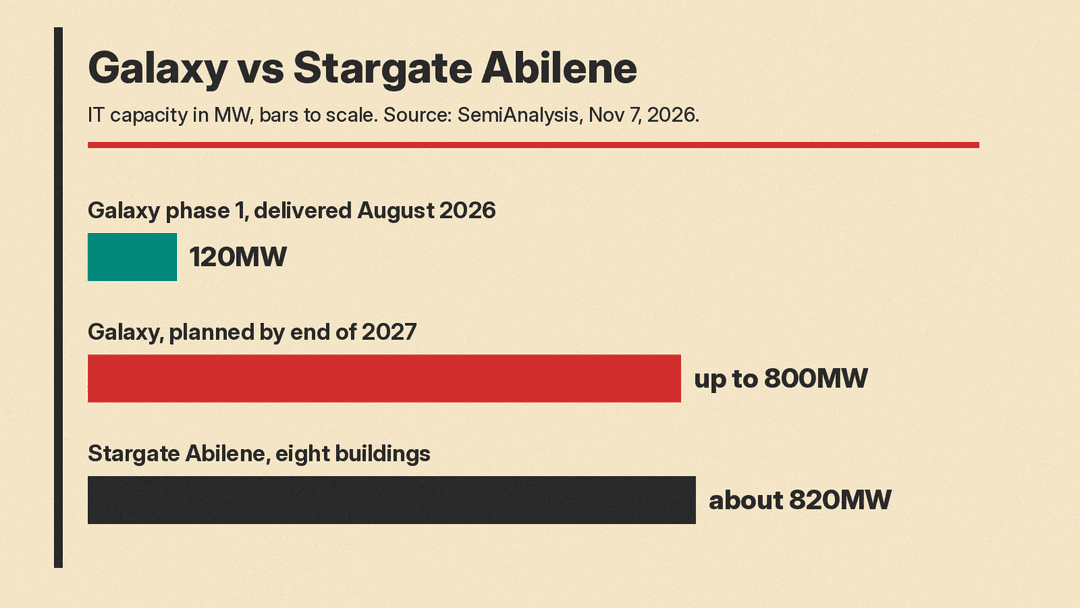
Galaxy is a campus in Ulanqab planned for up to 800MW of IT capacity. It has four phases, and all of them are built-to-suit for two internet giants that the report does not name. The first phase covers 120MW. SemiAnalysis says it was "delivered within a year at a fifth of US costs", and that the initial phase was delivered in August 2026. The full campus is expected to be completed by the end of 2027. Envision is a renewable systems integrator with more than 100GW of wind turbines installed worldwide. Its data center plans in Inner Mongolia add up to 3GW, and Galaxy is the first. Beyond running the data center, Envision builds its own wind farms and a dedicated power line to supply it.
How does Galaxy get its power?
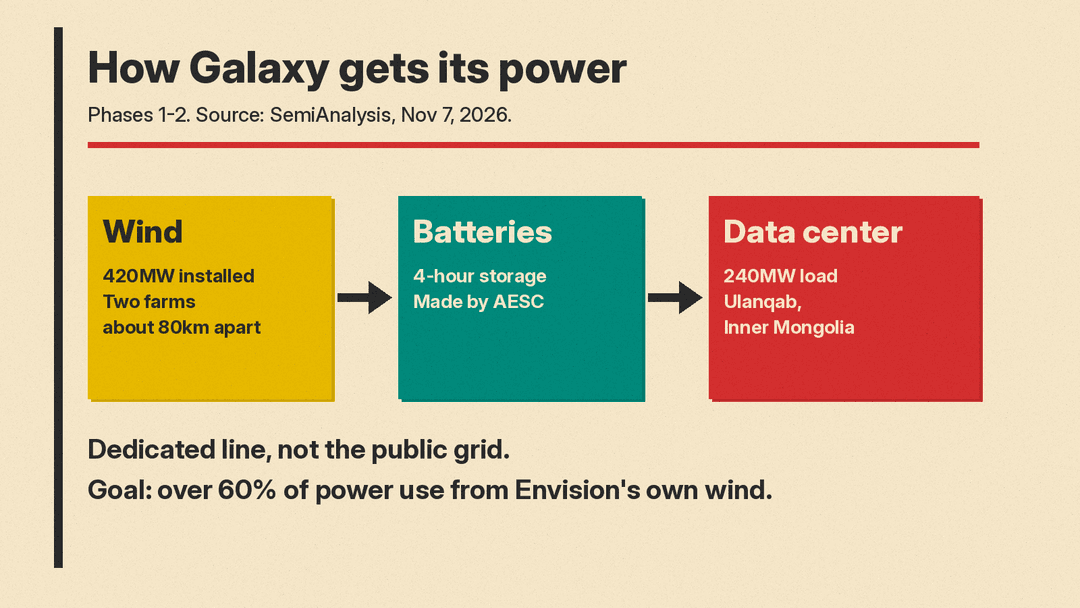
China calls this model source-grid-load-storage, or SGLS. A project builds its own wind or solar farm, its own battery storage and its own data center, and links them through a dedicated line instead of the public grid. The appeal for hyperscalers is long-term power at a largely fixed cost, and wind and solar counts toward green targets. Envision aims to supply over 60% of the power used by the first two phases with its own wind farms. Those two farms sit about 80km apart and about two hours' drive from the campus. Their combined installed capacity is 420MW, about 1.75 times the 240MW data center load. A 4-hour battery storage system shifts power from windy hours to calm ones. The batteries come from Envision affiliate AESC. Inner Mongolia holds about 57% of China's usable wind resources, and a wind farm there averages a capacity factor of roughly 32%. Ulanqab is windier, with a wind capacity factor of 35% to 40%.
What is the 800V DC pilot?
One 5MW hall runs a direct current pilot. Solid-state transformers, or SSTs, take 10kV AC from the grid and convert it straight to 800V DC for the racks. That removes the low-voltage transformers, the UPS and the rectifier stages in between. SemiAnalysis notes that the same architecture is "still on the US roadmap". 800V DC is the architecture Nvidia is pushing for its next generation of high-density racks. A larger version is planned for the next phase. Tom's Hardware notes that SemiAnalysis did not provide a measured efficiency improvement for the pilot. Roughly a quarter of Chinese data centers built in the past decade run on DC, while about 97% of US data centers still use AC UPS.
How does Galaxy compare with Stargate Abilene?
Crusoe describes Stargate Abilene in Texas as 1.2GW of power. The site is leased to Oracle, which runs it for OpenAI. SemiAnalysis says that comes to about 820MW of critical IT capacity, on par with the 800MW planned at Galaxy. A planned Crusoe expansion takes the whole Abilene site to 1.5GW of IT capacity. At Galaxy, a later phase "could take the campus to ~1GW" if the wind turbine factory next to it is converted. The two sites differ on power. Abilene draws on the grid and on gas turbines on site, while Galaxy relies largely on wind, SemiAnalysis says.
Related on llms.blog: Anthropic's reported OnePWR gas generator deal.
How is the campus cooled and built?
Liquid-cooled and air-cooled servers share one water loop, and there is no central chiller plant. SemiAnalysis says the design "has been running at scale in northern China for years". Nvidia says Vera Rubin can run on 45°C water without chillers, yet most US data centers keep a chiller. Envision also co-designed a prefabricated substation, built and tested as modules in a factory while civil work went on at the site. SemiAnalysis says this takes less than 3 months, versus about 6 months for a conventional indoor substation.
What do the China cost numbers show?
SemiAnalysis describes China's data center market as highly competitive. Rents have roughly halved over the past five years, to about $40/kW/month excluding power. Capex has fallen about 25% over the same period, to less than $3 million per MW. Power in Inner Mongolia costs about $0.055/kWh all-in. The surrounding Chahar High-tech Zone has nearly 30,000 construction workers across 22 data center projects, according to a local report cited by SemiAnalysis. Inner Mongolia has 25GW of announced data center projects, which SemiAnalysis says its next report will cover. For background on the region, see our look at how Ulanqab became the center of China's AI data center boom.
Is there local opposition?
SemiAnalysis calls Inner Mongolia the "West Texas" of China. It writes: "It's the 'West Texas' of China, but while the Lone Star State faces its highest ever anti-datacenter sentiment, Inner Mongolia is accelerating and faces no such backlash."
Related on llms.blog: Ohio votes to ban or limit data centers.
Will vertical integration pay off?
SemiAnalysis is cautious on the business model. "It is too early to say whether vertical integration will become a meaningful advantage in China's datacenter market." The report says hyperscalers still choose vendors mainly on resources and track record.
Sources
- SemiAnalysis field report on the Galaxy campus in Ulanqab, published November 7, 2026.
- Tom's Hardware coverage of the Galaxy campus, November 9, 2026.
