
Are software engineering jobs growing, or is AI shrinking them? The data in October 2026 gives a split answer. Job postings for US software developers have risen since early 2025, but they are still well below where they were before the pandemic. Federal projections still call for growth in software developer jobs, while they call for a decline in computer programmer jobs. And Stanford research finds the squeeze falls on young workers in AI-exposed jobs, mainly through less hiring.
This guide puts the main public numbers side by side, explains why they seem to disagree, and shows how to track them yourself. Every figure below links to the page it came from.
The short answer
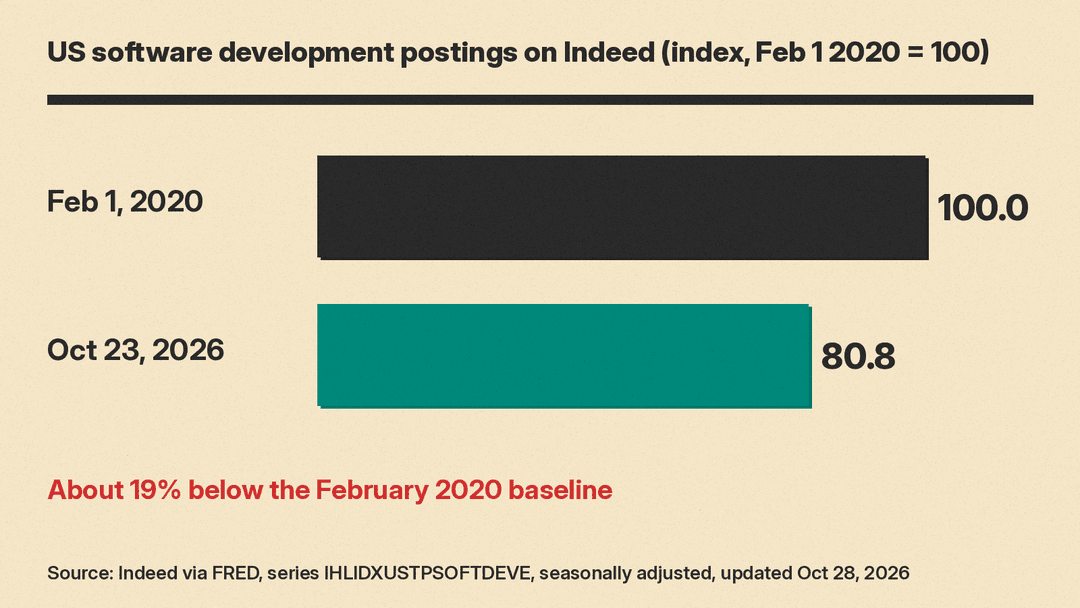
- Postings are rising from a low base. Indeed's US software development postings index stood at 80.8 on October 23, 2026, where February 1, 2020 equals 100 (FRED). That is about 19% below the pre-pandemic baseline.
- The rebound is mostly senior and AI roles. Indeed Hiring Lab found that 71% of the increase in software development postings between May 2025 and May 2026 came from senior roles, and 37% came from jobs that mention AI in their title, with the two groups overlapping (Indeed Hiring Lab).
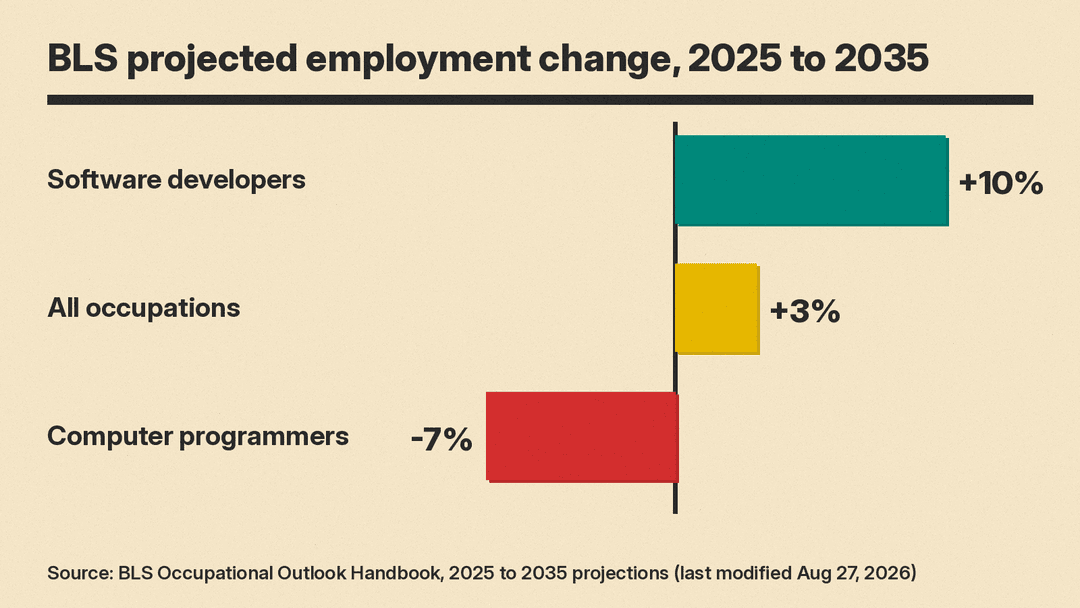
- BLS still projects growth for developers. The Bureau of Labor Statistics projects employment of software developers to grow 10% from 2025 to 2035, against 3% for all occupations (BLS).
- BLS projects a decline for programmers. Employment of computer programmers is projected to fall 7% over the same decade, and BLS names AI as one reason (BLS).
- Entry-level hiring is the weak spot. A Stanford Digital Economy Lab paper finds that employment of workers ages 22 to 25 in AI-exposed occupations "now stands 19% below where it would be had it kept pace with that of their less-exposed peers" (Stanford Digital Economy Lab).
What Indeed job postings show
Indeed publishes a daily index of job postings by occupation. The software development series is on FRED, the St. Louis Fed's data site, as IHLIDXUSTPSOFTDEVE. It is seasonally adjusted and uses a seven-day trailing average. The latest reading, updated October 28, 2026, is 80.79 for October 23.
In a July 2026 analysis, Indeed Hiring Lab economist Guillermo Gallacher wrote that US software development job postings "have grown by almost 15% since the launch of Claude Code in late February, 2025, while overall job postings fell by 7% over the same period" (Indeed Hiring Lab). The same post is careful about cause. It says "correlation does not imply causation" and notes there "were, of course, many other factors influencing the market both then and now."
Three more points from that analysis matter for job seekers:
- The starting point was low. At the time of the July post, software development postings were "about 27.5% below their pre-pandemic level, while overall job postings are essentially the same as in February 2020."
- AI-exposed jobs fell the most, then rebounded the most. Between May 2022 and May 2026, the more exposed to AI an occupation was, the more its postings declined. From May 2025 to May 2026 that pattern flipped: the more AI-exposed occupations generally rebounded the most.
- The gains are concentrated. Indeed's reading of its own senior and AI-title figures: "This suggests demand is growing for experienced professionals who can work with AI, not necessarily a broad-based recovery across all software roles."
The wider market gives context. Indeed's October 2026 labor market snapshot says its overall Job Postings Index hit 103.8 on October 16, almost 4% above the February 2020 level. It also says demand in several large tech hubs "has suffered from the pull-back in tech-related hiring," with local indexes in Seattle (67), San Francisco (72) and Santa Rosa (73) among the lowest in the nation. Those city figures cover all postings in those metros, not only software jobs.
What the BLS projections show
The Bureau of Labor Statistics publishes the Occupational Outlook Handbook, which gives 10-year employment projections and pay for each occupation. The current edition covers 2025 to 2035 and was last modified on August 27, 2026.
For software developers, quality assurance analysts and testers combined, BLS lists:
- Jobs in 2025: 1,905,400, of which software developers held 1,717,800.
- Projected growth, 2025 to 2035: 10% for the group and for developers alone, which BLS calls "much faster than the average for all occupations." Testers and QA analysts are projected at 6%.
- Openings: "About 106,100 openings for software developers, quality assurance analysts, and testers are projected each year, on average, over the decade." BLS says many of those openings come from replacing workers who change occupations or retire.
- Pay: "The median annual wage for software developers was $135,980 in May 2025." The lowest 10% earned less than $82,460 and the highest 10% earned more than $214,670.
BLS ties part of that demand directly to AI: "Demand for software developers, software quality assurance analysts, and testers is projected to be strong due to the continued expansion of software development for artificial intelligence (AI), Internet of Things (IoT), robotics, and other automation applications."
The computer programmers page tells a different story:
- Jobs in 2025: 110,800.
- Projected change, 2025 to 2035: a 7% decline, or 8,100 fewer jobs.
- Openings: about 4,400 a year, all from replacing workers who leave.
- Pay: a median of $100,390 in May 2025.
- Why: "To save time and money, many companies are expected to leverage technologies, including artificial intelligence (AI), to automate repetitive programming tasks." BLS adds that "some higher skilled programming tasks will likely shift to other workers, such as software developers."
Why the numbers seem to disagree
The sources measure different things, so they can all be right at once.
- Postings measure new demand. Indeed counts job ads. A low postings index means fewer open roles, not fewer people employed. Slower hiring does not by itself mean that existing workers lose their jobs.
- BLS projections measure total jobs over a decade. They start from 2025 employment and estimate 2035. They do not forecast the next few months of hiring.
- The job titles differ. BLS splits "software developers," who design applications and systems, from "computer programmers," who BLS says "turn the designs created by software developers and engineers into instructions that a computer can follow." Our reading: the projections suggest AI pressure falls hardest on the task of writing code to a spec, and less on the work of deciding what to build.
- Age matters. The Stanford paper finds "no evidence of widespread, economy-wide job displacement," but finds a gap for young workers in AI-exposed jobs. It says the gap "operates primarily through reduced hiring of young workers rather than increased separations," and that experienced workers "show no comparable gap." The authors describe these as "early, descriptive indicators" rather than causal estimates.
Put together, our reading is that the data points to a market where experienced engineers who work with AI are in demand, and where getting the first job is harder than it was.
The entry-level picture
If you are a student or recent graduate, the Stanford and Indeed findings point the same way. Indeed calls its senior-heavy rebound "in line with previous research focused on the disproportionate impact of AI on entry-level jobs." It adds that "the job market could still be experiencing a seniority-biased technological change."
We have covered related signals on llms.blog:
- Anthropic's junior share of tech hires fell from 27% to 9%, with tips on getting hired.
- US computer science enrollment fell 12% at four-year colleges in the National Student Clearinghouse's preliminary fall 2026 data.
What to do with this if you want a software job
The sources above do not hand out career advice, but they do describe what employers and forecasters are paying for. A few practical moves follow from them:
- Aim at the developer role, not only the coding task. BLS describes developers as people who "analyze users' needs and then design and develop software to meet those needs" and "plan how the pieces will work together." That is the part of the work its projections expect to grow.
- Learn to build with AI tools. Indeed found that 37% of the increase in software development postings came from jobs that mention AI in their title. Our AI engineer roadmap lists free courses to start.
- Show work, not only credentials. The Stanford paper finds the young-worker gap comes mainly from reduced hiring. A public project can help you stand out; see how to build an AI portfolio that gets interviews and common AI interview questions.
- Keep learning after you are hired. BLS says it plainly: "Throughout their career, developers must keep up to date on new tools and computer languages."
- Check your local market. Indeed's snapshot shows big gaps between metros, and the BLS developer page has a State & Area Data tab that points to Projections Central for state projections.
How to track these numbers yourself
All of these sources update on their own schedules, so check them before you make a decision:
- Indeed software development postings on FRED: daily index, free to chart.
- Indeed Hiring Lab AI tracker: the share of job postings that mention AI or generative AI terms, refreshed each month. The last data update was October 8, 2026.
- Indeed Hiring Lab: monthly US labor market snapshots.
- BLS Occupational Outlook Handbook: pay and 10-year projections, updated yearly.
- Stanford Digital Economy Lab: the "Canaries in the Coal Mine" paper, revised in August 2026, with a public set of AI economic indicators.
Bottom line
As of October 2026, US software engineering jobs are not vanishing, and they are not back to their old highs either. Postings are rising but remain about 19% below February 2020. BLS still projects 10% growth for software developers through 2035 and a 7% decline for computer programmers. The recovery in postings so far favors senior and AI roles, and Stanford finds that young workers in AI-exposed jobs are being hired less.
Sources
- Indeed: Software Development Job Postings on Indeed in the United States (FRED)
- Indeed Hiring Lab: AI and Job Postings: From Destruction to Creation? (July 8, 2026)
- Indeed Hiring Lab: US Labor Market Snapshot, October 2026
- Indeed Hiring Lab AI tracker on GitHub
- BLS Occupational Outlook Handbook: Software Developers, Quality Assurance Analysts, and Testers
- BLS Occupational Outlook Handbook: Computer Programmers
- Stanford Digital Economy Lab: Canaries in the Coal Mine? Six Facts about the Recent Employment Effects of Artificial Intelligence
