
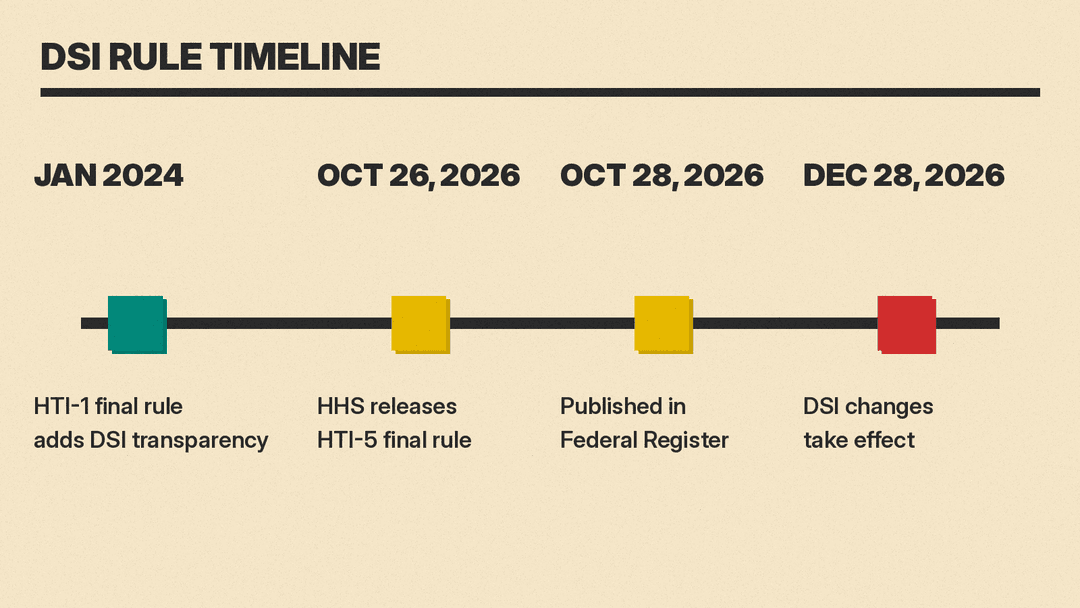
The federal government is removing a certification rule that required electronic health record software to support a "model card" for predictive AI tools built into it, so clinicians could look up how a tool was trained and how it performs. The HTI-5 final rule, released by the Department of Health and Human Services (HHS) on October 26 and published in the Federal Register on October 28, 2026 (91 FR 67916), takes effect on December 28, 2026, except for three amendatory instructions that take effect on January 1, 2027.
The rule comes from the Office of the National Coordinator for Health Information Technology (ONC), the HHS office that runs the federal certification program for health IT. ONC says that of 60 certification criteria, the final rule removes 14, revises seven and leaves 39 unchanged.
What the AI rule required
The requirement sits in the "decision support interventions" (DSI) criterion at 45 CFR 170.315(b)(11). ONC adopted its algorithm transparency requirements in the HTI-1 final rule in January 2024. In ONC's words, the criterion "ensures that users can leverage health IT for clinical decision-making by supporting their selection of both evidence-based and predictive DSIs (PDSIs) and enabling users' access to transparent information on DSI performance and quality."
In the HTI-5 rule, ONC describes what the removed parts did. The source attribute requirements "support 'model cards' for PDSIs, which essentially function as nutrition labels and provide important information for providers using a PDSI, such as how a PDSI's algorithm was trained, its intended use and limitations, and how it performs across different patient groups."
What HTI-5 changes
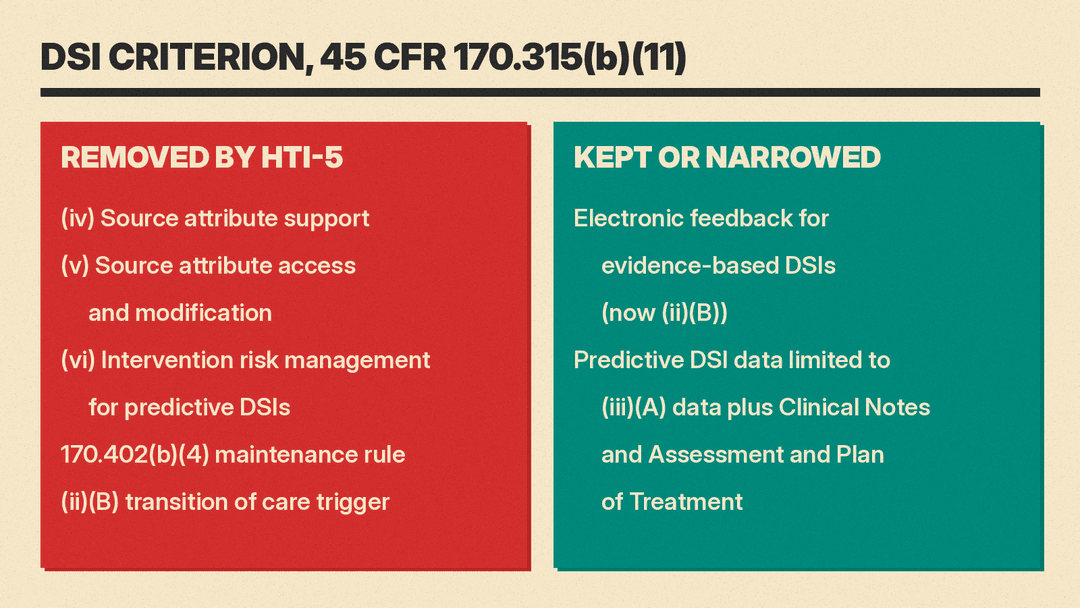
For the DSI criterion, the final rule:
- Removes the source attribute support requirements in 170.315(b)(11)(iv).
- Removes the source attribute access and modification requirements in 170.315(b)(11)(v).
- Removes the intervention risk management requirements for predictive DSIs in 170.315(b)(11)(vi).
- Removes the related maintenance rule in 170.402(b)(4), which required developers to review and update as necessary source attribute information and intervention risk management practices.
- Limits the predictive DSI data requirement to the data in 170.315(b)(11)(iii)(A) plus the Clinical Notes and Assessment and Plan of Treatment data classes.
- Removes the requirement in 170.315(b)(11)(ii)(B) and the reference to "drug-drug and drug-allergy contraindication checking" in 170.315(b)(11)(iii).
- Keeps the electronic feedback requirement for evidence-based DSIs, now numbered 170.315(b)(11)(ii)(B).
The rule also follows Executive Order 14434 in its wording. It uses "super intelligence (SI)" where earlier rules said artificial intelligence, so the federal text now refers to "the super intelligence 'model card' requirements." We covered the term change in Trump Says US Will Be 'Officially Banning' the Term AI.
What commenters said
ONC states in the rule that "A large majority of commenters were not supportive of our proposal, primarily due to concerns about removing DSI transparency and risk-management requirements." It reports that many commenters called the removal "premature since the requirements have been in effect for less than two years and have not been fully evaluated." Others said removal "would create a significant regulatory gap in SI governance at a time when SI adoption is accelerating."
The rule also lists concerns about who carries the load. Commenters said the proposal "would shift evaluation, governance, and liability burdens related to SI tools to providers and health systems," and some commenters said the burden shift would be "especially problematic for small, rural, safety-net, shared-network, community healthcare, and LTPAC organizations." LTPAC means long-term and post-acute care.
Why ONC went ahead
ONC says it found no evidence that users relied on the requirements. In its words, it "identified no evidence through peer reviewed publication or trade press indicating that users of certified health IT have relied on the transparency requirements in Sec. 170.315(b)(11) to access, record, or modify source attributes, or that the requirements have led to positive impacts on patient care." It adds that developers "have reported that during care delivery, most clinical users lack the time or technical background to engage with source attribute information for DSIs."
ONC also says removal "does not mean that such information about intended use, provenance, training data, limitations, performance, and known risks is unknown or unavailable to users." It encourages users to ask their developers for that information and reminds them of the duty to identify potential bias in predictive DSIs and avoid discrimination under 45 CFR 92.210. For the older clinical decision support source attribute rules for evidence-based tools, ONC says it "will further consider for future rulemaking whether these or similar requirements should be reinstated."
The cost case
HHS ties HTI-5 to Executive Orders 14192 and 14267 and says it "is projected to save more than $1.5 billion in regulatory costs." The rule's own estimate is a present value of cost savings of $1.55 billion and annualized net cost savings of $108.1 million, in 2024 dollars at a 7% discount rate. That figure covers the whole rule, not only the AI changes.
"American doctors and patients need better technology, not more Washington paperwork," HHS Secretary Robert F. Kennedy, Jr. said in the HHS release. National Coordinator for Health IT Tom Keane, M.D., said HHS has "taken decisive action to significantly lower the administrative compliance burden for developers."
Why it matters
The DSI changes take effect on December 28, 2026, the rule's general effective date, according to the Federal Register; the January 1, 2027 exceptions cover other criteria. From that date, ONC certification no longer requires record systems to support model card information for predictive tools. ONC says this does not stop developers from giving that information to users.
ONC encourages hospitals and clinics that want that information to ask their developers for it. ONC's own advice in the rule is that users "discuss SI quality and performance before deploying DSIs supplied by the developer of their certified health IT."
Sources
- Federal Register: HTI-5 final rule, 91 FR 67916 (October 28, 2026)
- GovInfo: HTI-5 final rule PDF
- HHS: HHS Finalizes HTI-5 Deregulatory Rule (October 26, 2026)
- ONC: HTI-5 Final Rule Overview
- Akin: ONC Issues HTI-5 Final Rule Removing Model Card and Risk Management Requirements
- Federal Register: Executive Order 14434
- eCFR: 45 CFR 92.210
