
Look for remote AI jobs with no experience and you can land on two very different things. One is real platforms that pay contractors to rate and improve chatbot answers. The other is scams that use job words such as "tasks" and "online assessor" to get people to send money. This guide explains what the real work asks of you, what the scam looks like, and how to tell them apart before you share anything. It was checked against each source in October 2026.
The short answer
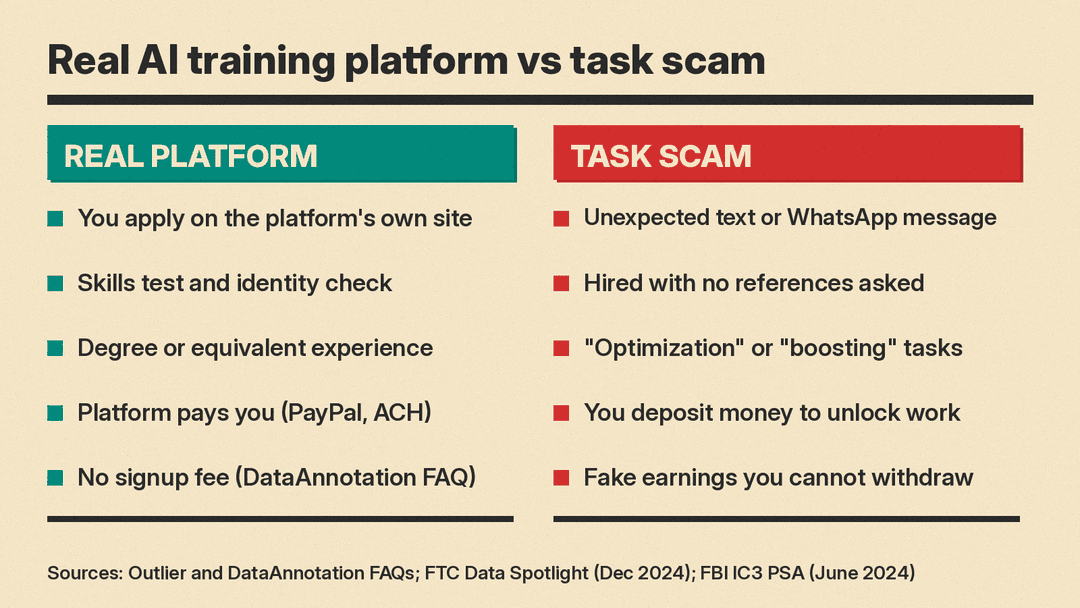
The two real platforms in this guide screen you with a skills test and pay through named methods. Outlier verifies your identity inside its own onboarding, and DataAnnotation's FAQ says it charges no signup fees. The task scam the FTC and FBI describe starts with a message you did not ask for, hires you without asking for references, and at some point asks you to pay to keep working or to withdraw "earnings". The FTC's advice for this pattern is short: "Never pay anyone to get paid."
"No experience" is also only half true on the real side. The two platforms below ask for a degree (or, at DataAnnotation, equivalent experience) and a skills test. Outlier's home page says "No AI experience needed."
What real remote AI training work looks like
AI companies pay people to check and improve model output. On the two platforms below, this is contract work, not a salaried job. Both describe their process in public FAQs that are useful as a baseline.
Outlier. Outlier's FAQ says it is "a platform operated by Scale AI that connects experts with leading AI companies to provide human feedback that improves large language models (LLMs)." Depending on your field, you "may generate prompts, rank AI outputs, improve model responses, or complete other tasks that enhance AI performance." Key points from the same page:
- Degree: "Yes, you need at least an associate degree to work on Outlier." Some projects ask for a bachelor's, master's or PhD.
- Screening: onboarding "typically takes 30 to 90 minutes" and includes skill screenings and identity verification. The FAQ calls the selection process competitive.
- Status: you work "as an independent contractor/freelancer, not as an employee of Outlier."
- Pay: rates "vary by expertise, project complexity, and location," and the FAQ says you see the tasking rate before you start a project. Payments go out weekly by PayPal, Airtm or ACH bank transfer.
- Supply of work: "Available projects vary and may not always match your specific field."
- Contact: sign-up questions go to onboarding@outlier.ai.
DataAnnotation. DataAnnotation's FAQ says the work includes evaluating chatbot responses, comparing AI outputs, flagging factual errors, testing AI-generated images, writing prompts and reviewing code. Key points:
- Degree: the baseline for general work is "a bachelor's degree or equivalent real-world experience." STEM projects need a master's or PhD (or a bachelor's plus 10 or more years of experience), and professional projects need licensed credentials in law, finance or medicine.
- No job history: the FAQ says someone "with a bachelor's degree but no formal work experience could qualify" for general projects.
- Pay: general projects start at $25 to $50 per hour, and coding projects start at $40 to $150 or more per hour, according to the FAQ. Payment is by PayPal.
- Screening: a Starter Assessment that takes about an hour for most tracks. You can take it only once.
- Fees: the FAQ says the platform "charges no signup fees."
- Supply of work: "If you qualify for our long-running projects and demonstrate high-quality work, work will be available to you." The FAQ also says that if you have not heard back, your application is likely still under review or was not accepted.
These are the platforms' own descriptions, not an endorsement or a pay guarantee. They are useful because they show what a real process includes: a public FAQ, a screening step, identity checks inside the platform, and stated pay methods. Neither FAQ describes a payment from you to start work.
What the scam looks like
The FTC calls the main pattern a task scam. Its December 2024 Data Spotlight describes it this way: you do "simple repetitive tasks such as liking videos or rating product images" in an app that shows commissions building up. Early small payouts build trust. Then you are told to deposit money to finish the next set of tasks or to get your earnings out. The FTC says: "That money isn't real. And if you deposit money, you won't get it back."
The spotlight names three common elements:
- An unexpected text or WhatsApp message offering online work "but no specifics."
- Buzzwords such as "product boosting" or "app optimization."
- A design meant to hook you, sometimes with a group chat of supposed (fake) experienced workers sharing success stories.
The FBI's Internet Crime Complaint Center described the same scheme in a June 4, 2024 public service announcement. Its red flags:
- "You are directed to make cryptocurrency payments to your employer as part of a job."
- "The job description uses the term "optimization" and involves relatively simple tasks."
- "The scammer does not require any references as part of the hiring process."
The FTC described a new text scam in an April 2026 consumer alert. It says fake recruiters claim to be with companies you might know and say they are hiring for at-home jobs like "online assessor" or "remote position," and often mention pay, sometimes daily or weekly rates, without details on the job. The new twist, per the FTC, is a request to reply "YES" or "INTERESTED" instead of clicking a link. After that, the alert says, the scammer moves to a fake check or to paid online tasks that end with a request to deposit your own money.
Fake recruiters also use real company names. The FTC's July 2025 alert on fake recruiters says they often reach out by email or text, sometimes from a personal phone number or email account. They may ask for your driver's license, Social Security or bank account number for "employment paperwork," sometimes before you even interview. It says: "Real employers won't ask for that kind of information before they've actually interviewed and hired you."
How big the problem is
The numbers below are reports. The FTC notes that most frauds are never reported, so its figures likely reflect only a fraction of the harm.
- The FTC's December 2024 spotlight says reported job scam losses topped $220 million in the first half of 2024. About 20,000 people reported task scams in that half year, compared with about 5,000 in all of 2023. Based on a sample of reports, the FTC estimated that task scams made up 38.8 percent of job scam reports in the first half of 2024.
- The same spotlight says crypto losses to job scams were about $41 million in the first half of 2024, compared with about $21 million in all of 2023.
- The Better Business Bureau's employment scams 2026 update says nearly 50,000 people reported an employment scam to BBB Scam Tracker over the last three years, and that reports doubled in 2025 over the previous year. It puts the median loss for task scams in its 2025 data at $2,300.
- BBB also says that in 2025, half of the more than 23,000 Scam Tracker reports about employment scams listed text messages as the delivery method.
Five checks before you share anything
Each check below comes from the FTC, the FBI or the platforms' own pages.
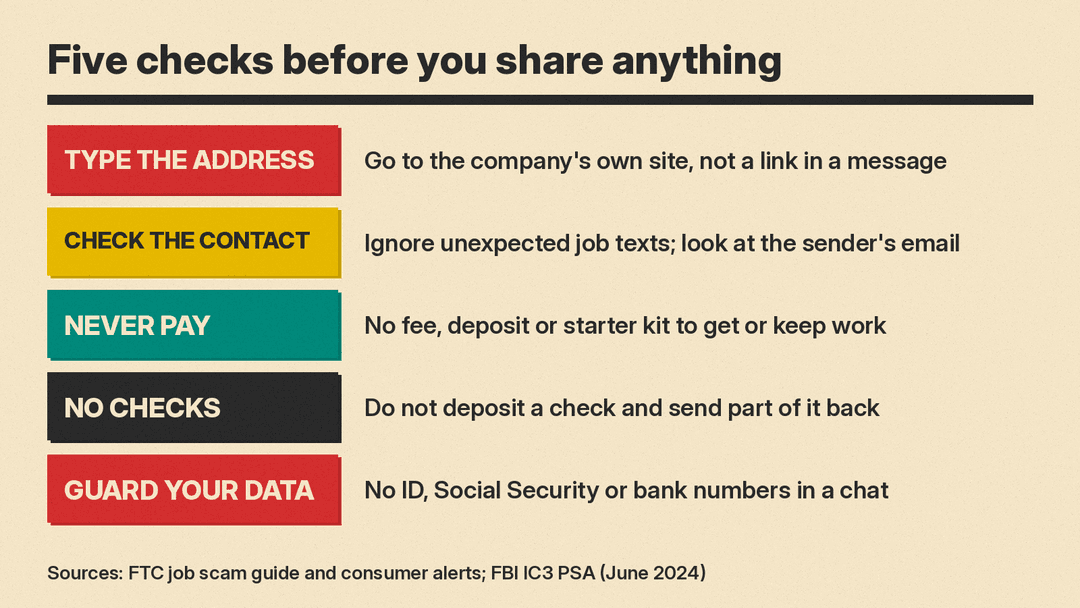
Start from an address you type yourself. An FTC alert on hijacked job ads advises that you verify openings on the organization's official website, noting that most include a careers or jobs section. For a platform like Outlier or DataAnnotation, go to its site directly instead of following a link in a message.
Look at how they reached you. The FTC's spotlight says to "Ignore generic and unexpected texts or WhatsApp messages about jobs." Its 2025 alert says recruiters generally email from a corporate account, not a personal one such as @gmail.com or @yahoo.com.
Refuse any payment to the employer. The FTC's job scams guide says: "Honest employers, including the federal government, will never ask you to pay to get a job. Anyone who does is a scammer." The FBI adds: "Never send money to an alleged employer." DataAnnotation's FAQ lists "requirements to purchase starter kits" among its red flags.
Do not deposit a check from a new employer. The FTC guide describes the fake check pattern: an employer sends a check, tells you to keep part and send the rest on or buy gift cards. The guide says the check will bounce and "the bank will want you to repay the amount of the fake check."
Keep personal data inside the real process. Outlier describes identity verification as an onboarding step on its platform. The FTC's 2025 alert says real employers will not ask for that kind of information before they have interviewed and hired you. The FBI advises: "Do not send financial or personal identifiable information to people making unsolicited job offers."
The FTC guide also suggests searching the company or recruiter name with "scam," "review" or "complaint" and talking the offer over with someone you trust. It notes that finding no complaints does not prove a company is honest.
If you already sent money
The FTC guide says that no matter how you paid, whether by debit or credit card, mobile payment app, wire transfer, gift card, cash reload card or cryptocurrency, you should immediately contact the company you used to send the money, report the fraud and ask to have the transaction reversed if possible. Report the scam to the FTC at ReportFraud.ftc.gov. The FTC also suggests reporting to your state attorney general, and the FBI asks victims to report to ic3.gov. It asks them to include any transaction information tied to the scam.
Watch for a second scam. The FBI's PSA says: "Do not pay for services that claim to be able to recover any lost cryptocurrency funds."
The bottom line
Remote AI training work exists, but on the two platforms above it is screened contract work with degree or experience requirements, and the amount of work depends on which projects are available. If an offer arrives by text, hires you on the spot, talks about "optimization" or "boosting", or asks you for money in any form, treat it as the FTC and FBI describe: a scam. If you are building toward a longer AI career, our guides to AI jobs without a CS degree and building an AI portfolio cover the next steps.
Sources
- Outlier: Frequently asked questions
- DataAnnotation: Frequently Asked Questions
- FTC: Paying to get paid: gamified job scams drive record losses (December 12, 2024)
- FTC: That job offer text is probably a scam (April 2026)
- FTC: Job scammers are looking to hire you (July 2025)
- FTC: Job Scams
- FTC: Scammers are hijacking job ads. Here's how to spot the fakes (May 2023)
- FBI IC3: Scammers Defraud Individuals via Work-From-Home Scams (June 4, 2024)
- BBB: Employment scams 2026 update
- FTC: ReportFraud.ftc.gov
