
Want to become a prompt engineer? The skill is in demand. The job title, much less so. As of October 2026, job boards that count AI postings show very few roles named "Prompt Engineer," while prompting shows up as a requirement inside many other AI jobs, most of all AI engineer roles.
This guide covers what the hiring data shows, what a real prompt engineering posting asks for, what it pays, and a practical path to build the skill with free resources from Anthropic, OpenAI, Google and DeepLearning.AI.
Is prompt engineer still a real job?
Yes, but it is a small one as a title. Three live trackers, each measured in October 2026, point the same way.
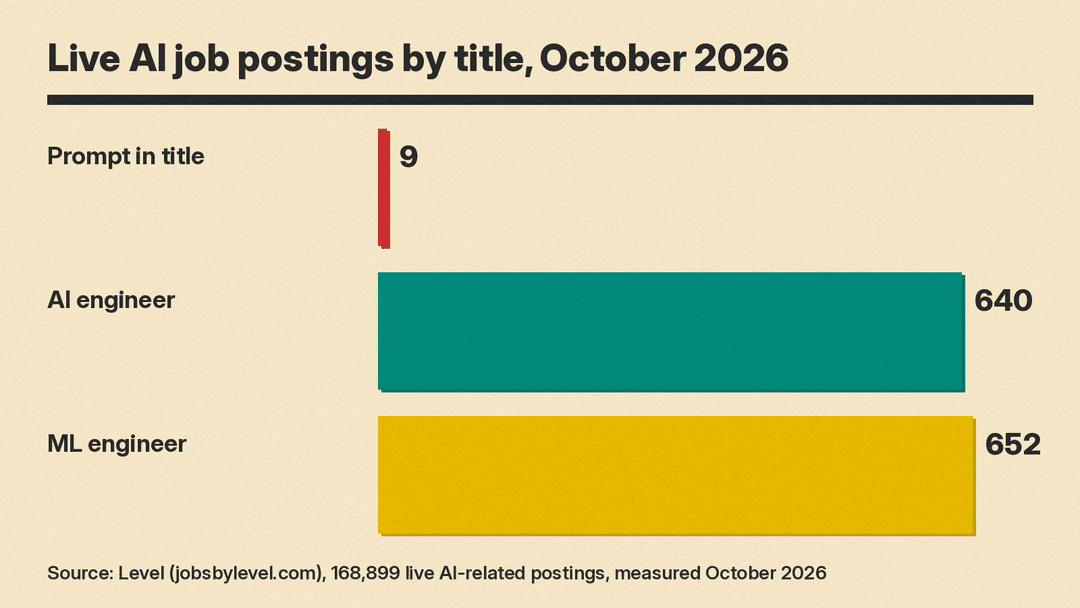
- Job titles. Level, a job board that rates postings by how much AI work they involve, says "Only 9 of 168,899 live AI-related postings put prompt in the title, against 640 for AI engineer and 652 for machine learning engineer." It adds that prompting shows up as a skill inside other roles far more often than as a standalone job.
- Open roles and pay. The AI Hiring Index from Made by Agents, built from Adzuna listings and last updated October 26, 2026, lists 111 open Prompt Engineer postings in its US view with an average advertised salary of $108,980. That count was down 17.2% from the month before. The same table lists 17,746 AI Engineer postings at an average of $179,918.
- Skill mentions. The Data Pay Index counted 850 open data and AI postings at 489 companies that mention prompt engineering, or 6.4% of the data and AI postings it tracks, as of October 28, 2026.
These numbers change every week or month, and each tracker counts differently, so treat them as a snapshot. The pattern across all three is consistent: few jobs carry the title, and many more jobs expect the skill.
Where the prompting work went
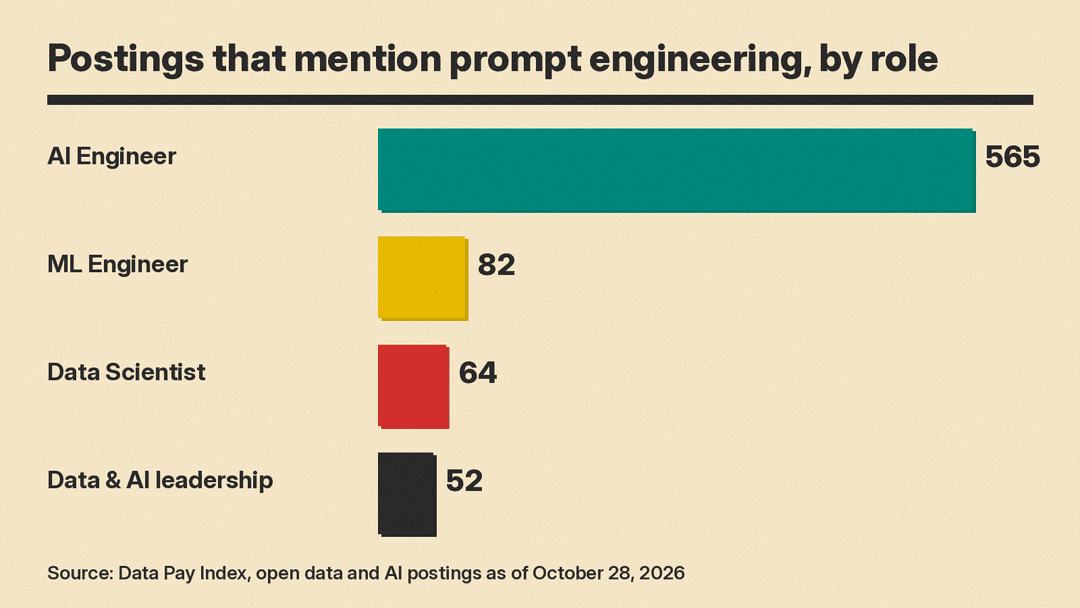
The Data Pay Index breaks down which roles ask for prompt engineering. In its October 2026 count, the largest group by far was AI Engineer, with 565 postings (14.4% of AI Engineer postings it tracks). Next came Machine Learning Engineer with 82, Data Scientist with 64, and Data and AI leadership with 52.
Labs describe the shift too. In its engineering post on context engineering for AI agents, Anthropic writes: "At Anthropic, we view context engineering as the natural progression of prompt engineering." It defines prompt engineering as "methods for writing and organizing LLM instructions for optimal outcomes." Context engineering covers what information the model sees across a longer task, such as system instructions, tools, external data and message history, not only the instruction text.
For a job seeker, that means two things. First, search for AI engineer, applied AI and LLM roles, not only "prompt engineer." Second, build skills one step past writing a good prompt: testing prompts, measuring results and feeding the model the right context.
What prompt engineer jobs pay
Pay depends heavily on how the employer defines the role. Here is what the sources above report, as of October 2026.
- Average advertised salary for the Prompt Engineer title in the US: $108,980, per the AI Hiring Index.
- Median pay for US postings that mention prompt engineering: $197K, from 275 postings with pay seen since October 18, 2026, per the Data Pay Index. Its breakdown by level shows a $190K median for senior titles and $222K for staff or lead titles. In its role breakdown, 565 of the 850 postings that mention prompt engineering are AI Engineer roles.
- One real posting: a CACI AI Prompt Engineer role on Built In lists a proposed salary range of $39,400 to $72,600, which CACI says is the national average for the position.
The gap matters. In these trackers, the Prompt Engineer title shows a lower average than the AI Engineer title, and the postings that list prompting as one skill show a higher median.
What a real posting asks for
Job ads show what employers want in their own words. The CACI posting above, which Built In labels Entry level, has a clear list.
Its listed responsibilities include:
- "Develop, refine, and iterate on prompts for various generative AI models (LLMs) to elicit desired behaviors, responses, and creative outputs."
- "Conduct testing to compare prompt variations, analyze results drive continuous improvement."
- Provide input on strategies for model fine-tuning and Retrieval Augmented Generation (RAG).
Its required qualifications include US citizenship with the ability to pass a CBP background investigation, a high school diploma or equivalent, onsite work in Ashburn, VA and/or Washington, D.C., and problem-solving and communication skills. Its desired skills include software development experience, internships or academic projects, hands-on work with large language models, any programming language such as Python or JavaScript/TypeScript, and familiarity with "few-shot, chain-of-thought, structured outputs, function calling" plus RAG concepts such as embeddings and vector databases.
Read five or ten postings in your target area and list the skills that repeat. That list is your study plan.
The skills to build
Each item below links to a free official source.
Clear instructions and structure
Every major lab publishes a prompting guide. OpenAI's prompt engineering guide defines prompt engineering as "the process of writing effective instructions for a model, such that it consistently generates content that meets your requirements." Google's Gemini API prompt design strategies page and Anthropic's prompt engineering overview cover similar ground for their models. Read all three and compare their advice.
Testing and evaluation
Employers ask for this skill by name. Anthropic's prompt engineering overview starts with a section called "Before prompt engineering," which assumes you already have "A clear definition of the success criteria for your use case" and "Some ways to empirically test against those criteria." Its companion page, Define success criteria and build evaluations, walks through tests from exact match checks to LLM-based grading. This matches the CACI line about testing prompt variations and analyzing results.
Context, tools and retrieval
Postings ask for RAG, embeddings, structured outputs and function calling. Anthropic's context engineering post explains why this matters for agents. Our explainer on writing an agent skill (SKILL.md) shows one current way teams package instructions and context for coding agents.
Some code
The higher pay figures above come from a tracker where most postings that mention prompting are AI Engineer jobs, and the CACI posting lists software development and a programming language as desired skills. Basic Python, calling a model API and reading JSON are a practical place to start.
A free learning path
Work through these in order. Each one is free to start, as of October 2026.
- Anthropic's Prompt Engineering Interactive Tutorial. The GitHub course is broken into "9 chapters with accompanying exercises," plus an appendix, and each lesson has an "Example Playground" where you can change prompts and see how the responses change. The README notes the tutorial uses Claude 3 Haiku, an older model, so check current model names in Anthropic's docs.
- ChatGPT Prompt Engineering for Developers. This DeepLearning.AI short course, taught by Isa Fulford (OpenAI) and Andrew Ng, is listed as Beginner, 1h40m, with 9 video lessons and 7 code examples. The page offers "Learn for Free," with a paid PRO plan for an accomplishment.
- The official guides. Read the OpenAI, Google and Anthropic pages linked in the skills section, then rewrite one of your own prompts using each guide's advice.
- Prompt Engineering Guide. The Prompt Engineering Guide collects techniques such as zero-shot, few-shot and chain-of-thought prompting, plus sections on RAG, function calling and context engineering. Use it as a reference when a posting names a technique you do not know.
- Evaluations. Finish with Anthropic's success criteria and evaluations page and build one small test set for a task you care about.
How to prove the skill to an employer
A certificate says you watched a course. A project shows you can do the job. Build one or two small projects that match the posting language:
- A prompt comparison. Pick one task, such as summarizing support tickets. Write three prompt versions, run each on the same 20 to 50 examples, score the outputs against written criteria, and publish the results and your reasoning.
- A small RAG app. Answer questions over a set of public documents, and show how you checked that answers cite the right passages.
- A structured output tool. Turn messy text into clean JSON with a schema, and track how often the output is valid.
Put each project in a public repo with a short write-up. Our guide on building an AI portfolio that gets interviews covers how to present it, and our list of AI interview questions helps you prepare for the conversation that follows.
Who should aim for the title, and who should not
Aim for roles titled prompt engineer if you like writing and testing, and you want a first AI job without much coding. Expect a narrow market and a wide pay range, and read each ad closely to see whether the job is really evaluation, content or engineering work.
If you can code, or are willing to learn, aim at AI engineer and applied AI roles and treat prompting as one strong skill on your resume. That is where the trackers above show most of the postings that ask for it.
Sources
- Level: Are AI prompt engineers in demand?
- Made by Agents: AI Hiring Index
- Data Pay Index: Prompt engineering jobs, demand and pay
- CACI: AI Prompt Engineer posting on Built In
- Anthropic: Effective context engineering for AI agents
- Anthropic: Prompt engineering overview
- Anthropic: Define success criteria and build evaluations
- Anthropic: Prompt Engineering Interactive Tutorial
- OpenAI: Prompt engineering guide
- Google: Prompt design strategies (Gemini API)
- DeepLearning.AI: ChatGPT Prompt Engineering for Developers
- Prompt Engineering Guide
