
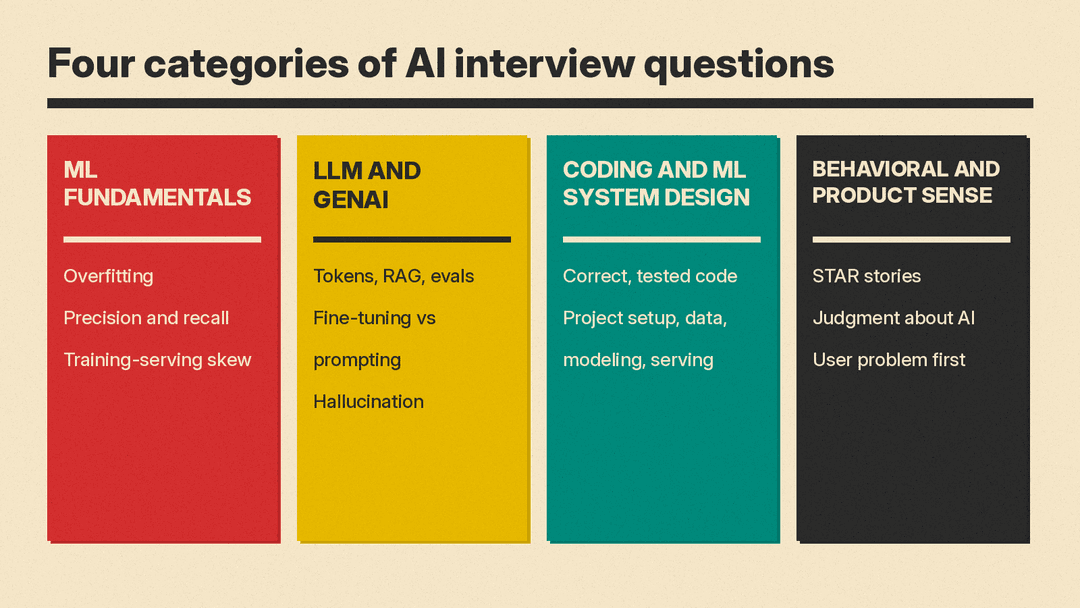
This guide groups common AI and ML interview questions into four categories: ML fundamentals, LLM and GenAI, coding and ML system design, and behavioral and product sense. The categories draw on Chip Huyen's ML interview book and the interview pages of OpenAI, Anthropic and Amazon, all linked below. For each category, the guide says what a strong answer covers and points to free, primary material. It is written for ML engineers, AI engineers who build LLM apps, data scientists, and people moving into non-engineering AI roles.
The questions below are typical topics, not quotes from any company's interviews. Company process details come from each company's own careers pages, as of October 2026. Processes change, so read the page for the role you apply to.
What the interview loop looks like
Chip Huyen's free Introduction to Machine Learning Interviews book says the ML interview pipeline "evolved out of the tried-and-true software engineering interview pipeline." It also says companies split topics across interviewers: "One interviewer might ask you about theories, a couple about coding, one about ML systems design." The same page adds: "No company expects you to know everything."
Company pages describe similar stages:
- OpenAI. The OpenAI interview guide lists application and résumé review, introductory calls, a skills-based assessment, final interviews and a decision. It says assessment formats "vary by team and may include: pair coding interviews, take-home projects, technical tests, etc." It says candidates typically go through four to six hours of final interviews with four to six people over one to two days.
- Anthropic. The Anthropic careers page says "All interviews are conducted over Google Meet." It says: "For technical roles, we use live coding tools like Colab and CodeSignal." It also says "You can look things up" and asks candidates to be comfortable with basic syntax and standard libraries. For non-technical roles, it says "interviews are conversational."
- Amazon. The Amazon interview loop page says "Each person will assess different aspects of your skills and experience." The Amazon SDE II interview prep page describes an online assessment, then "four 55-minute interviews" for that role.
AI tools in interviews. Check the rules before you start. OpenAI says expectations for AI tools vary by interview: "some formats intentionally allow them, while others are designed to assess your independent problem-solving without AI tools." Anthropic's guidance on candidates' AI usage (last updated Jul 10, 2025) says live interviews have "no AI assistance unless we indicate otherwise." For take-home assessments it says: "Complete these without Claude unless we indicate otherwise." It encourages candidates to "Use Claude to research Anthropic, practice your answers, and prepare questions for us."
ML fundamentals
These questions check that you understand how models learn and how to measure them.
Common topics:
- Overfitting. What it is, how you detect it, and how you reduce it. The Google ML glossary defines overfitting as "Creating a model that matches the training data so closely that the model fails to make correct predictions on new data." A good answer names the signal (training metrics improve while validation metrics get worse) and fixes such as regularization, more and more varied data, or a simpler model. The glossary says "Regularization can reduce overfitting."
- Precision and recall. When to use which. The glossary defines precision by the question "When the model predicted the positive class, what percentage of the predictions were correct?" and recall by "When ground truth was the positive class, what percentage of predictions did the model correctly identify as the positive class?" A good answer ties the choice to the cost of a false positive versus a false negative in the product.
- Data splits and leakage. Why you keep training, validation and test sets apart, and how information from the test set can leak into training.
- Training-serving skew. The glossary defines training-serving skew as "The difference between a model's performance during training and that same model's performance during serving." A good answer gives causes, such as different feature code paths or a shift in input data after launch.
- Model choice. When a linear or tree model is enough, and when a neural network is worth the cost.
What interviewers look for here is depth, not vocabulary. Huyen's technical skills section says "You should understand ML beyond citing buzzwords" and "Ideally, you should be able to explain every architectural choice you make."
How to prepare. Google's Machine Learning Crash Course is free and modular. Its Classification module covers "thresholding, confusion matrices, and metrics like accuracy, precision, recall, and AUC." Its Datasets, Generalization, and Overfitting module covers dataset preparation and overfitting. Part two of Huyen's book has "over 200 knowledge questions," each marked with a difficulty level.
LLM and GenAI
These questions are for roles that build on large language models. They test whether you can build on a model you did not train, and whether you know where it fails.
Common topics:
- Tokens and context windows. What a token is and why it matters for cost and limits. The glossary says a token is "the atomic unit that the model is training on and making predictions on," and a context window is "The number of tokens a model can process in a given prompt." The Intro to Large Language Models module in the Crash Course says that for English "one token corresponds to ~4 characters or about 3/4 of a word." A good answer connects tokens to pricing, latency and truncation.
- Hallucination. What it is and how you reduce it. The glossary defines hallucination as "The production of plausible-seeming but factually incorrect output by a generative AI model that purports to be making an assertion about the real world." A good answer names more than one control: grounding with retrieved sources, asking for citations, constraining the output format, and measuring the hallucination rate on a test set. Our AI hallucinations explainer covers this in more depth.
- RAG. How retrieval-augmented generation works and when to use it. The glossary calls RAG "A technique for improving the quality of large language model (LLM) output by grounding it with sources of knowledge retrieved after the model was trained." A good answer walks through chunking, embedding, retrieval, ranking and the prompt, then says how you would test retrieval quality separately from answer quality. See our plain-English RAG explainer.
- Fine-tuning versus prompting. When each fits. The glossary defines fine-tuning as "A second, task-specific training pass performed on a pre-trained model to refine its parameters for a specific use case." A good answer starts with prompting and retrieval because they are cheaper to change, and moves to fine-tuning when you need a consistent format, style or behavior that prompts do not give, and you have enough good examples. It also says how you would compare the options on the same evaluation set.
- Evals. How you would know a change made the system better. A good answer describes a fixed set of test inputs with expected results, automatic checks where possible, human review or a model grader where not, and a rule to run the set before every prompt or model change. Huyen's ML systems design notes warn that "Evaluation can be very difficult for generative models."
How to prepare. Take the Crash Course LLM module (its page lists an estimated length of 45 minutes). Then build one small LLM app with retrieval and an eval set, and be ready to explain every design choice in it. Our AI engineer roadmap and our list of free AI agent courses cover what to build and where to learn it.
Coding and ML system design
All three company pages above describe coding work for technical roles. OpenAI lists pair coding interviews among its assessment formats, and Anthropic uses live coding tools. Amazon's SDE II prep page says: "Expect to be asked to write syntactically correct code" and asks candidates to "check for edge cases and validate that no bad input can slip through." OpenAI's guide says: "For engineering interviews, we generally look for well-designed solutions to the challenge, high-quality code, optimal performance, and good test coverage." For ML roles, Huyen's technical skills section says: "Aspects of computer science that are more relevant to ML include algorithms, data structures, time/space complexity, and scalability."
ML system design questions are open-ended prompts, such as how you would build a fraud detection algorithm or a recommendation system. Huyen collects open-ended ML system design exercises and notes that "many questions are ambiguous on purpose." Her book says these are "the questions that candidates often find to be the hardest." Amazon's SDE II page says to "Expect at least one question on software systems design."
A strong answer follows the four components in Huyen's design a machine learning system chapter: "project setup, data pipeline, modeling (selecting, training, and debugging your model), and serving (testing, deploying, maintaining)."
- Project setup. Ask about goals, user experience, performance constraints, evaluation and personalization before you name a model. Huyen writes: "Before you even say neural network, you should first figure out as much detail about the problem as possible."
- Data pipeline. Where the data and labels come from, how fresh they must be, and how you handle privacy and bias.
- Modeling. Start with a simple baseline, then say what you would try next and why.
- Serving. Latency and cost targets, how you test before launch, how you monitor after launch, and when you retrain.
For an LLM app, the same structure applies. In the modeling step, you choose a model, prompt, retrieval setup and guardrails instead of training a model, and you add the eval set from the LLM and GenAI section.
Behavioral and product sense
Behavioral questions ask about past work: a hard project, a failure, a disagreement, a time you used data to decide. Amazon's SDE II page says "A significant portion of the conversation will focus on how you've demonstrated our Leadership Principles in your past jobs."
The same page says "past behavior is an indicator of future success," and Amazon's interview loop page says "One way to structure your responses is the STAR method." STAR stands for Situation, Task, Action and Result. The page asks candidates to focus on their individual contributions and to use "I" instead of "we." Its sample questions include "How have you used data to develop a strategy or make a decision?"
For AI roles, prepare stories that show judgment about AI itself:
- A time a model or AI feature did not work as expected, how you found out, and what you changed.
- A time you chose not to use AI, or chose a simpler model, and why.
- How you explained a model's limits to a non-technical stakeholder.
Product sense questions ask how you would add AI to a product. A good answer starts with the user problem, says how you would measure success, names the failure modes (wrong answers, cost, latency, privacy), and says what a first, small version would be.
For non-technical roles, Anthropic's careers page says it looks for "people who bring clarity, judgment, and a genuine interest in the mission." OpenAI's guide says it cares about "collaboration, effective communication, openness to feedback, and alignment with our mission and values." Expect questions about why you want to work on AI at that company.
A prep plan
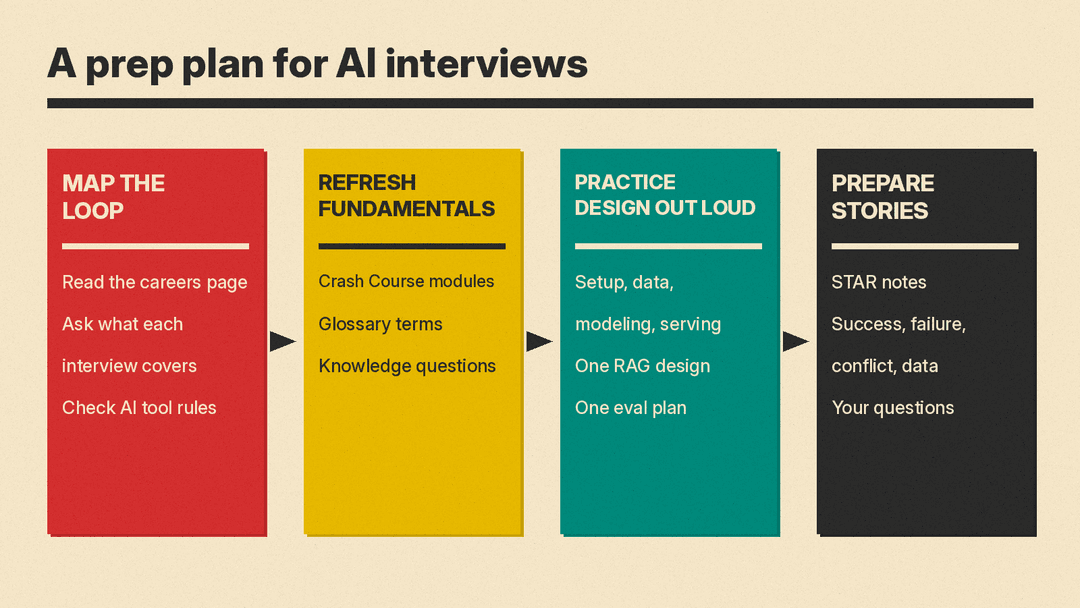
Map the loop. Read the careers page and the job description for the role. Ask your recruiter which skills each interview covers. Huyen's do's for ML interviews include: "Ask your interviewer what skills they are trying to assess so you can tailor your answers." Check whether AI tools are allowed in each stage.
Refresh fundamentals. Work through the Crash Course modules you are weakest in, including the LLM module. Use the Google ML glossary to check that you can define each term in one or two plain sentences. Then answer the knowledge questions in Huyen's book for your level.
Practice design out loud. Pick an exercise from Huyen's list and talk through project setup, data pipeline, modeling and serving with a timer running. Her do's list says "Think out loud" and suggests mock interviews with friends. For LLM roles, rehearse one RAG design and one eval plan.
Prepare stories. Write short STAR notes for a set of past projects that show different strengths: a success, a failure, a conflict, and a decision you made with data. Review everything on your résumé, since Huyen's list also says interviewers might want to know all the details. Prepare questions for each interviewer.
If you are still choosing a learning path, our guide to AI certifications worth getting compares cost and format.
Common mistakes
- Naming a model before you understand the problem in a design question.
- Listing terms without explaining the tradeoff behind them.
- Claiming tools or courses you cannot discuss in depth. Huyen's do's list warns: "Everything you mention in an interview will be fair-game for the interviewer to ask."
- Using AI tools in a stage where the company does not allow them.
- Telling team stories with "we" and never saying what you did.
Sources
- Google Machine Learning Crash Course
- Google Machine Learning Crash Course: Intro to Large Language Models
- Google Machine Learning Glossary
- Chip Huyen, Introduction to Machine Learning Interviews
- Chip Huyen, Interview pipeline
- Chip Huyen, Technical skills
- Chip Huyen, Do's for ML interviews
- Chip Huyen, Design a machine learning system
- Chip Huyen, ML systems design exercises
- OpenAI interview guide
- Anthropic careers
- Anthropic guidance on candidates' AI usage
- Amazon interview loop
- Amazon SDE II interview prep
