
Yes, you can get an AI-related job without a computer science degree, but the path is narrow. Employers have dropped degree lines from many job ads, yet hiring data shows the change in who actually gets hired is small, and among jobs that usually call for a college degree, those that ask for AI skills are more likely to ask for a four-year degree.
This guide covers what the hiring data says, which entry routes are documented by employers and government agencies, and how to show skills when you do not have the diploma. Every claim links to the page it comes from. Figures are as of October 2026.
What the hiring data says
Three sets of data point in slightly different directions, and it helps to read them together.
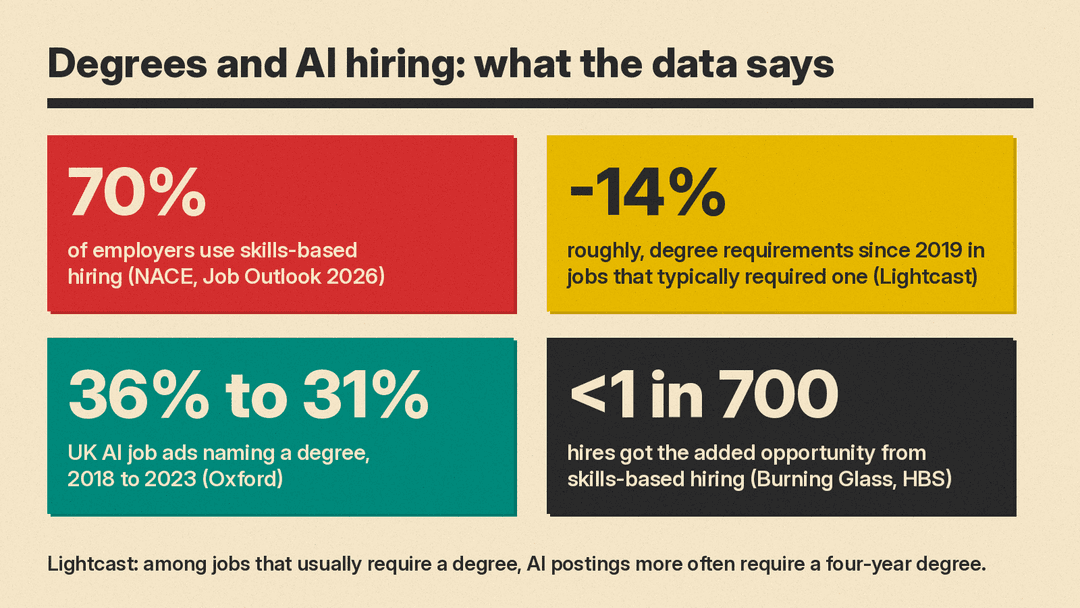
Skills-based hiring is growing. In the National Association of Colleges and Employers (NACE) Job Outlook 2026 survey, 70% of employers said they use skills-based hiring, up from 65% the year before. NACE also reports that screening by GPA fell from 73% of employers in 2019 to 42% in the 2026 survey.
Degree requirements are falling overall. Labor market analytics firm Lightcast found that degree requirements are down roughly 14% since 2019 in US jobs that have typically required college degrees.
But AI jobs still ask for degrees more often. The same Lightcast analysis, published September 2026, found that among traditionally college-educated jobs, "postings that require AI are actually more likely to require a four-year degree than those that do not." Lightcast counts a job as an AI job if it asks for at least one of its 300+ AI skills, and says over 50% of those jobs are not in the tech industry. One of its explanations: AI may be layered on top of a profession, such as healthcare or finance, that keeps its own education requirements.
There is one bright spot in that report. Within IT and computer science, Lightcast says degree requirements for both AI engineers and AI jobs overall are down since 2019, with "a clear decline since 2024."
Removing the degree line is not the same as hiring without one. A February 2024 report from the Burning Glass Institute and Harvard Business School found that the annual number of roles from which employers dropped degree requirements rose almost fourfold from 2014 to 2023. But it concluded that the added opportunity from skills-based hiring showed up in "not even 1 in 700 hires last year." The institute's summary says many companies announced dropping degree requirements, "but sustained hiring changes remain elusive for most."
In the UK, degree requirements for AI roles have also come down. An Oxford Internet Institute study of over 10 million UK job ads found that the share of AI job postings that specified a degree fell from 36% in 2018 to 31% in 2023. It also estimated a 23% wage premium for AI skills, compared with 13% for a master's degree and 33% for a PhD. The full paper is in Technological Forecasting and Social Change.
The practical takeaway: a missing degree will not stop every application, but you need something else that proves you can do the work.
Routes into AI-related work without a CS degree
These are entry routes that an employer or government agency documents on its own page. None of them is a guarantee of a job.
Data analyst roles
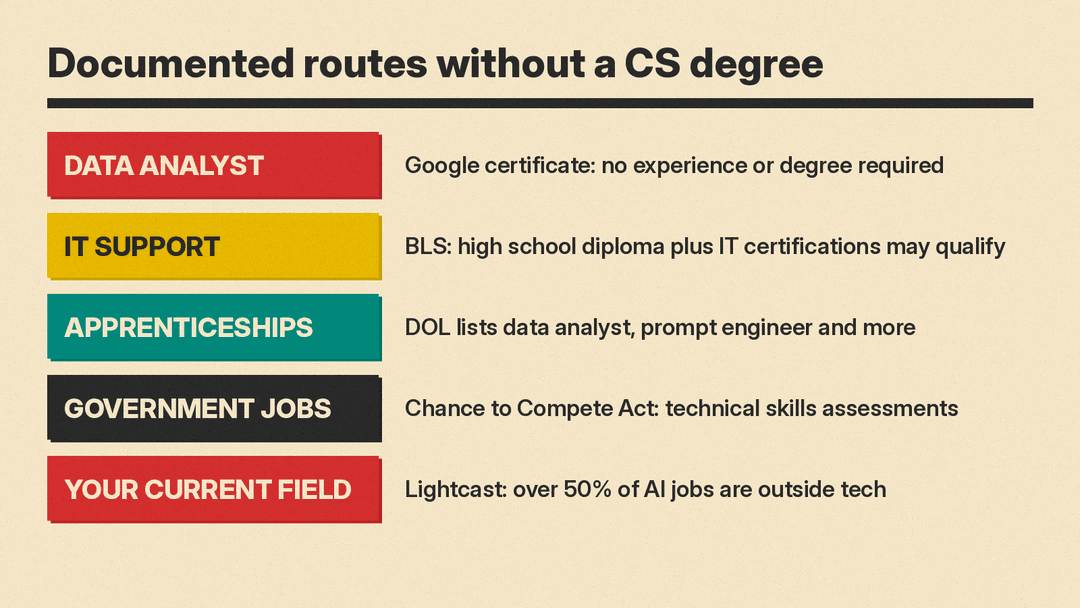
Data analysts prepare, process and analyze data, and Google's certificate now includes training on using AI for that work. Google's Data Analytics Certificate page says "No experience or degree required" for its entry track, and lists target titles such as data analyst, junior data analyst, associate data analyst, operations analyst and business systems analyst.
Google says the certificate takes about 240 hours, or three to six months depending on weekly hours, and costs $49 per month in the US and Canada after a 7-day free trial. It says graduates can connect with over 150 US employers in its hiring consortium, which it describes as "committed to considering" certificate graduates for entry-level jobs. That is a promise to consider, not to hire.
IT support and help desk
Help desk work is an entry point that BLS documents without a degree requirement, and it is also a job that AI is changing. The US Bureau of Labor Statistics (BLS) says user support specialists typically need to complete some college courses, but "candidates may qualify with a high school diploma plus relevant information technology (IT) certifications." BLS lists the May 2025 median pay for computer user support specialists at $61,860.
Be clear-eyed about the outlook. BLS projects employment of computer user support specialists to decline 3% from 2025 to 2035, "as organizations continue to implement automated tools, such as chatbots, for troubleshooting." It still projects about 48,700 openings per year for computer support specialists overall, all from people leaving or changing jobs. BLS also notes that many support specialists later move into roles such as information security analyst, systems administrator or software developer.
Registered apprenticeships
An apprenticeship pays you while you train. The US Department of Labor's technology apprenticeship page says more than 58,000 registered apprentices were served across technology, cybersecurity and AI-related occupations in 2025. It lists occupations including application developer, customer service tech support, cybersecurity support technician, data analyst, IT generalist, IT project manager, network support technician, prompt engineer and software developer.
The department has also launched an AI in Registered Apprenticeship portal for organizations building AI-focused programs. Its list of national program sponsors for AI-centric occupations includes groups such as Apprenti, CareerWise and Step IT Up America. These pages are written for employers, but the sponsor names are a useful list to search for open apprentice roles.
Employer apprenticeships such as IBM's
Some large employers run their own programs. IBM describes its apprenticeship program as "a full-time, earn-and-learn program for individuals who don't have a 4-year bachelor's degree in the field they're pursuing, but have acquired knowledge in the domain." Note that last part: you are still expected to arrive with some skills. IBM points candidates to its SkillsBuild, Coursera and Skills Gateway courses to build them.
Government jobs
Public employers have written skills-based hiring into law and policy. The federal Chance to Compete Act of 2024, signed in December 2024, tells examining agencies, for the first three years after enactment, to give preference, "to the maximum extent practicable," to technical assessments of job-related skills when they test applicants for competitive service positions. The Office of Personnel Management's implementation plan describes this as the federal government's "transition to skills-based hiring."
Some states made similar moves. In January 2023, Pennsylvania Governor Josh Shapiro announced that 92 percent of state government jobs, about 65,000 positions, do not require a four-year college degree, and the state launched a website listing open jobs that do not need one.
AI skills inside the job you already have
Lightcast's finding that over half of AI jobs sit outside the tech industry cuts both ways. Those roles often keep the degree or license of the underlying profession. But if you already work in marketing, operations, customer support, healthcare administration or another field, adding AI skills to that job may be a shorter path than switching into a new title. The Oxford study's 23% AI skills premium is an estimate from UK job ads, not a raise anyone is promised.
Which AI jobs usually still want a degree
Lightcast says that, like other career areas, "AI jobs in tech are more likely to require a college degree." It splits IT and computer science jobs into AI engineers, who "would have the most expertise," non-engineer AI jobs and non-AI jobs. Degree requirements for AI engineers have come down since 2019. Lightcast notes that AI workers, especially AI engineers, are highly educated, but says "the degree itself might be less of a prerequisite for their jobs than their actual expertise."
How to prove skills without the diploma
Since the Burning Glass report shows that dropping the degree line rarely changes the final hire on its own, the work is to make your skills easy to check.
- Build a small public portfolio. Show finished projects with clear write-ups. Our guide on how to build an AI portfolio that gets interviews covers project ideas by level and free demo hosting.
- Pick a credential that matches a target title. Google's data analytics certificate, for example, names the entry-level titles it prepares you for. See our list of AI certifications and who each one fits.
- Prepare for skills tests. NACE says employers use skills-based hiring most often during interviewing (87%) and screening (65%). Our AI interview questions guide covers what technical rounds ask.
- Look at apprenticeships. IBM describes its program as "earn-and-learn," so you are paid while you train.
- Learn for free first. Before paying for anything, test your interest with our list of free AI courses. If you want the longer technical route, our AI engineer roadmap lays out the steps.
Watch for fake task jobs
Job offers for easy work from home that ask for no degree and no experience can also be scams. The FBI's Internet Crime Complaint Center warns about fake work-from-home jobs built around simple tasks such as rating restaurants or "optimizing" a service by clicking a button, where victims are told to make cryptocurrency payments to "unlock" work. Its red flags include being asked to pay your employer in cryptocurrency and a hiring process that asks for no references. Its advice is plain: "Never send money to an alleged employer." Our guide to remote AI jobs with no experience compares what real AI training platforms ask for with how task scams work.
A real employer pays you. If a job offer arrives unprompted by text or chat and asks you to deposit money first, it is not a job.
The bottom line
A CS degree is no longer a hard gate for every AI-related job, and federal and some state employers have written skills-based hiring into law and policy. But the data shows employers move slowly in practice, and among jobs that usually call for a degree, AI jobs are still more likely to ask for one. The routes with the clearest documentation are data analyst certificates, IT support, registered apprenticeships, government jobs and adding AI skills to work you already do. In each case, what gets you hired is proof you can do the work.
Sources
- NACE: Employer Use of Skills-Based Hiring Practices Grows
- Lightcast: Degree Requirements are Dropping, But They're Still Higher for AI Jobs
- Burning Glass Institute and Harvard Business School: Skills-Based Hiring, The Long Road from Pronouncements to Practice
- University of Oxford: Skills-based hiring driving salary premiums in AI sector
- Technological Forecasting and Social Change: Skills or degree? The rise of skill-based hiring for AI and green jobs
- Google Data Analytics Certificate
- BLS Occupational Outlook Handbook: Computer Support Specialists
- Apprenticeship.gov: Technology
- Apprenticeship.gov: AI in Registered Apprenticeship
- US Department of Labor: AI in Registered Apprenticeship portal launch
- Apprenticeship.gov: Three Options to Integrate AI in Registered Apprenticeship Programs
- IBM: The IBM Apprenticeship Program
- Chance to Compete Act of 2024 (Public Law 118-188)
- OPM: Chance to Compete Act implementation plan
- Pennsylvania Governor's Office: 92 Percent of Commonwealth Jobs Do Not Require a Four-Year Degree
- FBI IC3: Scammers Defraud Individuals via Work-From-Home Scams
