
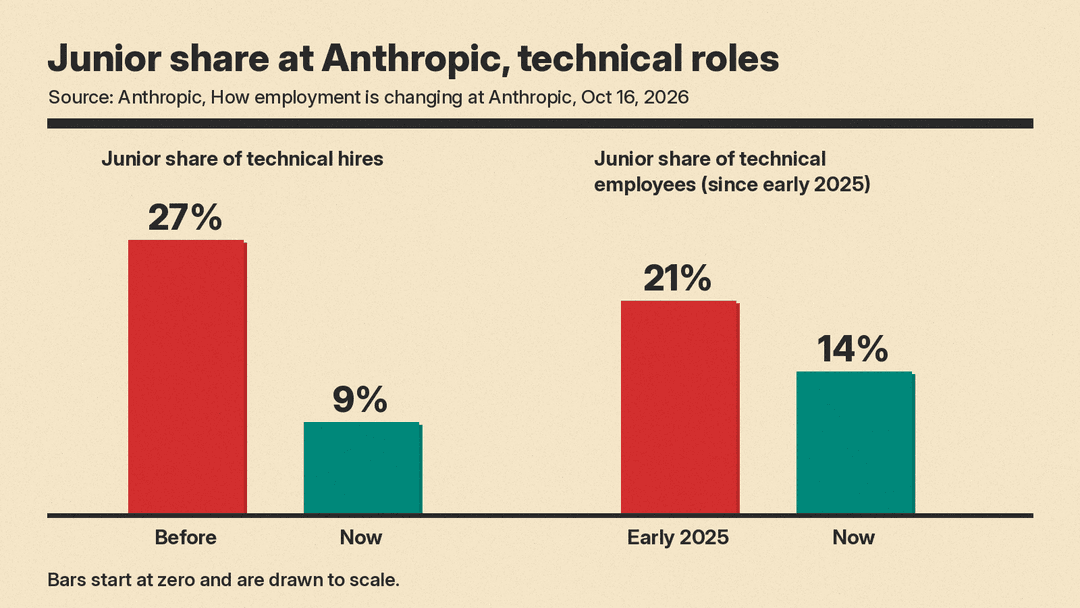
If you are trying to land your first job in AI, a new labor report from inside an AI lab is worth your time. On October 16, Anthropic published How employment is changing at Anthropic, a study of its own workforce by Nathan Wilmers, Regina Catipon, Maxim Massenkoff, and Peter McCrory. The headline number: junior roles fell from 27% to 9% of the company's technical hires.
That is one company, and an unusual one. But it is also a company that has, in the report's words, "thoroughly molded its workflows around AI", which is why people read it as a preview. This guide covers what the report actually found, what wider labor data says about young workers, what hiring managers at Anthropic now screen for, and what you can do about it if you are early in your career.
What Anthropic's report found
The report draws on internal data covering employment, AI use, output, employee surveys, Slack and calendar patterns, and hiring decision records, plus 17 employee interviews. The findings that matter most for job seekers:
- Fewer junior technical hires. The share of junior-level employees in technical departments slipped from 21% to 14% since early 2025. The share of technical hires who were junior fell faster, from 27% to 9%. Postings for juniors have fallen "particularly sharply since December 2025".
- It began in core technical teams. Internal discussion of lower demand for junior technical staff emerged in core technical functions in January 2026. The teams that relied most heavily on Claude found that writing code and finding bugs could increasingly be offloaded to it. By April, engineering and research teams had deemphasized hiring for lower band technical positions.
- Managers say AI changed what they hire for. In an April survey, a majority of managers described hiring for a different set of skills due to AI. Around a third of ML managers and a fifth of software engineering managers reported hiring less due to AI.
- Agents now log more hours than people. Counting only employee-directed interactive agent sessions, agents worked six times as many hours as their human handlers by August. The report measures agent time as runtime and human time as headcount times 40 hours a week, so this is a measure of agent activity, not of jobs replaced.
- Output per person rose. Code commits per engineer were at five times their velocity of six months earlier. Lawyers processed more contracts and salespeople closed more deals.
- Technical hiring still grew. This is the detail most summaries skip. Technical hiring "has continued growing in absolute terms". What fell is the junior share, and the technical share of the whole company, which went from 61% to 56% as hiring in sales, finance, and recruiting outpaced it.
The authors are direct about the limits of their own response. Anthropic has set up an early warning system for jobs at risk and prioritizes moving existing staff into new roles, but the report says "none directly address the slowdown in junior hires" and that "employment protections for incumbents will not benefit those not hired to begin with."
For the company's separate survey of how its staff expect AI to change the economy, see our write-up of Anthropic's AI expectations gap report.
Is this only an Anthropic story?
The broader data points the same way for young workers, though the picture is less stark.
- Stanford payroll data. The revised Canaries in the Coal Mine paper by Erik Brynjolfsson, Bharat Chandar, and Ruyu Chen (August 12, 2026) uses ADP payroll data on millions of US workers through June 2026. It finds "no evidence of widespread, economy-wide job displacement". But employment of workers aged 22 to 25 in AI-exposed occupations "now stands 19% below where it would be had it kept pace with that of their less-exposed peers", and experienced workers show no comparable gap. The authors say this works mainly through less hiring of young workers rather than more job separations, and they call the results early, descriptive indicators rather than causal estimates.
- Recent college graduates. The Federal Reserve Bank of New York's labor market for recent college graduates page says conditions "remained challenging" through the second quarter of 2026, with unemployment for recent graduates at about 5.6 percent and underemployment edging up to 42 percent.
- Other research. Anthropic's report cites prior work finding that AI-native startups and AI adopters are flatter and employ fewer entry-level employees, including Kim and Koning's AI-Native Firms working paper at Harvard Business School and Hosseini Maasoum and Lichtinger's Generative AI as Seniority-Biased Technological Change.
The common thread is that the squeeze lands on hiring at the bottom of the ladder, not on people already in jobs.
Where entry-level hiring still happens
None of these sources publishes a list of safe junior jobs, so be wary of anyone who does. What the evidence does say:
- Where AI complements the work, not substitutes for it. The Stanford paper finds declines are concentrated in occupations where AI usage mainly substitutes for human tasks. Where usage mainly complements workers, "employment is flat or rising, especially for experienced workers".
- Business functions at fast-growing AI companies. At Anthropic, intensive hiring in sales, finance, and recruiting outpaced technical hiring. The report notes that part of this is normal growth as a company scales.
- Interpersonal work. The report says that for many non-technical roles, core work such as "a sales call, an interview, cross-functional alignment on a complex problem" remains human.
- Not routine admin. Administrative functions that usually grow with headcount did not speed up at Anthropic. An executive assistant quoted in the report said "we've already moved past the point of Claude augmenting away the really entry-level admin type role."
One more signal is worth noting. Employees with at least a year at Anthropic were 50% more likely to move across departments each month in 2026 than in 2025, and one product design team that wrote product content rotated into agent prompting and writing model evals. Once you are inside, roles shift often. Getting in the door matters more than landing the exact title.
What hiring managers now screen for
This is the most useful part of the report for job seekers. Anthropic ran an automated coder over hiring manager interview scorecards for thousands of hires since 2024.
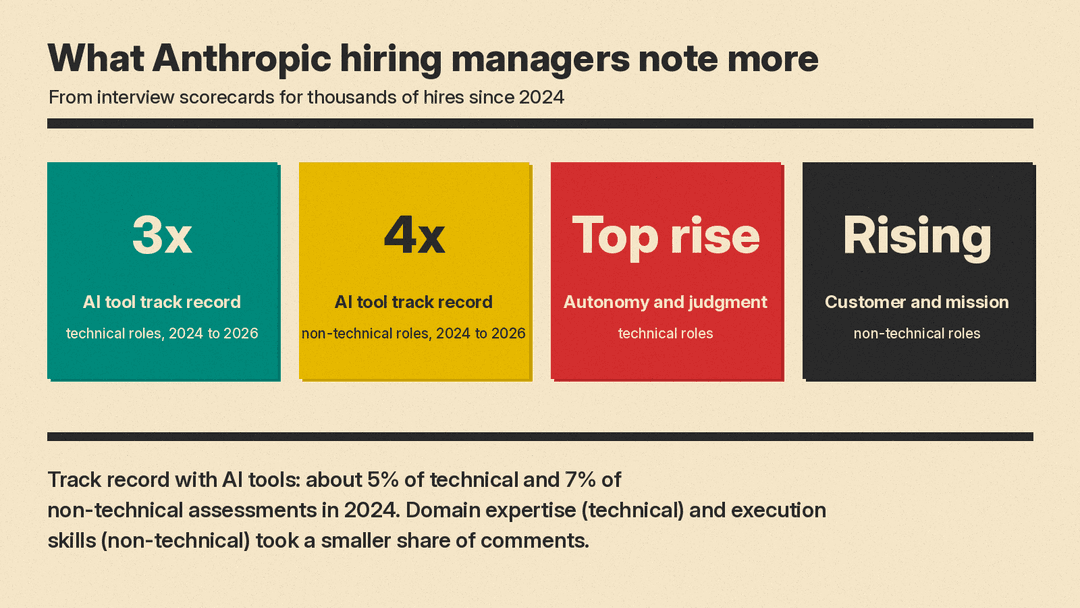
- Creative use of AI tools. In 2024, hiring managers noted a candidate's track record with AI tooling in around 5% of assessments for technical roles and 7% for non-technical roles. By 2026, those rates had tripled for technical roles and quadrupled for non-technical ones.
- Autonomy and judgment. For technical candidates, the biggest increases were in comments on autonomy and judgment. Discussion of domain expertise shrank as a share of the assessment. One manager said: "I expect models to continue to be jagged, so for my team I want them to be fungible across domains."
- Customer and mission orientation. For non-technical candidates, these rose while discussion of execution skills fell.
A separate Anthropic study, Agentic coding and persistent returns to expertise (June 16, 2026), adds a nuance. Across about 400,000 Claude Code sessions, people made most of the planning decisions and Claude made most of the execution decisions, and the more domain expertise a person brought, the more often a session ended in success. The study says success depended on how well a person understood the problem, not whether they were trained in coding.
How to act on this if you are starting out
These steps follow from what the sources say hiring managers reward. They are not a guarantee.
- Show AI tool use in public work. Since managers now note AI tooling far more often, build projects where you directed agents to do real work, and write up how. A small app, a data analysis, or an automation for a club or a local business all count. Our best free AI courses guide and free datasets list are good places to find material. Our AI engineer roadmap puts those skills in order, from Python to a shipped portfolio.
- Make your judgment visible. Autonomy and judgment are hard to show on a resume. A short write-up for each project that explains what you chose not to build, what went wrong, and how you checked the agent's output shows both. For the resume itself, see our ChatGPT prompts for resumes and cover letters.
- Learn the work of managing agents. The report says "meta-work" rose from 10% of the average employee's interactive Claude sessions in fall 2025 to 22% in spring 2026: writing specs for multi-agent runs, having one agent review another's output, and monitoring pipelines. Written standing instructions for agents grew from a few hundred to 8,500 in a year. Practice those skills. Our explainer on how the Claude Code team reviews code shows one such loop, and What Is RAG? covers a core pattern for giving agents context.
- Pair AI skills with a domain. Because domain expertise raised success rates in the Claude Code study, AI skills plus knowledge of a field such as finance, law, health, or sales is a stronger pitch than general coding alone.
- Look at growing niches. Some specialties are growing even in weak markets. For example, our report on AI security engineer postings covers one role whose postings rose while the wider cybersecurity market fell.
- Consider business roles at AI companies. Hiring in sales, finance, and recruiting outpaced technical hiring at Anthropic, and non-technical staff there build software with coding agents. The report says coding-focused agent sessions for non-technical employees went from 2 per month in August 2025 to 90 in May 2026.
If you are thinking about a retraining program
Career changers should know what the evidence says about job training. Anthropic's review of worker retraining programs (August 12, 2026), coauthored by David Roodman and Maxim Massenkoff, combines 56 randomized US studies. On average, each person offered a training slot gained two to three percentage points in employment and roughly $1,000 a year in earnings, against a cost of about $13,000. A small set of "sector programs", which partner with employers in a high-demand industry and place people directly into jobs in that field, produced gains several times larger.
The practical lesson: if you pay for a program, favor one with real employer partners and direct job placement over one that only issues a certificate.
The bottom line
Anthropic's report is a case study of one fast-growing AI lab, not a forecast for every employer. But it lines up with Stanford's payroll data: the pressure from AI shows up first as fewer junior hires in AI-exposed work. The candidates who still get through are the ones who can show they use AI tools well, make sound calls without close supervision, and understand the problem they are solving.
Sources
- How employment is changing at Anthropic (Anthropic, October 16, 2026)
- Anthropic says its workforce has become less junior and is spending more time in meetings (TechCrunch, October 17, 2026)
- Canaries in the Coal Mine? Six Facts about the Recent Employment Effects of Artificial Intelligence (Stanford Digital Economy Lab, revised August 12, 2026)
- The Labor Market for Recent College Graduates (Federal Reserve Bank of New York)
- Agentic coding and persistent returns to expertise (Anthropic, June 16, 2026)
- Reviewing the evidence on worker retraining programs (Anthropic, August 12, 2026)
- AI-Native Firms (Kim and Koning, Harvard Business School Working Paper 26-090)
- Generative AI as Seniority-Biased Technological Change (Hosseini Maasoum and Lichtinger, SSRN)
