
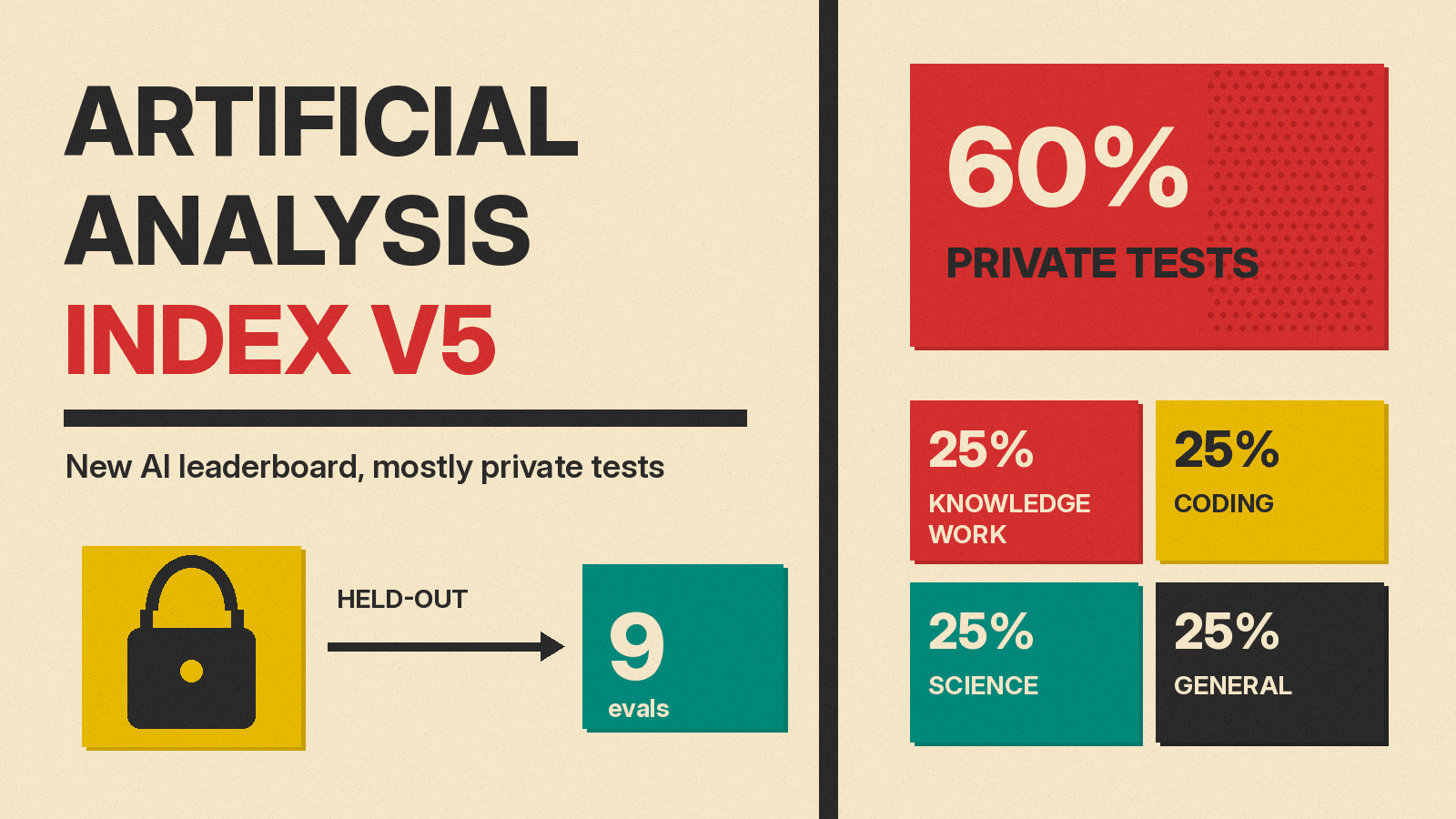
Artificial Analysis has rebuilt its main AI model score. Nathan Lambert of Interconnects calls the group's index "the most prominent independent intelligence metric for the latest frontier models." Intelligence Index v5, announced on October 27, 2026, now bases 60% of the index on evaluations with private test sets or held-out answers. The group calls it "our biggest upgrade since v4 launched in January."
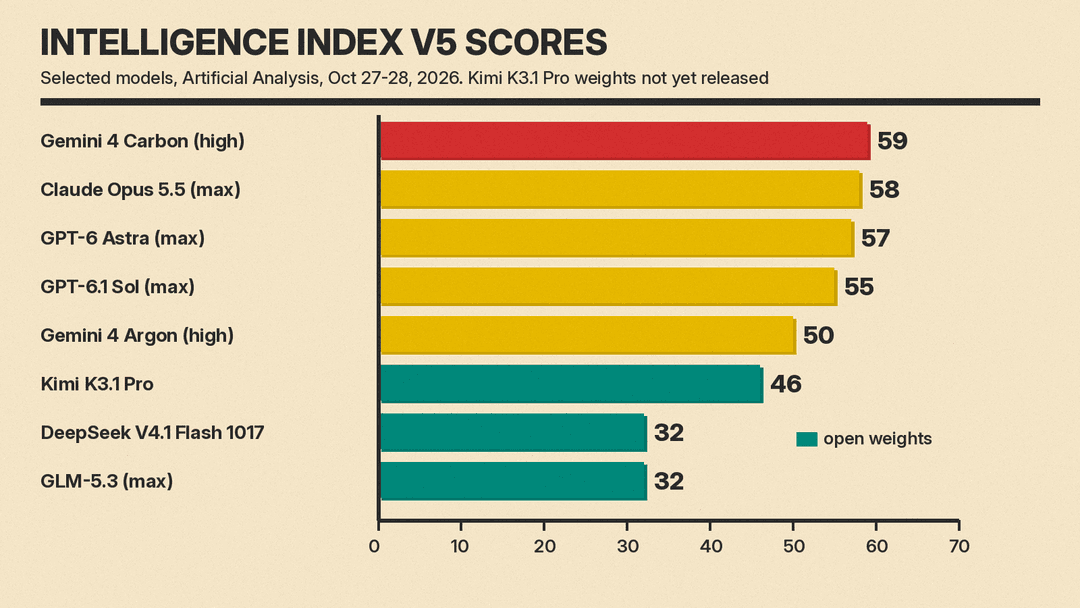
The leaderboard changed again within a day. On launch, Claude Opus 5.5 led. On October 28, Artificial Analysis said Google's new Gemini 4 Carbon had taken first place with a score of 59, one point ahead of Opus 5.5. The new index also shows a much wider gap between open-weight models and the closed frontier than the old one did.
What changed in the index
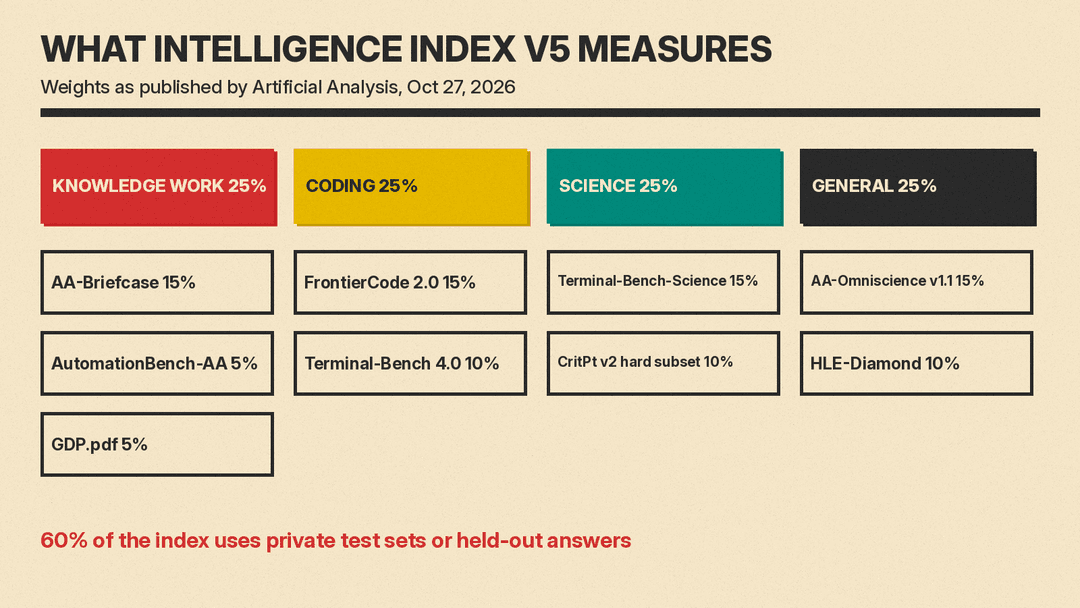
Artificial Analysis describes the index as "our composite measure of model capabilities across tasks reflecting real-world usage today." Version 5 combines nine evaluations in four equal groups:
- Knowledge Work (25%): AA-Briefcase (15%), AutomationBench-AA (5%) and GDP.pdf (5%).
- Coding (25%): FrontierCode 2.0 (15%) and Terminal-Bench 4.0 (10%).
- Science (25%): Terminal-Bench-Science (15%) and a CritPt v2 hard subset (10%).
- General (25%): AA-Omniscience v1.1 (15%, split 10% accuracy and 5% non-hallucination) and HLE-Diamond (10%).
Two benchmarks are new. FrontierCode 2.0 is Cognition's private coding test of 132 tasks in real open-source repositories, "graded on whether a maintainer would merge the agent's change." Artificial Analysis says an attempt that fails any blocking check scores 0, and the tasks stay private to avoid contamination. Terminal-Bench-Science has 70 agentic scientific research tasks run in a terminal, and a task passes only if every one of its tests passes.
Three were upgraded. HLE-Diamond replaces Humanity's Last Exam with a refined 1,000-question version split evenly between reasoning and knowledge. AA-Omniscience v1.1 drops saturated and public questions and revises ambiguous or wrong ones. CritPt v2 is now scored on a private 40-question hard subset of research-level physics questions.
GDPval-AA, SciCode and AA-LCR were removed. Artificial Analysis also launched a separate Progress Index v1, which places language models released since November 2022 on one capability scale. The group says the Intelligence Index "remains our primary measure of current model intelligence."
The new rankings
At launch, Artificial Analysis reported these scores:
- Claude Opus 5.5 (max): 58
- GPT-6 Astra (max): 57
- GPT-6.1 Sol (max): 55
- Gemini 4 Argon (high): 50, next after the top five, which Anthropic and OpenAI held
A day later, Artificial Analysis said Gemini 4 Carbon (high) scores 59 and holds the top score in 4 of the 9 evaluations: HLE-Diamond, Terminal-Bench-Science, AA-Omniscience and AutomationBench-AA. It added that Carbon "is not leading in coding and knowledge work." Carbon is being rolled out to selected users and is not yet publicly available, the group said. Our Gemini 4 Carbon launch post covers what Google released.
In the launch post, no single model led all nine tests. Claude Opus 5.5 led three (FrontierCode 2.0 at 46%, HLE-Diamond at 68% and AA-Omniscience v1.1 at 48). GPT-6 Astra led Terminal-Bench-Science (63%) and the CritPt hard subset (72%). Claude Sonnet 5.5, Kimi K3.1 Pro, Gemini 4 Argon and Muse Wonder Full each led one.
Open-weight models fall further behind
The biggest shift is for open-weight models. Artificial Analysis says the best one, Kimi K3.1 Pro (weights not yet released), scores 46, "12 points behind the leader, compared with a 3-point gap in v4.3." Of models with released weights, DeepSeek V4.1 Flash 1017 (max) and GLM-5.3 (max) score highest at 32, and Claude Haiku 5.5 (max) outscores all of them at 36.
Artificial Analysis says the gap is widest on HLE-Diamond and Terminal-Bench-Science. On Terminal-Bench-Science, the best model with released weights, DeepSeek V4.1 Flash 1017, scores 13%, and Artificial Analysis says "most open weights models we benchmarked score under 10%."
Cost and effort matter more
The index also tracks what a score costs. Artificial Analysis says Claude Opus 5.5 (max) costs $10.04 per Intelligence Index task, GPT-6 Astra (max) $6.24 and GPT-6.1 Sol (max) $1.27. It says Sol "scores within 4 points of Claude Opus 5.5 (max) at about an eighth of the cost per task."
Effort settings now swing results more. Opus 5.5 scores 35 at low effort and 58 at max, at 10 times the cost per task ($0.98 vs $10.04). The tests also demand more work: the median output per task rose from 35,000 to 59,000 tokens, according to the group.
The pushback
Not everyone accepts the new picture. In an Interconnects essay, researcher Nathan Lambert writes that "open models' demise from this seems greatly exaggerated, but I do think the previous index was flattering the open weight models too strongly." On the move to private tests, Lambert writes: "All in, this is a change that directionally I think is defensible, but it's not unanimous." He warns that "you're putting complete trust in the private benchmark builder," because the community no longer gets to find issues in the benchmark and push it to improve. He also writes that Artificial Analysis's business model is to make money from the labs to verify their results, and that he has "a solid amount of trust" for the group, though "not the most I do for anyone in the ecosystem."
Lambert expects leading open model labs to make substantial steps on the index at the next major model cycle, which he estimates at 2 to 3 months away. He also says the field needs more indices with other biases, such as coding-only ones.
Artificial Analysis itself notes on its index page that a higher score indicates stronger aggregate performance, "but individual benchmark results may be more relevant for specific use cases such as coding, agentic workflows, factuality, or scientific reasoning." With effort settings and cost per task moving scores this much, the per-test results are worth checking before picking a model.
We make a related case in our opinion piece on what a leaderboard rank does not tell you about a model.
Sources
- Announcing Artificial Analysis Intelligence Index v5 (Artificial Analysis)
- Gemini 4 Carbon is the new #1 on the Artificial Analysis Intelligence Index v5 (Artificial Analysis)
- Artificial Analysis Intelligence Index v5.0 (Artificial Analysis)
- Artificial Analysis v5 and the benchmarker's dilemma (Interconnects, Nathan Lambert)
