
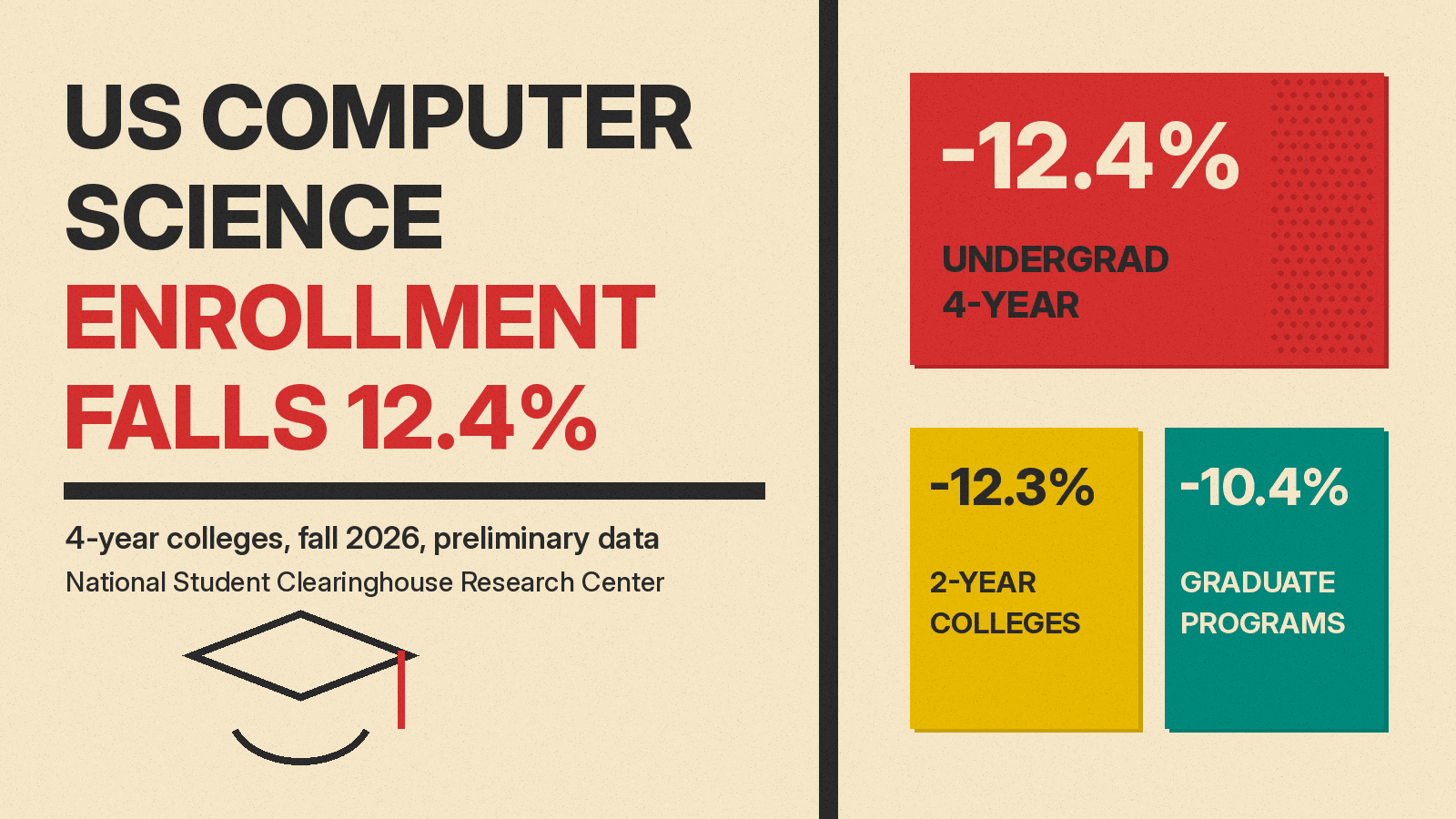
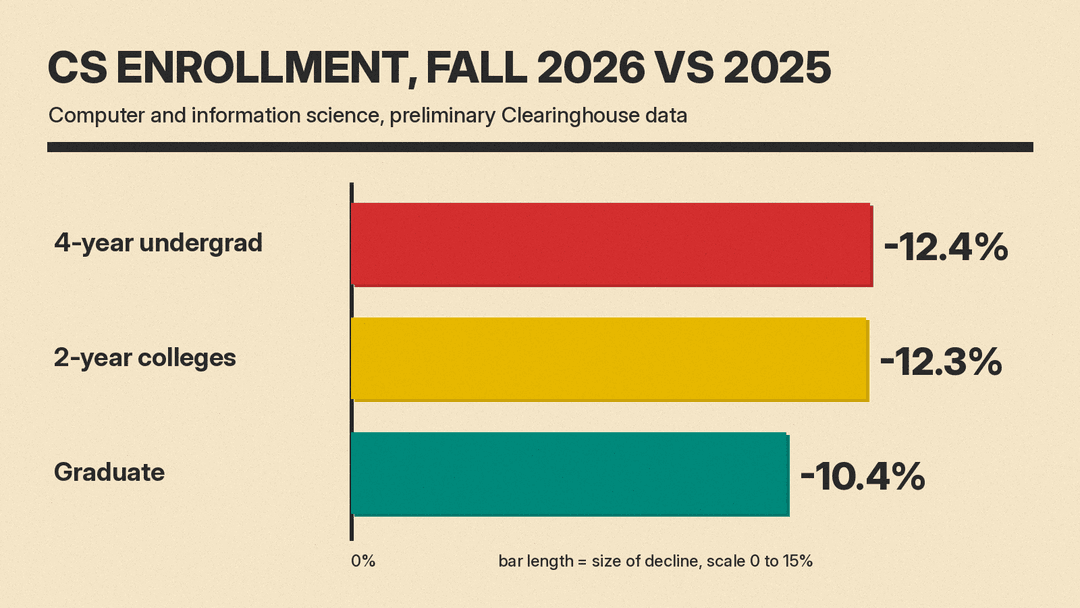
Enrollment in computer science programs at US colleges fell by double digits this fall, for the second year in a row. Preliminary data released on October 29 by the National Student Clearinghouse Research Center show computer and information science enrollment down 12.4% at four-year colleges, 12.3% at two-year colleges, and 10.4% in graduate programs, compared with fall 2025.
The drop stands out because almost nothing else in the report moved much. Total postsecondary enrollment was roughly flat (up 0.2%), and undergraduate enrollment rose 0.6%. Computer science had the biggest losses of any subject area in the data, Higher Ed Dive reports.
The numbers
These are the Clearinghouse's fall 2026 preliminary figures, year over year, from its report page:
- Computer and information science, undergraduate at four-year colleges: down 12.4%
- Computer and information science, two-year colleges: down 12.3%
- Computer and information science, graduate: down 10.4%
- Health majors: up 6.2% (undergraduate four-year), up 4.3% (two-year), up 2.0% (graduate)
- All undergraduate enrollment: up 0.6%
- Graduate enrollment: down 1.6%, with master's enrollment down 3.7%
This is the second straight fall of losses. Last year's preliminary report showed a 7.7% decline among four-year undergraduates in the field, according to The EDU Ledger. At two-year colleges, this fall's 12.3% drop follows a 5.9% dip last fall, Community College Daily reports.
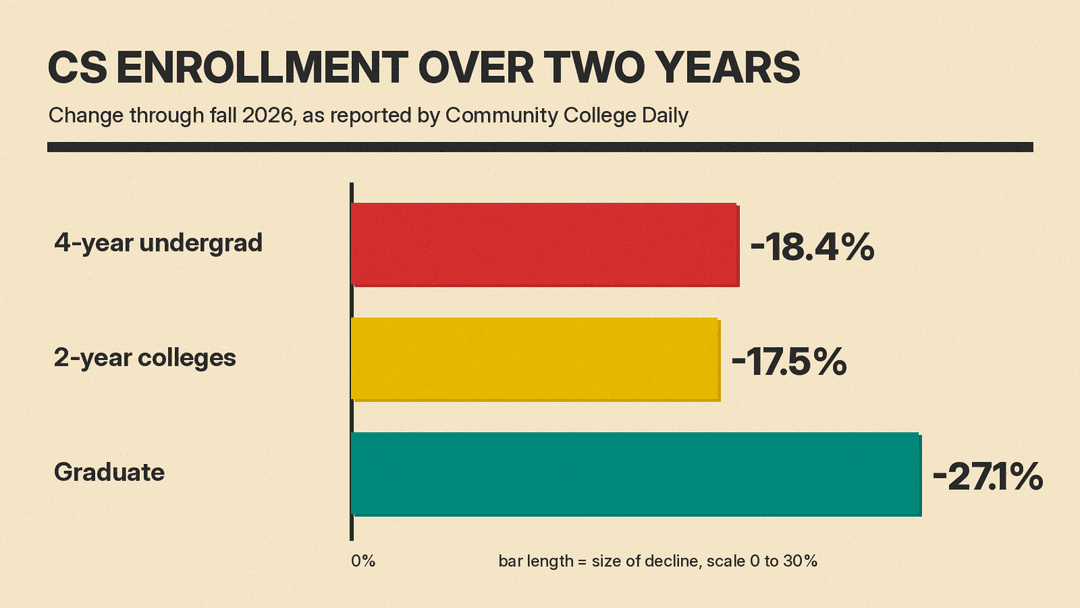
Over two years, Community College Daily says, undergraduate computer science enrollment is down 18.4% at four-year institutions and 17.5% at two-year colleges, and graduate computer science enrollment is down 27.1%.
What the researchers said
Matthew Holsapple, the Clearinghouse's senior director of research, described the reversal at a press conference. "Computer science led years of strong growth before reversing direction last fall, where we started to see numbers really drop," Holsapple said, as quoted by Higher Ed Dive. "This year, it's even more pronounced."
Holsapple also said, as quoted by Community College Daily: "Those are just remarkable declines for a field that, until recently, had been one of the fastest-growing areas that we've seen in higher education."
The Clearinghouse report itself gives the numbers, not a cause. The AI link comes from people commenting on it.
Where AI comes in
George R. Boggs, president and CEO emeritus of the American Association of Community Colleges, attributed the slide largely to uncertainty about artificial intelligence, The EDU Ledger reports. "Many formerly high-paying jobs, such as coding, can be done more efficiently by AI," Boggs said. He noted that major software companies are shrinking their workforces, and said health-related careers "seem to be safer bets for job security."
Business Standard carries a Bloomberg story reporting that AI's rise has made it harder for computer science graduates to find jobs in recent years, as companies cut many entry-level coding roles. It also points to an August report from the Bureau of Labor Statistics that found computer and mathematics jobs would feel the most impact from AI.
Higher Ed Dive adds a jobs data point that predates this fall. Amid tech layoffs and the rise of automated coding, unemployment for recent computer science and computer engineering graduates reached 7% and 7.8% in 2024, according to the Federal Reserve Bank of New York, about 3 percentage points above the overall unemployment rate that year.
Why it matters
For students and parents, the data show a fast shift in what people choose to study. Computer science was one of the fastest-growing fields in higher education until recently, in Holsapple's words, and it now shows the biggest losses of any subject area in the data. Health majors and, per Higher Ed Dive, engineering grew this fall.
Students who still want to work in AI without a computer science major can read our guide to AI jobs without a CS degree, which covers what hiring data says about degree requirements.
For colleges, master's programs are a concern on their own. Higher Ed Dive describes them as a critical revenue source for many institutions, and master's enrollment fell 3.7%. Boggs said, per The EDU Ledger, that the economy, high tuition, new limits on federal student loans and restrictions on international students are likely weighing on master's programs.
Caveats
These are early numbers. The report covers 7.92 million enrollments submitted as of September 24 by 46.0% of the institutions that report to the Clearinghouse, The EDU Ledger notes, and the Clearinghouse says the estimates are preliminary and subject to revision. The EDU Ledger adds that last year's early report showed total enrollment up 2.0%, but the final count put growth at 1.0%.
The preliminary data also leave out international student enrollment, Bloomberg reports via Business Standard. The Clearinghouse will publish its Final Fall Enrollment Trends report in January, with fuller data.
For more on how AI is changing entry-level work, see our post on Anthropic's falling share of junior tech hires and our guide on how to become a prompt engineer.
Sources
- National Student Clearinghouse Research Center: Preliminary Fall Enrollment Trends
- Higher Ed Dive: Undergraduate enrollment inched up this fall, while master's dips 3.7%
- The EDU Ledger: Fall College Enrollment Holds Steady as Master's Programs Slide
- Community College Daily: An early look at fall enrollments
- Business Standard (Bloomberg): Student enrolment in US computer science programmes falls as AI takes jobs
