
Epic Games has confirmed that it uses AI coding tools to "develop code and features" for Unreal Engine, its widely adopted game engine. In a statement to This Week in Videogames published on October 27, Epic's Executive Vice President of Development, Marcus Wassmer, named the tools: "There are a number of tools in use but probably the most obvious ones are Claude Code and Codex with their associated AI models."
He also gave specific results. The most concrete one is a rewrite of a significant portion of the engine's Direct3D 12 rendering layer that he estimated at three to six weeks for one engineer and that took about one week.
What Epic confirmed
The confirmation came in steps. According to This Week in Videogames, CEO Tim Sweeney replied on X to a developer on October 23: "Yes, we are now using AI tools to develop code for Unreal Engine." The outlet then sent Epic a list of questions, and Wassmer answered them.
Wassmer said where the work happens: "Almost all development happening right now is being done in the dev streams attached to Fortnite, UEFN [Unreal Editor for Fortnite], and UE6." He added that a 5.9 release is possible, and that "If we make it, it would be a relatively modest update for specific systems and will include changes developed with AI."
Asked whether parts of the engine are vibe coded, he said: "Yes, we are vibe-coding things. That means our engineers are no longer writing the bulk of the code, but they are still guiding the tools to get the architectural result we want. We're not 'one-shotting' the engine; we're iterating with AI to ship features developers want and keep the engine within the memory, performance, and scalability envelopes."
PC Gamer and Game Developer both picked up the statement on October 28.
The results Epic claims
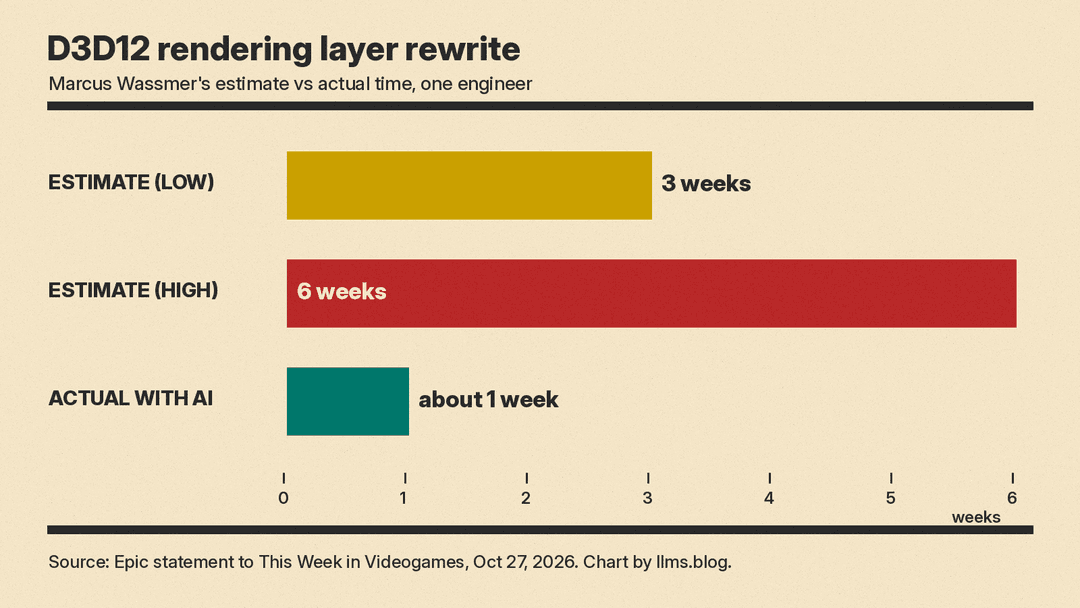
Wassmer listed the wins in his statement. In his words, the tools are "helping across a broad spectrum of development." The specific items he named:
- Cooking bugs. "Almost the complete elimination of non-deterministic cooking bugs which we've been fighting for a decade." Cooking is the step that prepares game content for use.
- Shaders. "An acceleration of work related to compressing shaders." He said the cooking and shader work "both significantly reduce patch sizes."
- Rendering. "A rewrite of a significant portion of the D3D12 rendering layer (which I estimated as needing three to six weeks of work for a single engineer, but the work was actually completed in about one week with a nice win on CPU time and fewer bugs)."
- Tests. "Lots of help in keeping our internal test suites healthy as well as expanding those test suites for more coverage."
- PC stability. Epic has "started deploying automatic monitoring of PC stability on Fortnite" that detects issues with specific driver and hardware combinations, plus "automatic root cause analysis and automatic fix generation."
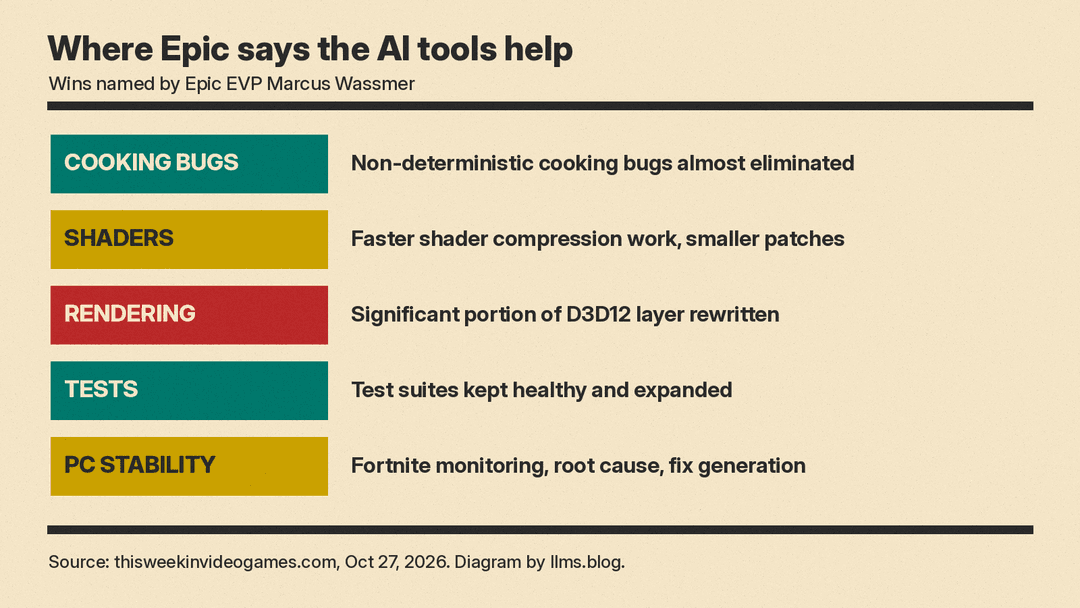
These are Epic's own figures. The statement gives no benchmark numbers for the CPU-time gain, no bug counts, and no outside check of the one-week timing. Treat the D3D12 comparison as one engineering lead's estimate set against one result.
Bigger refactors, and a more modular engine
The claim with the most impact for studios that build on Unreal is about structure, not speed. Wassmer said AI lets Epic take on "larger architectural refactors" that it had put off because they "involved changing thousands of files in relatively minor ways in each instance." His forecast: "Developers can expect the engine to end up significantly more modular for faster iteration times, and with more ability to strip out what you don't need from UE on a particular game."
That is a common pattern for coding agents. Wide, repetitive changes across a large codebase are tedious for people and suit tools that can edit many files and then run the test suite. Epic's mention of test coverage matters here: refactors at that scale are only safe if the tests catch regressions.
Why it matters
Unreal Engine is a large and old codebase. Wassmer described it as "30 years of foundational code." A public statement that, for the work Epic calls vibe coding, its engineers "are no longer writing the bulk of the code" is one of the clearest signs yet that agentic coding tools have moved into core infrastructure, not only new apps and prototypes.
It also continues a shift at Epic. Earlier this month, we covered Epic's Unreal Engine plugin for Claude Code. Now Epic says it uses the same class of tools on the engine itself. Other platform owners are moving in the same direction: Google recently opened Android Studio to Claude, Codex and more than 40 other agents.
Wassmer also answered the skeptics directly. "We are more concerned about the risks of moving too slowly than we are about AI skepticism," Wassmer said. "We don't think it's viable to take a halfway approach to AI in development."
The statement comes in a busy month. According to PC Gamer, Epic said it had "vibe coded the Epic Games Launcher to be faster than the other guy," and Sweeney criticized Steam's AI disclosure statements. Game Developer noted that surveys in recent years have shown game developers are worried about generative AI.
What to watch
- UE6 quality. Wassmer said "the best way to counter any skepticism is through the quality of the games and tools we're able to deliver." UE6 is the real test of that claim.
- Shared practices. He said Epic wants to "share best practices with other developers." If Epic publishes how it uses Claude Code and Codex on a codebase this size, that guide would be useful well beyond games.
- A possible 5.9. Any 5.9 release would be "a relatively modest update for specific systems" that includes AI-developed changes.
For a broader look at the tools in this space, see our comparison of the best vibe coding tools.
Sources
- Epic Games Confirms AI is Being Used to "Develop Code and Features for Unreal Engine" (This Week in Videogames)
- 'Yes, we are vibe-coding things': Epic confirms it's using AI tools to code Unreal Engine 6, Fortnite, and more (PC Gamer)
- Epic VP says AI tools stomped out decade-old Unreal Engine bugs (Game Developer)
