
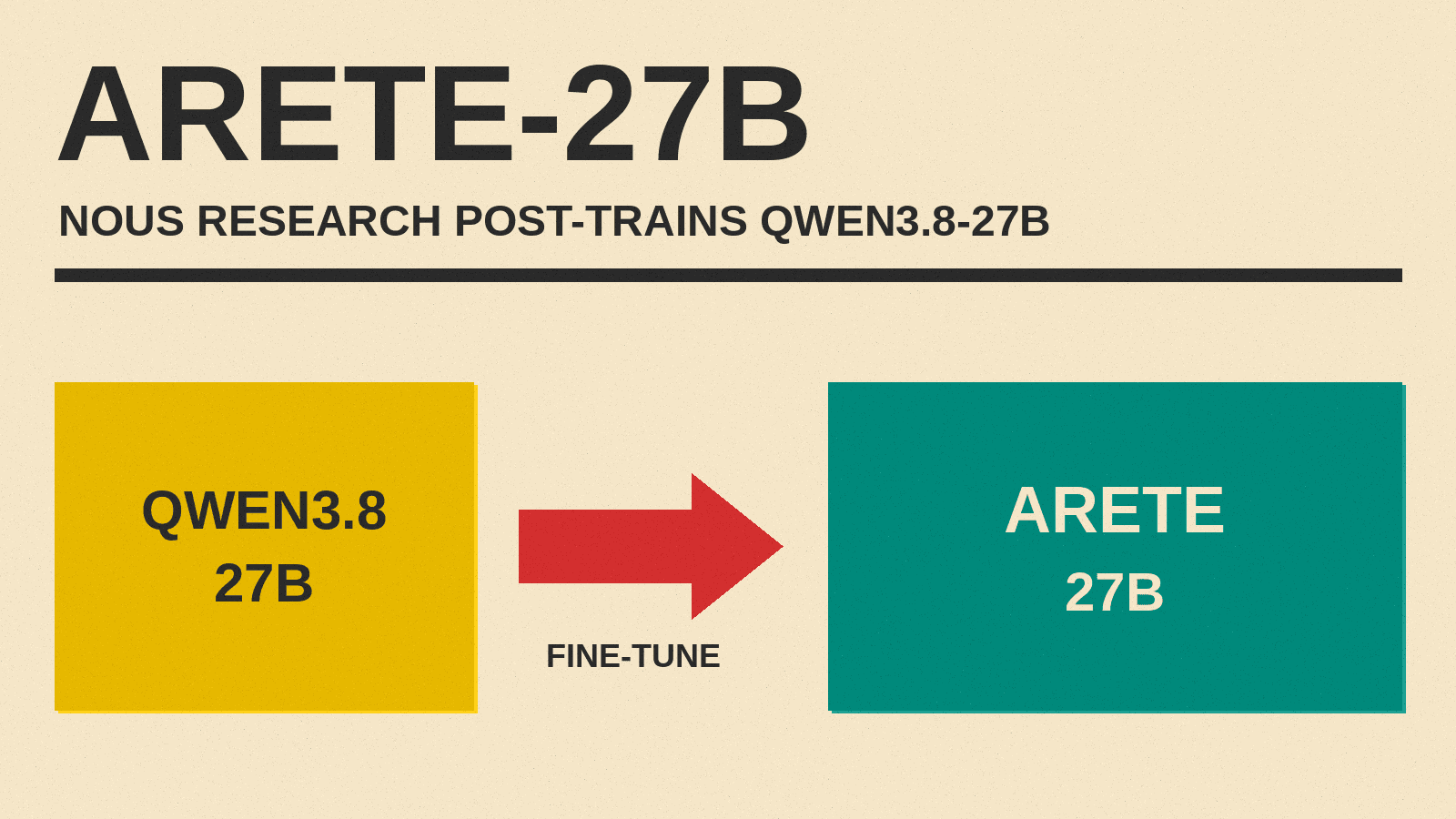
Nous Research has released Arete-27B, an open-weight model built on Alibaba's Qwen3.8-27B. In its announcement post, Nous says it "post-trained over Alibaba's Qwen3.8-27B to reinforce Western values on a Chinese-trained model." Hugging Face shows the repository was created on November 6, 2026, and the model card lists the Apache 2.0 license.
Nous says the extra training cost is "insignificant" against the scale of the model's pretraining. Its claim is that a popular open model's behavior on politically sensitive topics can be changed with a small amount of fine-tuning, without a meaningful loss on the general benchmarks Nous ran.
What Nous changed, and why
Our explainer What Is Qwen? covers the family. Nous says it chose Qwen3.8-27B "because it was the most performant local model, and because it exhibited a lot of the behavior we were targeting."
The model card says Nous "observed firsthand refusals, deflections, and CCP-framed answers on politically sensitive topics in Qwen3.8-27B." Nous trained for seven value categories:
- Freedom of expression
- State ideology
- State versus free market
- Education
- Data privacy and surveillance
- Democracy
- Environmental policy
Nous is careful about the scope of the claim. The card says: "That is not to claim that we remedied all behaviors associated with the extant viewpoint, but that we have addressed a potential root cause."
How it was trained
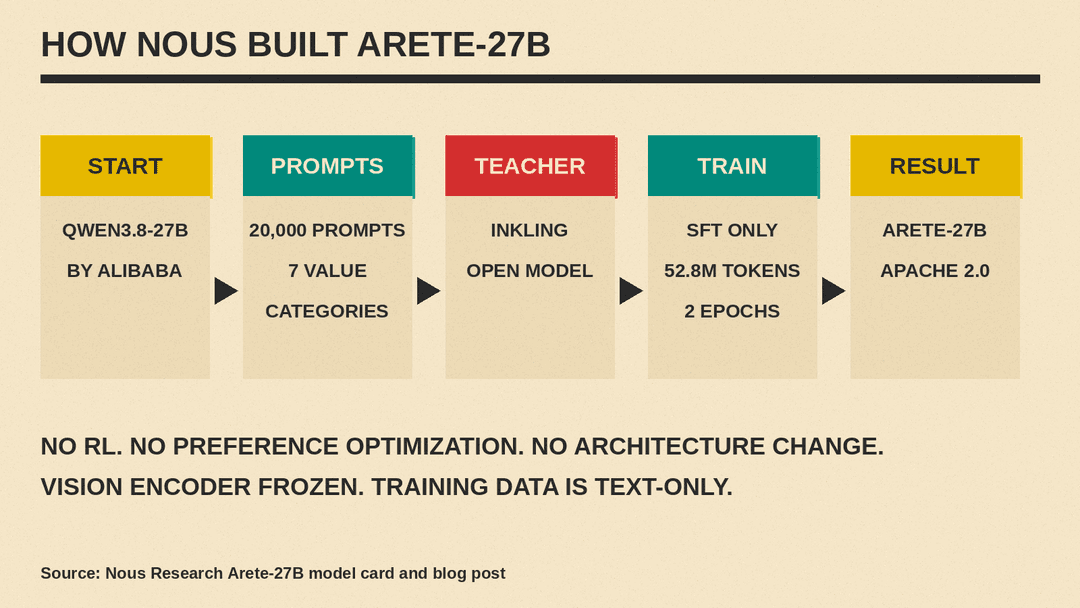
The method is plain supervised fine-tuning. The card says: "No RL, no preference optimization, and no architectural modification." Our guide What Is Fine-Tuning? explains the technique.
Key details from the model card and blog post:
- Nous generated "twenty thousand prompts across the seven categories" and collected answers from a teacher model alongside the starting model's own.
- The teacher was Inkling, which Nous calls "the best open model with a positive eval on what we were targeting." Nous says using an open teacher "avoided the terms-of-use restrictions associated with 'illicit distillation.'"
- Training used about 52.8 million tokens at 64k context, over two epochs and 1,202 steps.
- All language-model weights were trained. The vision encoder was frozen because the data is text-only, and the multi-token-prediction head was disabled during training.
Nous also published its training data as arete-data-pairs and its held-out test set as Propaganda_Eval.
How Nous measured the change
The evaluation has 803 prompts about topics that, in the words of its dataset card, the People's Republic of China "censors or presents through an official narrative." Nous says the prompts come from "English-language government statutes, news and research reports," with no single source supplying more than 13 prompts. For each prompt, Nous extracted two to four required facts from a dated source article.
An LLM judge, Grok 4.7, graded each answer without knowing which model wrote it. It scored two things:
- Fact mean (0 to 5): how many required facts the answer stated. A single "opposed" fact, where the answer denies it or gives the state's account instead, scores 0.
- Any propaganda: the share of answers that adopt the Chinese state's account as their own. Quoting the official line to identify it does not count.
Nous says it tuned the judge on a 25-prompt pilot graded by hand and removed training prompts that overlapped the test set.
The results
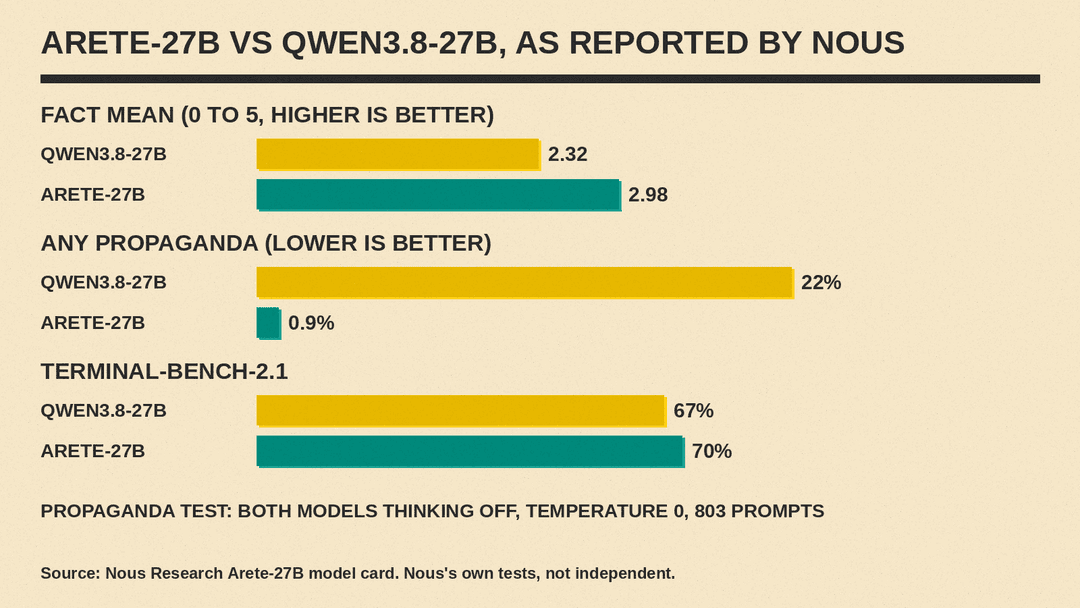
On Nous's own test, Arete-27B (thinking off) raised the fact mean from 2.32 to 2.98 out of 5 compared with Qwen3.8-27B. The share of answers with any propaganda fell from 22% to 0.9%, according to the model card's results table. The blog post rounds the same result to "from 22% to 1%."
Nous reports the largest change in freedom of expression, where "the fact score rose from 0.89 to 2.44 and the propaganda rate fell from 60% to 1%." The number of answers scoring 0 fell from 359 to 216 of 803.
One caveat on the propaganda table: Arete-27B and Qwen3.8-27B ran at temperature 0, while the other models in the table ran at temperature 0.6. The card says: "These are not identical decoding settings across all models." At temperature 0.6, Nous reports fact means of 2.88 for Arete-27B and 2.24 for Qwen3.8-27B; it gives no propaganda rates for that setting.
For general skills, Nous reports almost no change:
- Hermes Bench, Nous's internal benchmark: 65.77% for Qwen3.8-27B and 65.60% for Arete-27B, which Nous calls noise.
- Terminal-Bench-2.1: 67% for Qwen3.8-27B and 70% for Arete-27B. Nous says it does not "take credit for any seeming improvement" in this score.
Nous says it ran both models with the same setup on its own hardware and that differences from official benchmark results can come from different inference settings. All of these are Nous's own numbers, not independent tests.
A note on Nemotron
The blog post says Nous "strongly considered using Nemotron 3 Ultra" as the teacher, but "had found evidence that it too had a checkered record on China-related topics." Nous says it does not know the cause "definitively," and theorizes that the bias "came from working with Chinese open models during the training process." That is Nous's view, not a finding from NVIDIA. In Nous's own results table, Nemotron 3 Ultra (thinking off) scored 3.22 on fact mean and 0.6% on any propaganda.
Why it matters
The main claim in the blog post is about how thin this layer is. Nous writes that "the bias layer in a Chinese-aligned model is shallow" and that "the values in any open model are only ever one fine-tune away."
That cuts two ways. Nous writes that Chinese open-weight models "are among the strongest available, but they ship with state-aligned behavior baked into the weights." For teams with that concern, the open test set gives a way to measure the behavior, and Arete-27B shows one way to change it. Our guide Is DeepSeek Safe to Use? covers related concerns. By Nous's own logic, the same method could push an open model's values in other directions too.
Nous asks others to check its work: "We encourage the community to run the eval on our model, on theirs, on anything they choose." Because the prompts, judge prompt and scoring scripts are public, outside tests are possible.
