
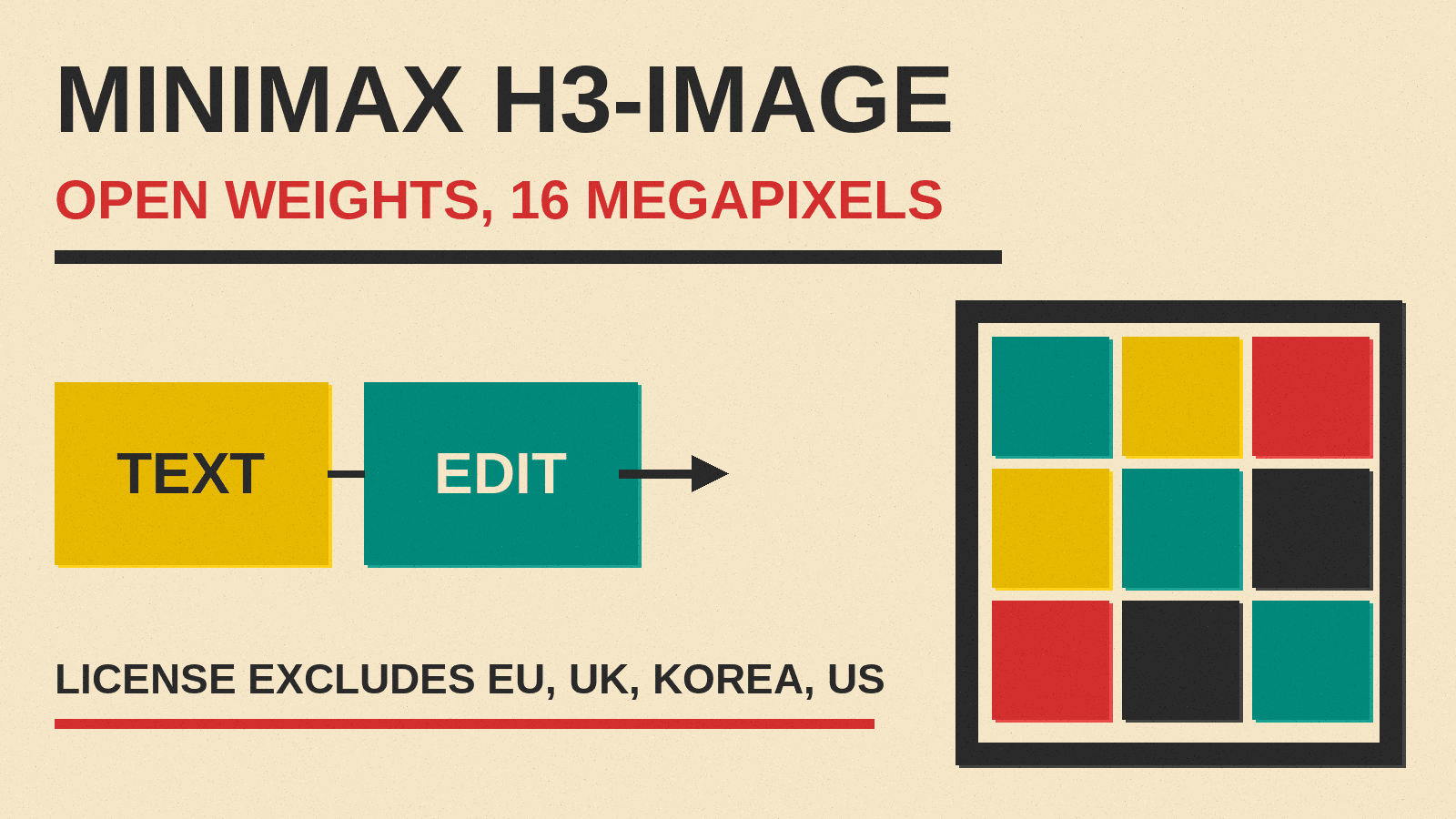
MiniMax released the weights of MiniMax H3-Image on November 11, 2026. It is an image model that makes pictures from text and edits existing images, and anyone can download it from Hugging Face. The catch is the license. It does not allow use in the European Union, the United Kingdom, South Korea or the United States.
Here is what the model does, what you need to run it, and what the license lets you do.
What MiniMax released
In its launch post, MiniMax calls H3-Image "an open-weight image generation model built on H3", its video and audio model family. The post says it supports "text-to-image generation, reference-based generation, and image editing."
The model card adds the details:
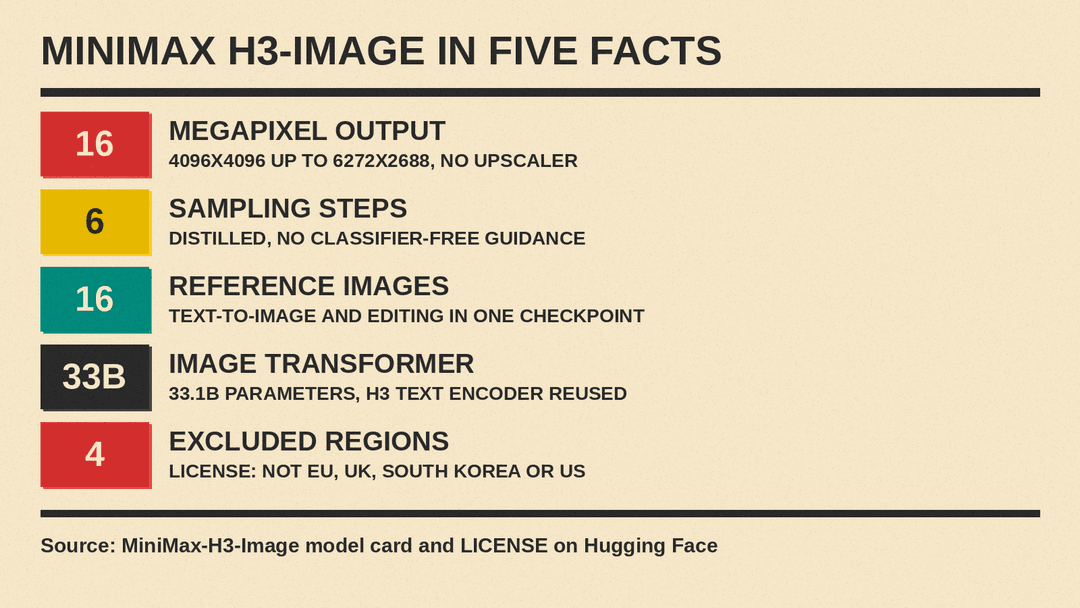
- One checkpoint does both jobs: it makes images from text and edits one or more reference images.
- It makes images of about 16 megapixels at every aspect ratio, from 4096x4096 (1:1) to 6272x2688 (21:9), "directly and without an upscaler."
- It is distilled to 6 sampling steps with no classifier-free guidance. Fewer steps means less computing work per image.
- It accepts up to 16 reference images in one edit, per the card and the launch post.
- The image part is a 33.1B-parameter diffusion transformer. It reuses the MiniMax-H3 text encoder (a Qwen3-VL text encoder) unchanged.
The card says the model "expects a detailed English description of the whole image." To help, MiniMax also published an optional prompt expander, MiniMax-H3-Image-PE, which turns a short prompt into a long one. The card says the PE model is covered by the same license.
Speed and quality claims
MiniMax makes three claims. Treat them as the company's own until outside tests appear.
- Speed. The launch post says H3-Image "can generate a 4K (4096 × 4096) image in under 10 seconds," at "up to 5× the speed of mainstream alternatives." The post does not name the hardware for that figure.
- Realism. The post says the model avoids "the overly smooth, artificial look often associated with AI-generated images."
- Prompt following. The post claims "state-of-the-art prompt adherence among open-weight models." The model card goes further and says it "delivers the strongest instruction following among open-source models."
What you need to run it
This is not a laptop model. The full Hugging Face file list was about 204 GB on November 11, because the repository also holds a text encoder folder and diffusers-format copies of the transformer and VAE. The card's own tables list these parts:
- The main repository at 68.65 GB, most of it the BF16 image transformer (66.28 GB) and the image VAE (2.34 GB).
- The text encoder, which the card says loads from the MiniMax-H3 repository, at 66.7 GB.
- The optional prompt expander at 17.9 GB.
The card recommends four ways to serve it: SGLang, vLLM-Omni, diffusers and ComfyUI, which has text-to-image and edit templates. It gives one-GPU server commands for SGLang and vLLM-Omni. It says the vLLM-Omni recipe supports NVIDIA and AMD accelerators, "including NVIDIA H200, RTX PRO 6000 Blackwell, AMD Instinct MI350X and more."
If you do not have that kind of hardware, MiniMax also offers the model through its API platform, MiniMax Code and the Hailuo AI app. The launch post says API pricing is 50 to 70 percent of comparable mainstream offerings, and that launch week brings 50% off image requests at 4K and above.
The license: read it before you build
H3-Image ships under the MiniMax-H3-Image Community License Agreement, published by MiniMax in the LICENSE file on Hugging Face. It is not an open source license such as Apache 2.0 or MIT. The terms that matter most:
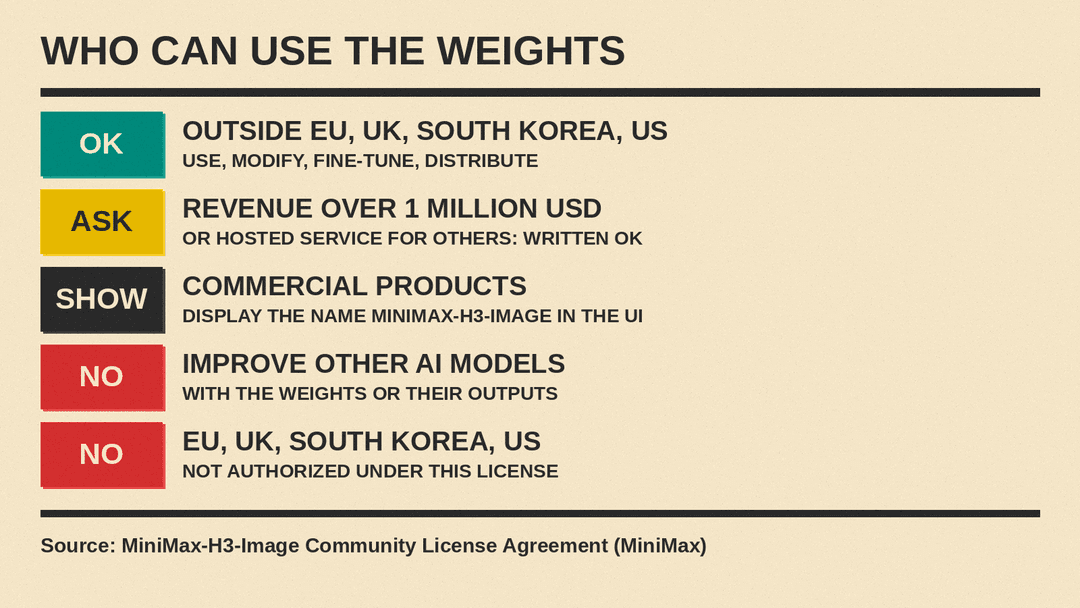
- Territory. The license grant applies "solely within the Applicable Territory," which means "worldwide, excluding the Excluded Territories." Those are "the European Union, the United Kingdom, the Republic of Korea and the United States of America." The license says use outside the Applicable Territory "is not authorized by this Agreement." It invites people in those regions to contact MiniMax about a separate license.
- Revenue and hosting. You need "a separate, prior written authorization from MiniMax" if your annualized revenue, with affiliates, "exceeds 1 Million USD," or if you "provide Hosted Service(s) to any Third Parties." The card links an application form.
- Name display. Commercial products that use the model "shall prominently display" the name "MiniMax-H3-Image" in their user interface.
- No training other models. You "may not use" the model or its outputs "to improve any other artificial intelligence model" other than H3-Image or its derivatives.
- Safeguards. Anyone who offers image generation to others must run "reasonable and proportionate technical and organizational safeguards" against misuse, plus a way to report violations.
- Outputs. "MiniMax claims no rights over the Outputs you generate."
Why it matters
The model card says 1 to 4 megapixel outputs are "common today." A downloadable model that claims 16-megapixel output in 6 steps raises the bar for what local and self-hosted image tools can do. Serving support is ready on day one: the card links recipes for SGLang, vLLM-Omni, diffusers and ComfyUI.
But the license splits the audience. Developers and studios in much of the world can try it, fine-tune it and ship it below the revenue limit, as long as they do not host it as a service for others. Readers in the US, EU, UK and South Korea cannot use these weights under this license at all. That makes H3-Image open weight, not open source, and it is worth reading the full text before you download well over 100 GB of files.
H3-Image is the latest piece of MiniMax's H3 family. Builders have already used H3 for single-GPU video with HyperFlow H3 Flash and Viggle's open video LoRAs. For background on the company, see our MiniMax explainer.
H3-Image is not the same model as Pruna's P-H3-Image, a smaller third-party image model that Pruna built from the H3 video model in early November.
