
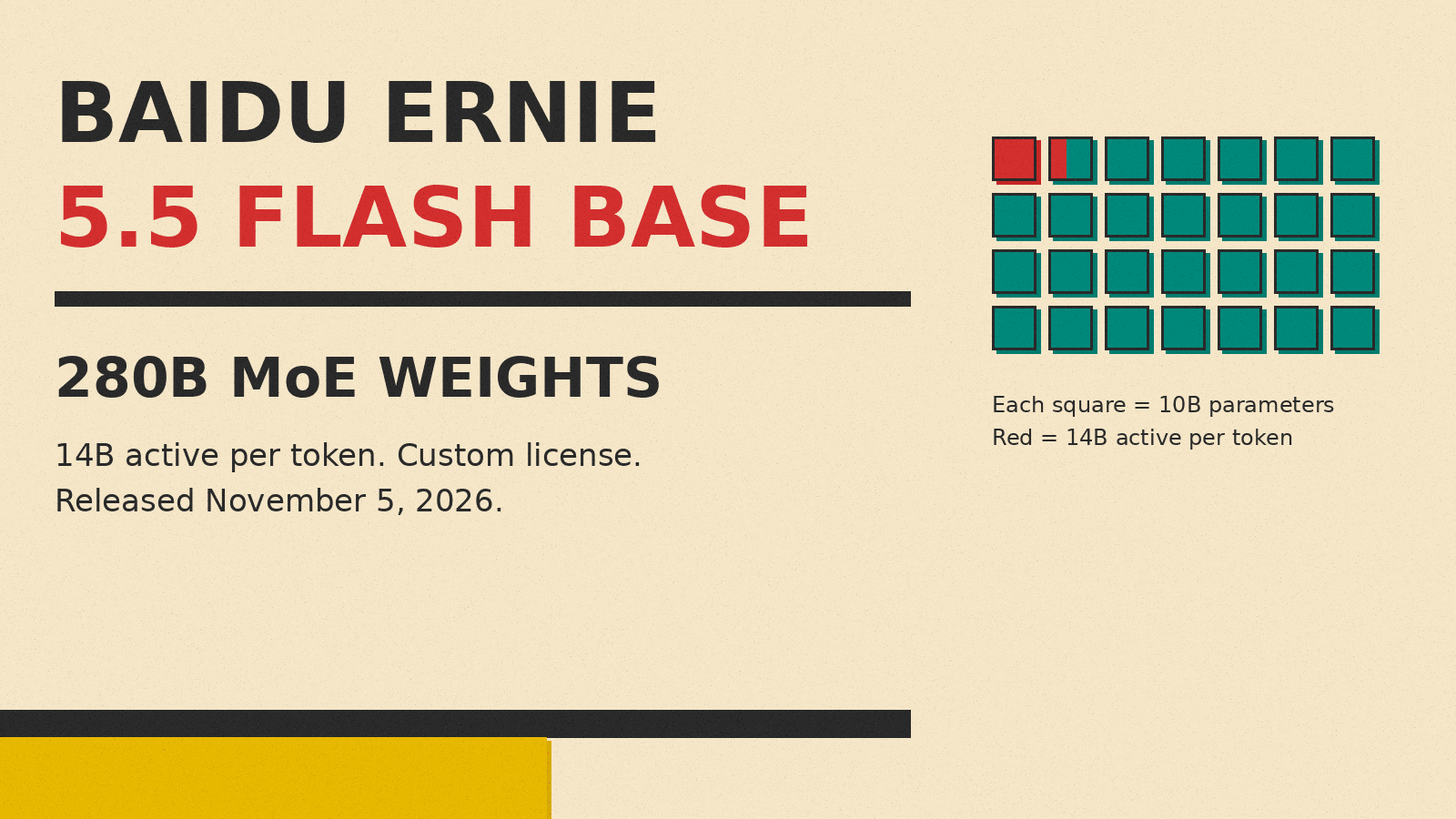
Baidu released the weights of ERNIE-5.5-Flash-Base on November 5, 2026. According to Baidu's ERNIE blog, it is a sparse Mixture-of-Experts language model with 280B total parameters, 14B of them active per token, pre-trained from scratch on 33.5T tokens. Training used a context of up to 128K tokens, and Baidu says fine-tuning and inference support 1M tokens.
Two details shape how useful the release is. This is a base checkpoint, taken at the end of pre-training, so it is not a chat model. And it ships under a custom license with geographic limits, not the Apache 2.0 license on Baidu's earlier ERNIE 4.5 repository.
What Baidu released
The Hugging Face model card lists two repositories: the FP8 weights (baidu/ERNIE-5.5-Flash-Base) and a BF16 copy (baidu/ERNIE-5.5-Flash-Base-BF16). Both are text-only. Baidu describes the weights as the checkpoint before any mid-training or post-training, meant as a starting point for domain adaptation, instruction tuning and reinforcement-learning research. Baidu's blog says a post-trained ERNIE 5.5 Flash will follow. It gives no date.
On parameter counts, Baidu says its 280B figure includes the input embedding and the output head and excludes the additional 0.36B ECHO parameters. The Hugging Face listing for the same files shows 286B.
The model card lists SGLang and vLLM as supported serving stacks. It also lists 43 layers, 512 routed experts with 10 chosen per token plus one shared expert, and a vocabulary of 201,216 entries.
The attention design
Long context is where the architecture differs most. Per the model card, 37 of the 43 layers use what Baidu calls Heavily Compressed Attention, which caches a single entry for every 128 tokens. The other 6 layers use Multi-head Latent Attention with sparse attention, so they still see individual tokens across the full context. Baidu says six long-context benchmarks stay strong with that mix.
Baidu's blog says a compressing layer caches only a small fraction of what a full-context layer needs. Baidu has published no serving cost figures, and we found no independent measurements as of November 5, 2026.
Baidu's benchmark table
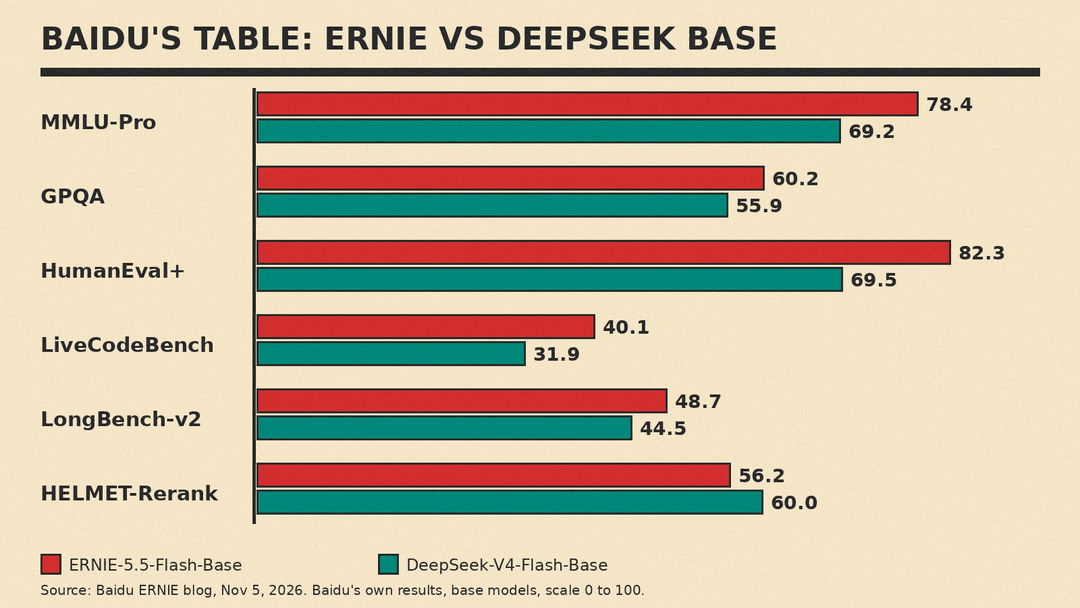
Baidu compared the base model with three similar-size base models on the same harness, prompts and few-shot examples: DeepSeek-V4-Flash-Base (284B total, 13B active), Hy3-preview-Base (295B total, 21B active) and MiMo-V2.5-Base (310B total, 15B active). These are Baidu's own results across 30 benchmarks. We have not seen a third party reproduce them.
By our count of the table on the ERNIE blog, ERNIE-5.5-Flash-Base has the top score in 24 of the 30 rows. The six rows where another model scores higher:
- ChineseSimpleQA: DeepSeek 75.3, ERNIE 73.0.
- BBH with chain of thought: Hy3-preview 90.0, ERNIE 89.2.
- INCLUDE-lite: DeepSeek 79.8, ERNIE 79.5.
- FullStackBench: Hy3-preview 56.7, ERNIE 54.6.
- HELMET-Rerank: DeepSeek 60.0, ERNIE 56.2.
- InfiniteBench: DeepSeek 48.0, ERNIE 46.5.
Some of the larger gaps against DeepSeek-V4-Flash-Base, as printed by Baidu: MMLU-Pro 78.4 against 69.2, HumanEval+ 82.3 against 69.5, and LiveCodeBench 40.1 against 31.9. These are scores for a base model, not a tuned chat model, and Baidu has not released a tuned one.
The license
The weights are under the ERNIE 5.5 Flash Base Model License Agreement v1.0, which is published in the Hugging Face repository. The ERNIE 4.5 repository baidu/ERNIE-4.5-300B-A47B-PT on Hugging Face is tagged apache-2.0. Key terms in the new text:
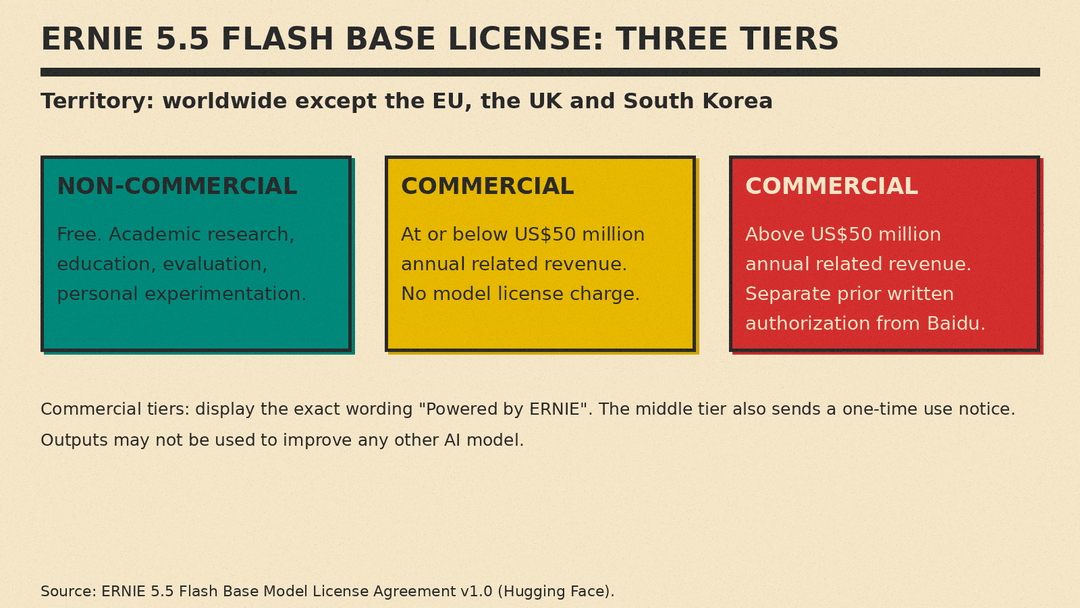
- Territory: the license applies worldwide other than the European Union, the United Kingdom and South Korea. It says the materials, derivative models and their outputs must not be used, reproduced, modified, distributed or displayed outside that territory.
- Non-commercial use, such as academic research, education, evaluation and personal experimentation, is free.
- Commercial use at or below US$50 million in annual revenue from related products or services carries no model license charge. It requires the exact wording "Powered by ERNIE" in the product, site or documentation, and a one-time use notice.
- Commercial use above US$50 million needs separate prior written authorization from Baidu. The license counts revenue from the whole related product or service, not only the part that uses ERNIE, and adds up the revenue of affiliates under common control.
- You may not use the model, a derivative model or their outputs to improve any other AI model, except the model itself and its derivatives.
- The acceptable use policy in Exhibit A bans, among 20 listed items, applying the model to military purposes.
The terms are long. Anyone planning commercial use, or any use in the EU, the UK or South Korea, should read the full text and ask a lawyer. This post is a summary, not legal advice.
For other recent Chinese open-weights licensing and benchmark coverage, see our look at the Kimi K3.1 Pro license and benchmarks and the Kimi K3.1 Pro, DeepSeek V4.1 Flash and MiniMax M3.1 Flash comparison. Tencent also launched its Hy4 model on November 4, covered in our Hy4 post.
What to watch
Three open points as of November 5, 2026:
- Baidu has not given a release date for the post-trained ERNIE 5.5 Flash.
- No independent benchmark runs of the base weights were available when we checked.
- Developers in the EU, the UK and South Korea fall outside the license territory as written.
