
China's commerce and science ministries want to put frontier AI models on the country's export control list. A draft published on October 16 as MOFCOM and MOST Announcement 2026 No. 48 would add 40 technologies to the Catalogue of Technologies Prohibited or Restricted from Export, and 23 of them are in AI: large models, agents, compute clusters, chip design and several information processing techniques. Public comments are open until November 15. A temporary rule took effect on the day of publication: exporters must register any transfer of a listed technology with MOFCOM before it happens.
The thresholds sit at the frontier, the ban list is short, and the ministry says serving a model through an API is not a technology export.
What would be restricted
The annex splits the AI items into a prohibited tier and a restricted tier. A MOFCOM spokesperson Q&A gives the totals across all three sectors as 14 prohibited and 26 restricted items.
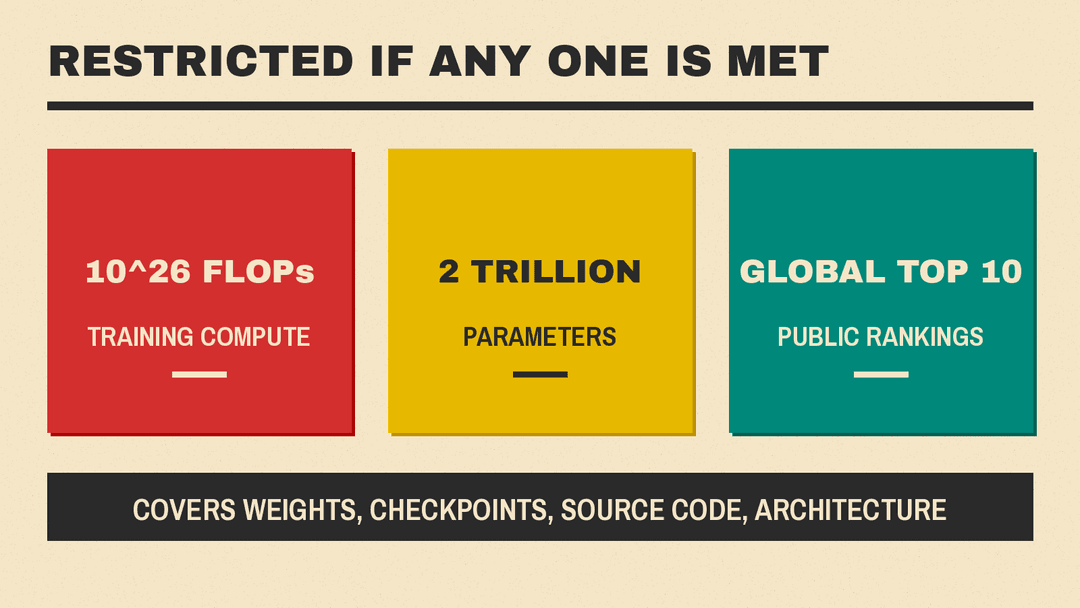
For large models, the restricted entry covers "core technology," which the annex defines as weights, key checkpoints, underlying source code, architecture design, and training optimization and inference acceleration techniques. A model qualifies if it meets any one of three tests:
- training compute of at least 10^26 floating point operations
- at least 2 trillion parameters (written in the annex as 20,000 亿)
- capability at a "globally leading level," which a note defines as a top 10 global ranking at the time of export from mainstream evaluators or large industry platforms, on measures that include overall performance, specialized ability, global call volume, safety and training efficiency
A separate restricted item covers models trained on China's "important data" as defined by the Data Security Law. Some early English coverage merged these two items into one test; the annex lists them separately.
Restricted agent technology includes planning that splits an instruction into 20 or more executable subtasks at set accuracy levels, multi-agent systems running 60 or more agents at once, and tool use across 200 or more third-party tools with at least 90 percent selection accuracy.
The rest of the restricted list covers AI chip design for 14 nm and below, memory chip design, techniques for clusters of more than 10,000 accelerator cards, and AI-assisted vulnerability discovery.
What would be banned
The prohibited AI tier is narrower. It covers AI-driven generation and mutation of malicious code aimed at critical infrastructure, defense or core government systems; large models trained on China's "core data" that then provide services; and high performance agents built mainly for those sensitive settings. The spokesperson framed the goal as preventing misuse and keeping AI "under human control."
What is explicitly carved out
The draft and the Q&A carve out three things.
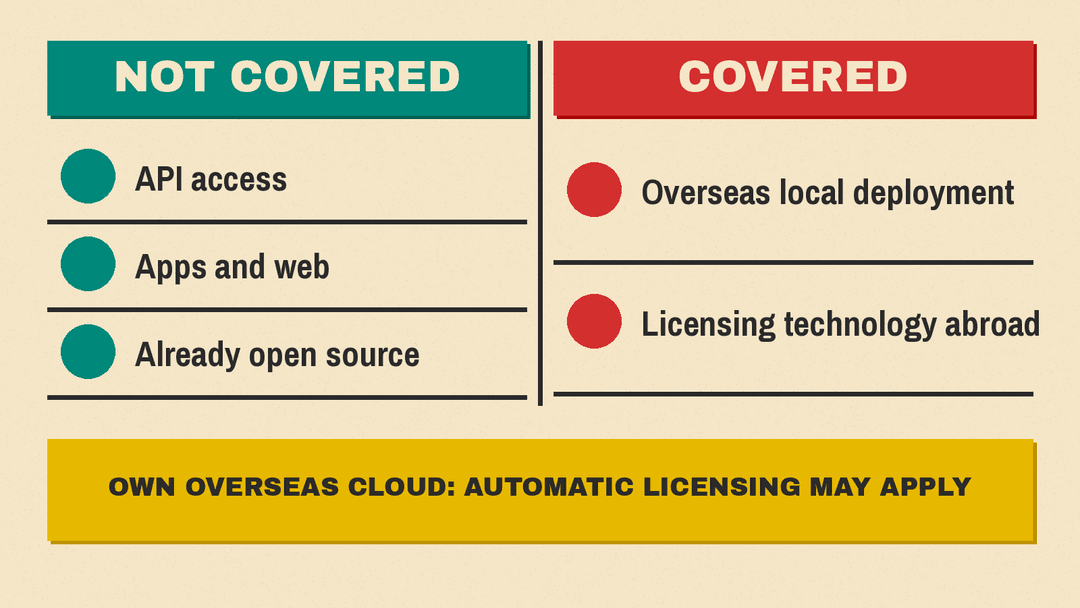
Published work. Technology that has already entered the public domain through open source releases or academic papers is not covered. The Q&A says open sourcing, Chinese firms' own compute centers abroad, overseas chip tape-outs, joint R&D and standards work will get "automatic licensing" so exports clear "as soon as they are reported."
Hosted access. The spokesperson said that offering a restricted model through API calls, app or web interaction, SaaS, or lightweight on-device deployment does not fall under model technology export management. Localized deployment of a restricted model overseas does fall in scope, though deployment on a company's own overseas cloud may qualify for automatic licensing.
Products. The Q&A says products made with listed technologies are outside the catalogue, and that "the great majority" of AI technology will remain freely exportable.
Why it matters
The parameter and compute lines are set at the top of the market. The Straits Times, carrying Bloomberg's report, named Moonshot's Kimi K3 and Alibaba's Qwen3.8-Max as examples of models at the 2 trillion parameter scale, and noted that Alibaba said in September it plans to build models of 5 to 10 trillion parameters. The top 10 test could reach further, since rankings shift week to week and the draft does not say which evaluators count.
The open-source carve out matters most for labs that publish weights, such as DeepSeek, Qwen, Zhipu and Moonshot. As drafted, weights already public stay outside the rules, and future open releases get automatic licensing: a registration step, not a ban. The South China Morning Post reported that how open-weight work will be treated in practice is the main open question among analysts, along with short-term compliance costs for companies expanding abroad.
The deals most exposed are the ones the registration rule names: licensing model technology to foreign partners, on-premises deployments for overseas customers, and ownership changes that move a lab's technology to a foreign entity. Geopolitechs read the registration first approach as a way for MOFCOM to map real export demand before finalizing the list.
The ministry says the revision "does not target any particular country, region or entity." AP and the WSJ both placed it in the context of technology competition with the United States, whose own controls have long run the other way, limiting chips going into China. According to the Straits Times report, China last added algorithms to the catalogue in 2020, during the TikTok dispute. Separately, on October 19, the US Department of Homeland Security ordered DeepSeek products removed from federal civilian agency IT.
Comments close November 15. Watch the final thresholds, how "globally leading" is measured, and whether the open-source exclusion survives intact.
Sources
- MOFCOM and MOST Announcement 2026 No. 48 (Chinese)
- MOFCOM spokesperson Q&A on the catalogue revision (Chinese)
- Global Times: commerce ministry on the AI export controls
- The Straits Times: China plans AI export curbs to exert control over key tech
- South China Morning Post: analysts on short-term costs
- AP: China moves to curb tech exports including for AI and solar
- WSJ: China Proposes Export Controls on AI Technologies
- Geopolitechs: initial thoughts on the proposed controls
