
Continuous Intelligence Limited, a London-based AI research company, announced ci-proto on 12 November 2026. The lab calls it "the debut model family from Continuous Intelligence" and says it is "available to use now." The public weight files we found are a 167 million parameter checkpoint on Hugging Face, released under a custom licence that allows research and commercial use if you meet its attribution and notification rules.
ci-proto is not a chat model. It reads sequences of measurements and returns numerical forecasts. The lab reports a leading score on one fev-bench table. A public board that uses a different metric, and that includes a closed API model, ranks it second. Those two figures are easy to mix up, so this post keeps them separate and links each source.
What time-series forecasting is for
A time series is a sequence of values recorded over time: a sensor reading, a price, a grid load, a vital sign. The 12 November announcement says: "Time series data sit at the heart of some of the world's most important systems, from machine sensors and trading feeds to electricity grids and patient vitals." It says the forecasts "inform critical decisions, such as when to maintain equipment, how to manage financial risk, and when to charge or discharge grid batteries." The company homepage gives a similar list: "manufacturing and energy grids to human health, retail and financial markets."
That is a different job from a chat LLM. A chat model is trained to generate text. A time-series foundation model is trained to forecast the next values of a measured series. Continuous Intelligence says time-series foundation models "learn from many datasets during pretraining, the approach behind the success of large language models," and that ci-proto "can forecast on unseen datasets straight away without extra training, an ability known as zero-shot forecasting."
The same post contrasts that approach with older tools. It says statistical models such as ARIMA and VAR "need to be fitted separately to each dataset and rely on linear relationships." It says machine learning models "can learn richer patterns across many variables, but each new dataset or application often needs a bespoke model, trained on large amounts of task-specific data."
The model does not answer with a single number. The Hugging Face model card says ci-proto returns nine quantiles from 0.1 to 0.9 for every target and forecast step, "to plan for a range of outcomes."
The five-model family, and what is on Hugging Face
The announcement describes a family of five models. It says: "fev-bench has a new #1 foundation model: ci-proto XL, the largest in our family at 167M parameters and still only a prototype. The smaller models deliver too. The five ci-proto models form the Pareto frontier for forecast error against model size and runtime." Pareto plots on that page label the five models as ci-proto XS, ci-proto S, ci-proto M, ci-proto L, and ci-proto XL. The only parameter count stated in the lab's prose is 167M, for XL, which it calls the largest. We did not find published parameter counts for XS, S, M, or L.
As of 12 November 2026, the Continuous Intelligence organization on Hugging Face lists one public model: ContinuousIntelligence/ci-proto. The news page's "Explore the models" link points to that organization page. The model card says the model was "Developed by: Continuous Intelligence Limited," that it is a "pretrained time-series foundation model for zero-shot probabilistic forecasting," and that it has "Parameters: 167M." The repo's config.json lists "parameters": 167190592.
The Files tab on that repo, checked on 12 November 2026, contains two weight files: model.ckpt (668,895,231 bytes) and model-long.ckpt (668,921,710 bytes), plus config.json (237 bytes), tta.json (529 bytes), LICENCE (12,209 bytes), and README.md (5,514 bytes). The card says model.ckpt is used for "histories up to 16,384 steps," model-long.ckpt is used for "longer histories, selected automatically," tta.json holds "preprocessing and calibration settings," and config.json holds "model information."
The Hugging Face repo's initial commit is dated 11 November 2026 at 10:21 UTC (2:21 a.m. Pacific Time). The model card was added on 12 November 2026 at 09:22 UTC (1:22 a.m. Pacific Time). The GitHub repository was created on 11 November 2026 at 10:51 UTC. The installable package is continuousintelligence on PyPI, version 0.1.1, uploaded 12 November 2026 at 09:22 UTC; version 0.1.0 was uploaded the day before. The project requires Python 3.10 or later, and earlier than 3.15.
In short: the lab describes five models, and the public weight files we found on 12 November 2026 are the 167M checkpoint pair on that one Hugging Face repo. We did not find separate public weight repos for XS, S, M, or L.
A 2 million step context, and what "64 times" refers to
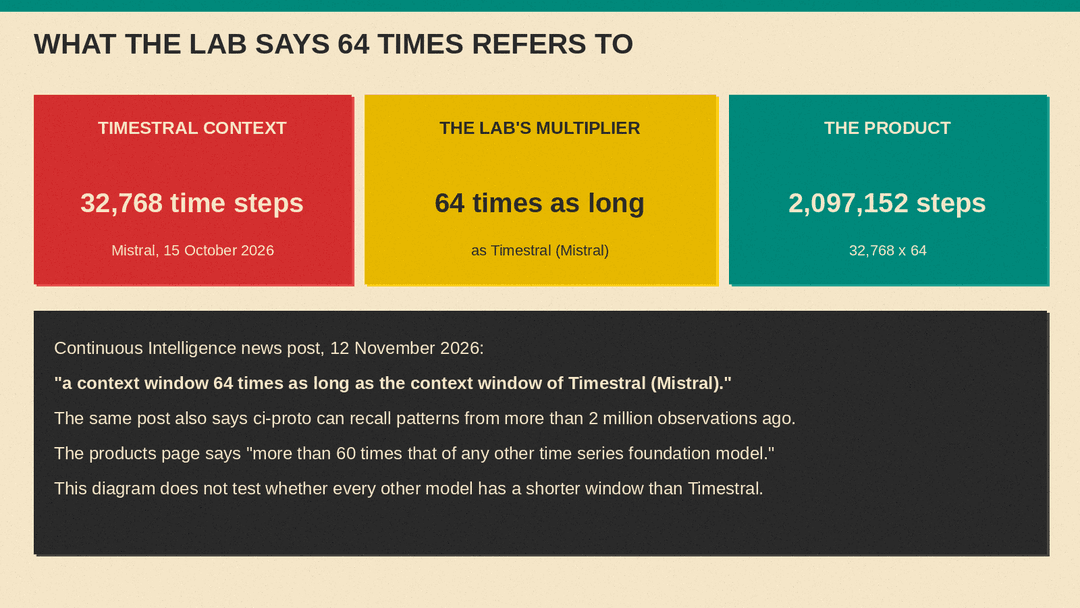
The announcement says ci-proto "can recall patterns from more than 2 million observations ago, with a context window 64 times larger than any other time series foundation model's." That "any other" comparison is the lab's claim. Later in the same post, the lab is more specific: "We show that ci-proto can use information from a context window 64 times as long as the context window of Timestral (Mistral)."
Mistral's Timestral announcement, dated 15 October 2026, lists Timestral's context length as 32,768 time steps. 32,768 times 64 is 2,097,152, which matches the lab's "more than 2 million" figure. We covered Timestral's open-weight forecast models when Mistral released them. We are not independently checking whether every other time-series foundation model has a shorter window than Timestral.
The lab's products page uses slightly different wording: "a context window of over two million steps, more than 60 times that of any other time series foundation model." The 12 November news post is the source that names Timestral and the 64 times figure.
On architecture, the same news post says most existing time-series foundation models use Transformers, and that "Attention enables accurate recall, but its computational cost grows quadratically as the number of past observations increases." It then says: "With ci-proto's novel attention-free time mixer, the computation needed to read history only grows linearly with its length."
The lab illustrates the long context with a scheduled power outage example, labelled "Simulated data." It says that with four years of electricity-use history, an earlier scheduled outage is in context and the forecast captures a drop in use, while a 23-day history misses that drop. It notes: "One eight-hour window from this experiment, using the ci-proto long-context checkpoint. Both forecasts receive the same future power outage schedule."
The fev-bench scores, and why one number can mislead
fev-bench is a forecast evaluation benchmark of 100 tasks across seven domains, including 46 tasks with covariates. The evaluation library is the autogluon/fev project. The official interactive leaderboard, after a redirect from the older fev-leaderboard URL, is the autogluon/fev-bench Hugging Face Space.
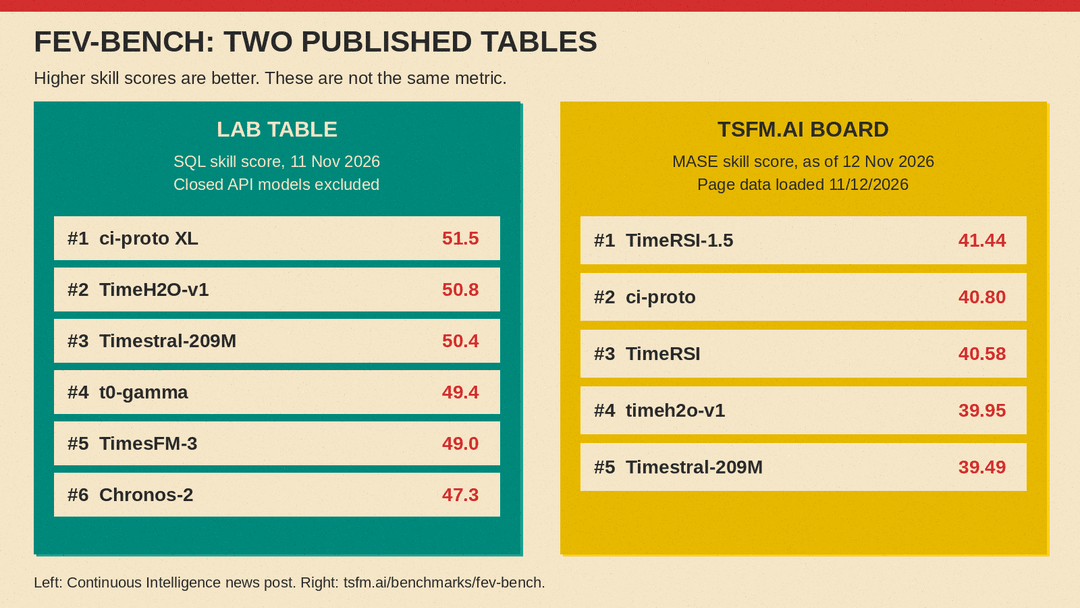
The lab's announcement says "ci-proto is the #1 foundation model on fev-bench." It prints a table captioned "SQL skill score across 100 tasks. Closed API models are excluded from this table. 11th Nov 26." In that table, higher is better:
- #1 ci-proto XL, 51.5
- #2 TimeH2O-v1, 50.8
- #3 Timestral-209M, 50.4
- #4 t0-gamma, 49.4
- #5 TimesFM-3, 49.0
- #6 Chronos-2, 47.3
Those are vendor-reported figures on the lab's own page. The model card says the evaluation was "zero-shot on all 100 tasks of fev-bench, with the released preprocessing and calibration in tta.json, scored by scaled quantile loss."
A different public view of published fev-bench results, the FEV Bench leaderboard on TSFM.ai, does not put ci-proto first. We checked that page on 12 November 2026. It says "Page data loaded 11/12/2026" and cites "Source revision 9cf943c3." It "orders all published results by MASE Skill Score," and it says skill is measured "relative to a seasonal naive baseline." Higher is better. On that board, TimeRSI-1.5 leads with a MASE skill score of 41.44, followed by ci-proto at 40.80 and TimeRSI at 40.58. The same table lists timeh2o-v1 at 39.95, Timestral-209M at 39.49, timesfm-3 at 37.82, and Chronos-2 at 35.50. For ci-proto it also lists a win rate of 83.22, inference of 0.53 seconds per 100, 0% train overlap, and 0 failures.
51.5 and 40.80 are not two readings of the same score. SQL skill and MASE skill are different error measures, each converted into a skill score against a baseline. The lab's table also excludes closed API models. In the official fev-bench model directory, TimeRSI and TimeRSI-1.5 are listed as model_type: closed-api (organization "GaTech & SamayLabs"), while ci-proto is listed as model_type: pretrained, zero_shot: true, and commercial_use: true, with organization Continuous Intelligence.
The TSFM.ai source revision 9cf943c3 is commit 9cf943c on autogluon/fev, dated 11 November 2026 at 12:52 UTC, titled "Add ci-proto wrapper and fev-bench results (#211)," and co-authored by Ben Walker.
A single headline number can hide those choices: which metric, which models are included, and which day's snapshot you are looking at. We have written before about how a benchmark score can mislead readers when the evaluation setup is not spelled out. That earlier post is about a different benchmark and a different model. The same caution applies here: read the caption, not only the rank.
The licence
The GitHub README says: "The code and model weights are released under the ci-proto Code and Model Licence." The same text appears on the Hugging Face card as "The model weights are released under the ci-proto Code and Model Licence." The licence file is identical on GitHub and Hugging Face (12,209 bytes). Its title is "ci-proto Code and Model Licence," Version 1.0, 10 November 2026. The licensor is Continuous Intelligence Limited.
The file says it "is based on the Apache License, Version 2.0, with additional attribution and notification requirements in Section 10." It is not Apache License 2.0 by itself. The project's pyproject.toml records the combined field LicenseRef-ci-proto AND Apache-2.0 AND CC-BY-4.0, which matches the README: Continuous Intelligence's code and weights use the ci-proto licence, some third-party components keep Apache License 2.0, and the bundled example data uses CC BY 4.0.
The licence includes its own brief summary: "Free for research and commercial use, subject to the attribution and notification requirements in Section 10. Redistribution and use in externally available products or services require public attribution and a one-time notification to Continuous Intelligence. Purely internal use is exempt from these additional requirements." The file then says: "This summary is provided for convenience. The terms below govern use of the code and model."
Section 10 is the added part. If you distribute or make available the work or a derivative relating to any part of the source or model weights, or a product or service (including another AI model) that contains or uses any of the work's source code or model weights, you must (A) provide a copy of the licence with those materials, and (B) prominently display this text, in a publicly accessible place, "on each related website, user interface, blogpost, about page, or product documentation": "Uses ci-proto, released by Continuous Intelligence. Continuous Intelligence does not endorse or approve this product or service."
If you use the source code, model weights, or model outputs "to create, train, fine tune, distil, or otherwise improve an AI model, which is distributed or made available," Section 10 also applies to that model and to any externally available product or service that contains or uses it.
For each model released by Continuous Intelligence Limited whose source, weights, or outputs you use, you must notify contact@continuousintelligence.co.uk once, on or before your first distribution or making available under Section 10, "identifying You, the relevant model, a brief description of Your use or distribution, and the location of Your public attribution." The licence says this notification "does not require approval by the Licensor."
The licensor may, by written notice, require you to remove that public-facing attribution from materials under your control within 30 days of receiving the notice. The corresponding attribution requirement is then waived for those materials. "Required copyright and legal notices must remain." The licence says: "The requirements of this Section 10 do not apply to purely internal use."
The rest of the file follows the Apache pattern: a copyright licence and a patent licence (the patent licence ends if you file patent litigation over the work), redistribution conditions including licence copies and change notices, an "AS IS" warranty disclaimer, and a limitation of liability.
The NOTICE file says Continuous Intelligence's contributions are covered by LICENCE, and that listed upstream components keep Apache License, Version 2.0, a licence published by the Apache Software Foundation. It names TiRex-2 from NX-AI/tirex-2 (copyright 2026 NXAI GmbH), xLSTM from NX-AI/xlstm (copyright 2024 NXAI GmbH and its affiliates 2024), and Mamba from state-spaces/mamba. The bundled Bike Sharing example is credited to Hadi Fanaee-T (2013), UCI, under CC BY 4.0, a licence published by Creative Commons.
How to try it
The GitHub README and the model card give the same quick start. Install with Python 3.10 to 3.14:
pip install continuousintelligenceThen, in Python, import continuousintelligence as ci and model = ci.load_model("ContinuousIntelligence/ci-proto"). The README says the loader "uses CUDA when available." The lab also says the model can "Run locally through the same Python API" on CPU and GPU. The documented forecast call takes a history tensor and a horizon; the default horizon in the README's usage details is 320, and the quick start forecasts 24 hourly steps. The bundled example forecasts the next day of bicycle rentals from five observed days of hourly demand in Washington, D.C.
The products page links the weights on Hugging Face and the code on GitHub, and it says an "arXiv Technical report" is "coming soon." We did not find that report at the time of writing.
Continuous Intelligence Limited is registered in England and Wales, company number 17329019, with a registered office at 107 Cheapside, London, EC2V 6DN. The about page lists Dr Benjamin Walker as co-founder and CEO, and AJ Shears as co-founder and COO/CFO.
Sources
- Introducing ci-proto (Continuous Intelligence, 12 November 2026)
- ci-proto products page
- Continuous Intelligence homepage
- About the Continuous Intelligence team
- SPRIND funding announcement, company description
- Hugging Face model card: ContinuousIntelligence/ci-proto
- Hugging Face Files tab / config.json
- Hugging Face organization
- GitHub repository: continuousintelligence/ci
- ci-proto Code and Model Licence
- NOTICE
- PyPI: continuousintelligence
- fev-bench paper
- autogluon/fev
- Official fev-bench leaderboard Space
- fev-bench models.yaml
- autogluon/fev commit 9cf943c, 11 November 2026
- TSFM.ai FEV Bench leaderboard (checked 12 November 2026)
- Mistral: Introducing Timestral, 15 October 2026
