
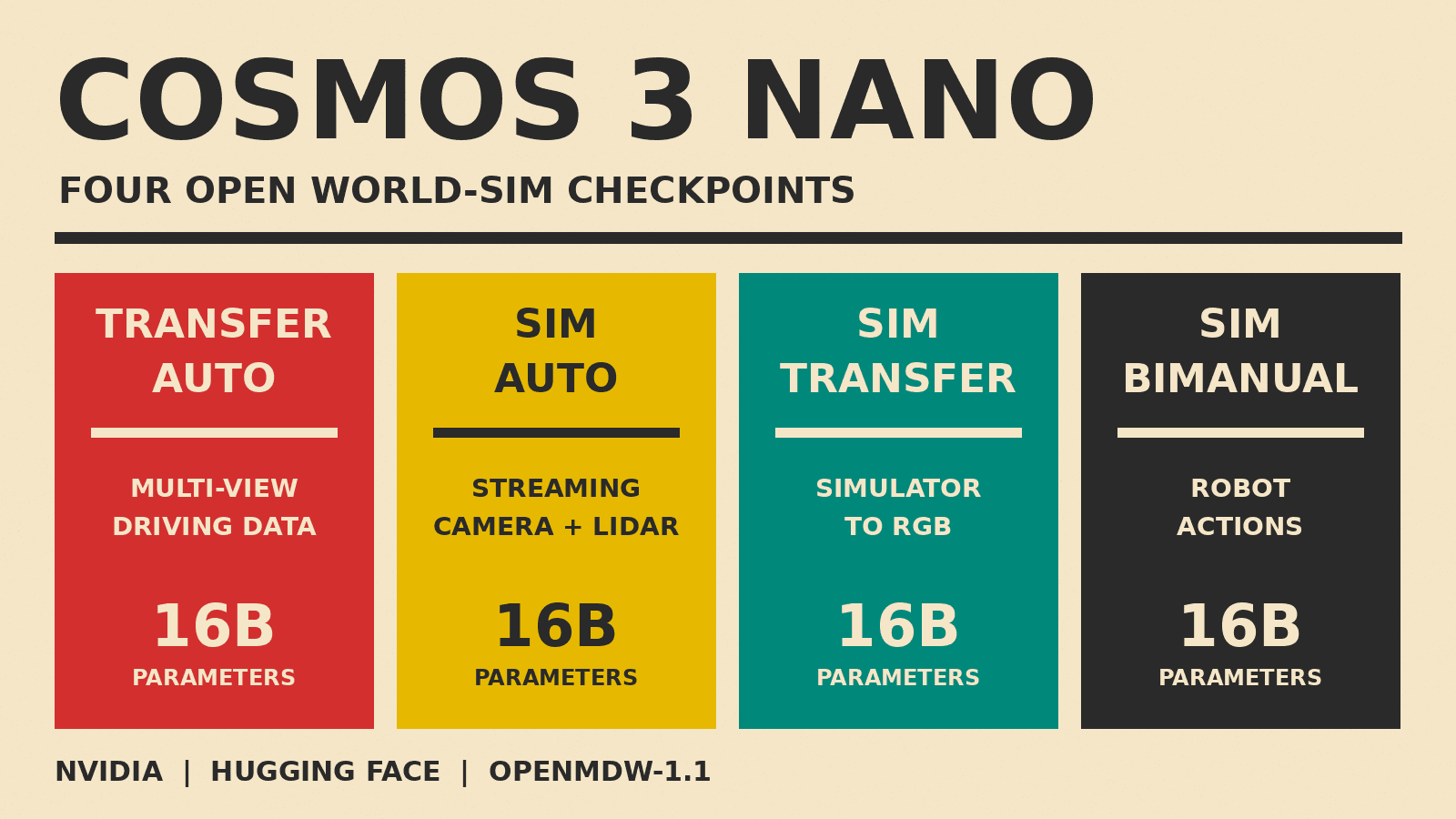
NVIDIA published four new open-weight Cosmos 3 Nano checkpoints for interactive world simulation in a Hugging Face blog post dated November 5, 2026. They are post-trained examples of Cosmos 3 Nano. Each card lists 16B trainable parameters and the OpenMDW1.1 license (the OpenMDW-1.1 text in NVIDIA's GitHub repo uses the hyphenated form).
The repos are nvidia/Cosmos3-Nano-Transfer-Auto, nvidia/Cosmos3-Nano-Sim-Auto, nvidia/Cosmos3-Nano-Sim-Transfer, and nvidia/Cosmos3-Nano-Sim-Bimanual. Each card lists Hugging Face release date 10/20/2026. The "Initial model release" weight commits are dated October 21, 2026 UTC on all four repos (October 20 evening America/Los_Angeles). The November 5 blog announces the four example checkpoints.
Physical AI, in NVIDIA's words
On the Cosmos3-Nano card, NVIDIA describes Cosmos as "a world foundation model platform designed to accelerate the development of Physical AI by enabling machines to understand, simulate, and interact with the physical world across robotics, autonomous driving, and smart space environments, including industrial and factory-scale applications." The blog frames these checkpoints as tools for interactive world simulation and multi-sensor multi-view driving scenes: controls in, next camera (and sometimes LiDAR) observations out. NVIDIA's hedge: "These problems remain hard: the work ahead is to measure where the models faithfully support policy learning and evaluation, understand their limits, and improve where they fall short."
NVIDIA also uses OpenMDW-1.1 for its Nemotron 3.5 Bolt 74B weights. Other interactive world models we have covered include Tencent's Hy-Nomas, an open 8B model under Apache 2.0, and DeepMind's Genie 4, announced as a research preview for trusted testers. Neither is part of this release.
The four checkpoints
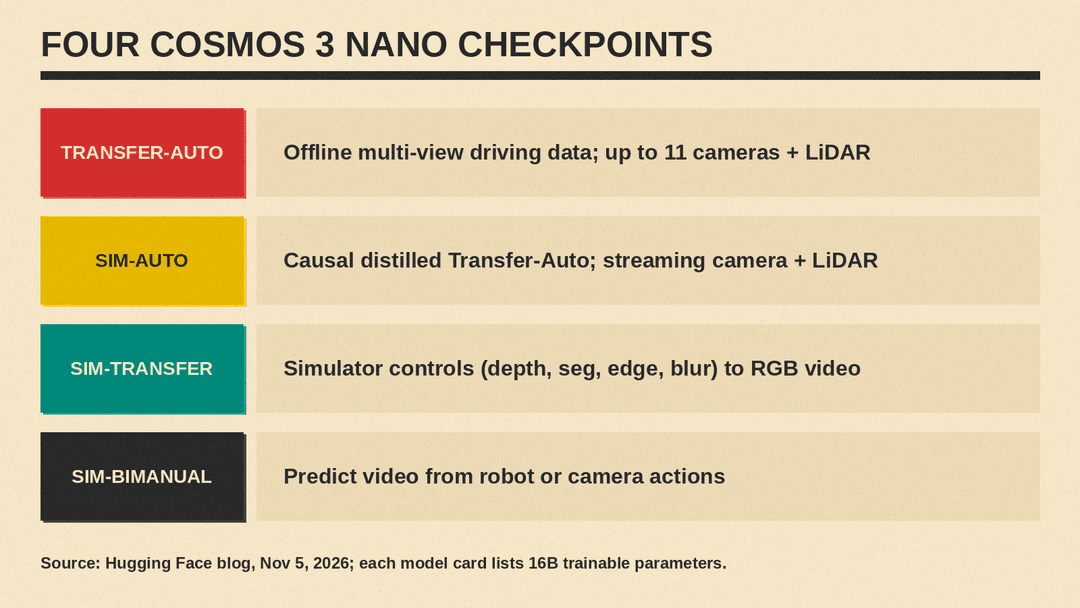
Transfer-Auto. Bidirectional offline synthetic driving data. Synchronized video across up to 11 camera views (including fisheyes) and joint RGB-LiDAR. World Scenario Map (WSM) controls set structure and traffic; text sets weather, lighting, and time of day. Source for distillation into Sim-Auto.
Sim-Auto. Causally distilled streaming variant of Transfer-Auto. Successive chunks of synchronized camera video and LiDAR "in just a few denoising steps," using history and updated driving controls. The card's RGB eval uses four denoising steps and guidance 1.
Sim-Transfer. Simulator controls plus a text prompt to photorealistic RGB. Controls named in the blog and card: depth, segmentation, edges, blur. "Text guides appearance; physics and ground-truth state stay with the simulator." Card names NVIDIA Isaac Lab as an integration path.
Sim-Bimanual. Predicts video from robot or camera actions. The blog says it "supports interactive two-arm simulation for YAM and AgiBot embodiments." The card Inputs section states "Supported embodiment: AgiBot" and does not name YAM. Both are NVIDIA sources; they disagree on YAM. Controls can come from a policy or a human-operated joystick. The mixed-action example uses 59 control values, padded to 64 in training.
Hardware (as the sources state it)
The blog's Sim-Bimanual section lists these requirements: "Linux, an NVIDIA GPU, Docker, and NVIDIA Container Toolkit. The published vLLM-Omni setup was tested on one GB200; this is not a minimum-memory specification." Cards list NVIDIA Blackwell and NVIDIA Hopper. Sim-Transfer and Sim-Bimanual also report single-GPU 480p throughput on RTX PRO 6000 (8.3 and 20.6 frames/s, NVIDIA vLLM-Omni figures). The cards do not publish a minimum VRAM for these four checkpoints and do not list Q4, Q8, or GGUF packs.
NVIDIA's quality numbers
All figures are from NVIDIA's model cards.
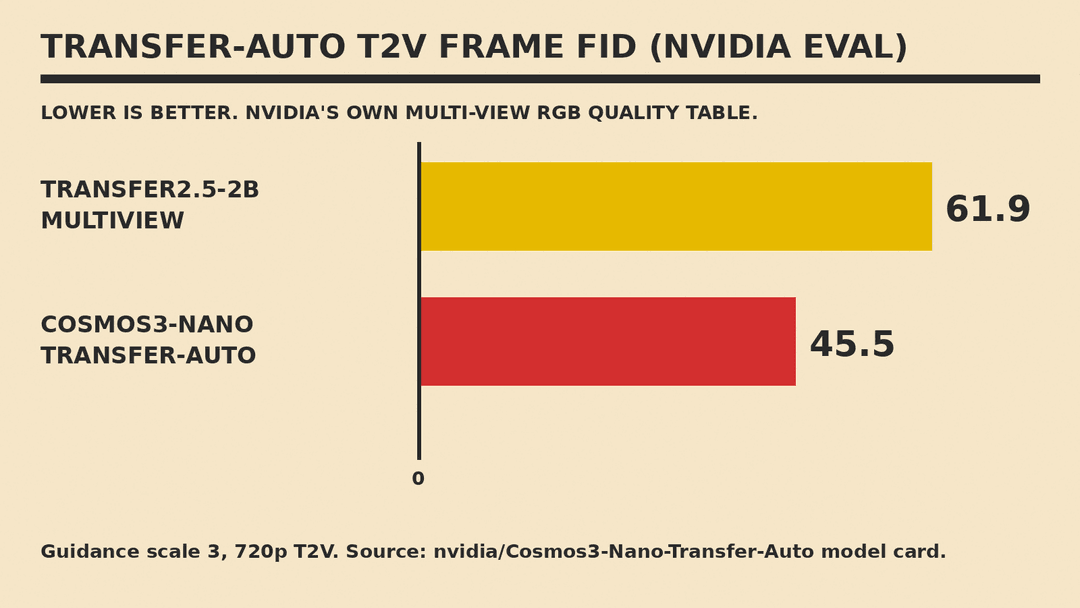
Transfer-Auto RGB (720p, guidance 3): Frame FID T2V/I2V Transfer2.5-2B Multiview 61.9/41.9, Transfer-Auto 45.5/27.8; FVD I3D 772/383 vs 488/238; FVD StyleGAN-V 770/382 vs 487/237; DOVER technical 8.56/8.22 vs 9.01/8.27; Temporal Sampson 0.530/0.524 vs 0.473/0.472; ACM 0.885/0.878 vs 0.906/0.902; CSE2 2.51/2.45 vs 2.01/2.25; CSE5 2.07/1.98 vs 1.63/1.80.
Transfer-Auto LiDAR (T2V, guidance 3): BEV JSD global/local 0.0401/0.220; BEV MMD^2 0.00347; Frechet Utonia 12.8; Utonia MMD^2 0.0208; Temporal CTC/real 1.17; Vehicle CTC/real 2.53; Object support recall 0.885; Object detection F1 @3m 0.237 (card also lists LidarVerse 21- and 116-scan rows on a different subset).
Sim-Auto RGB (720p, guidance 1, four steps): Frame FID T2V/I2V 48.6/33.6; FVD I3D 480/325; FVD StyleGAN-V 479/324; DOVER 7.30/7.51; Temporal Sampson 0.503/0.505; ACM 0.906/0.900; CSE2 2.60/2.36; CSE5 2.24/2.09. Card notes the Transfer2.5 baseline used guidance 3.
Sim-Auto LiDAR (T2V, guidance 1): BEV JSD 0.0552/0.277; BEV MMD^2 0.00593; Frechet Utonia 20.1; Utonia MMD^2 0.0354; Temporal CTC/real 1.28; Vehicle CTC/real 3.59; Object support recall 0.816; Object detection F1 @3m 0.188.
Sim-Transfer PAI-Bench-C vs Cosmos3-Nano: DOVER 10.175942 vs 10.359606; Segmentation mIoU 0.73776 vs 0.643263; Blur SSIM 0.88665 vs 0.855906; Edge F1 0.340696 vs 0.214024; Depth SI-RMSE 0.619426 vs 0.842346. Same card, VLM-judge and consistency table: Prompt following 7.025417 vs 7.184583; Video quality 4.950833 vs 4.929583; Perceptual drift 0.006504 vs 0.006349; Temporal Sampson 0.096544 vs 0.081045.
Sim-Bimanual: PAI-Bench-G video quality 73.9099, ATE 4.7072, RTE 0.0545, RRE 0.1002, drift 0.0210. Sana-WM simple: 77.2887, ATE 1.0040, RTE 0.0124, RRE 0.0551, drift 0.0118. Sana-WM hard: 76.3971, ATE 1.3085, RTE 0.0161, RRE 0.1774, drift 0.0161. AgiBot-World: quality 76.0884, PSNR 14.4138 dB, SSIM 0.6839, LPIPS 0.3454, drift 0.0118. AgiBot-GEAR: 74.4912, PSNR 14.0158 dB, SSIM 0.6172, LPIPS 0.4057, drift 0.0188. Cards also list LingBot-World 2.0, Sana-WM, and DreamDojo 2B/14B comparison rows.
License (OpenMDW-1.1)
Weights: each model card says the model is ready for commercial or non-commercial use and is released under OpenMDW1.1. Code: the Cosmos GitHub README says "Source code and models are released under OpenMDW-1.1," and the LICENSE file in the cosmos-framework repo, which the cards say was used to develop the models, is the same agreement. GitHub's license field shows "Other" for both repos. The agreement's "Model Materials" covers the models plus related artifacts, including data, documentation and software. OpenMDW-1.1 is published on openmdw.ai, a Linux Foundation site, not written for Cosmos alone. The OpenMDW-1.1 text grants permission, free of charge and subject to compliance, "to deal in the Model Materials without restriction, including under all copyright, patent, database, and trade secret rights included or embodied therein." Distribute any portion and you must retain (1) a copy of the agreement and (2) applicable copyright and origin notices. Filing, maintaining, or voluntarily participating in a lawsuit asserting the Model Materials infringe a patent or copyright terminates the grants, unless that suit responds to a corresponding suit first brought against you. The agreement sets no restrictions or obligations on the use, modification or sharing of outputs. Materials are "AS IS," without warranty, and providers are not liable for claims or damages. You clear other persons' rights and obtain needed consents. The text sets no fixed term. The README adds that the project may download third-party open source software, whose licenses users should review, and lists cosmos-license@nvidia.com for custom licensing.
Sources
- New NVIDIA Cosmos 3 Open Models for Interactive World Simulation (Hugging Face, November 5, 2026)
- nvidia/Cosmos3-Nano-Transfer-Auto
- nvidia/Cosmos3-Nano-Sim-Auto
- nvidia/Cosmos3-Nano-Sim-Transfer
- nvidia/Cosmos3-Nano-Sim-Bimanual
- nvidia/Cosmos3-Nano
- OpenMDW License Agreement, version 1.1
- NVIDIA/cosmos on GitHub (README, Citation & license section)
- NVIDIA/cosmos-framework LICENSE (OpenMDW-1.1)
