
Alibaba fully launched Qwen4-Max on November 16, 2026, five days after a preview of the model opened on November 11 (UTC+8). API access to the preview was limited to Alibaba's Token Plan subscription, and Alibaba published no benchmarks or parameter count with it. The full release adds pay-as-you-go API access, published prices, an architecture description and a set of benchmark claims. What it does not add is downloadable weights: Qwen4-Max is available only as a hosted model, and Alibaba says smaller Qwen4 models will get open weights, with no date given.
What did Alibaba launch?
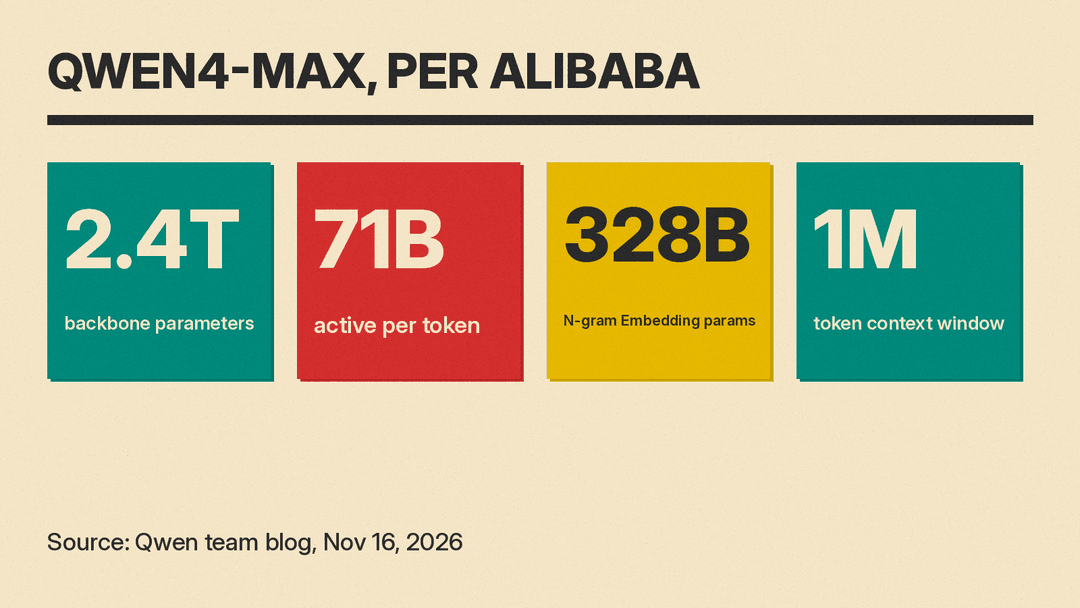
The Qwen team's launch blog, dated November 16, calls Qwen4-Max "your new AI teammate for work, creativity, and discovery." According to the blog, the model is built on a new Qwen4 architecture with 2.4 trillion backbone parameters, 71 billion activated per token, and an additional 328 billion N-gram Embedding parameters. It has native vision and a one-million-token context window.
The blog lists three architecture changes: Gated DeltaNet layers paired with Qwen Sparse Attention (QSA) for long contexts, a Gated Residual design with four parallel residual branches, and N-gram Embedding.
Alibaba's press release calls Qwen4-Max "the most capable model in the Qwen family to date" and says its 71 billion active parameters per token are "25% fewer activated parameters compared to Qwen3.8-Max at the same 2.4T scale."
What does Alibaba claim on benchmarks?
These figures come from Alibaba and have not been independently checked.
- Work360: Alibaba built this benchmark itself. The blog says it spans 26 Tier-1 domains, 182 Tier-2 subdomains and 721 Tier-3 specialized fields. Qwen4-Max scored 52.69, up from 47.74 for Qwen3.8-Max, according to the blog.
- Token use: the blog says Qwen4-Max uses about 24% fewer tokens on Work360 at Xhigh effort and 35% fewer at High effort than Qwen3.8-Max. On Terminal-Bench 4.0 the reductions are about 48% and 49%.
- Cost per task: the blog says the average cost per Work360 task drops from $4.43 to $1.67, which it calls "a 62% reduction." Alibaba's own materials round this differently: the press release says "around 60%," and Alibaba Cloud's November 17 enterprise post says "58% lower."
- Code Arena: the press release says Qwen4-Max "ranked 6th on Code Arena," as of its November 16 publication.
- Secure code: in its safety section, the blog says the function-level rate of code that passes both functionality and security checks on Last Secure Code Bench rose from 22.0% for Qwen3.8-Max to 31.8%.
The blog also says training data for offensive cybersecurity tasks was removed while defensive data was kept, and that a review by its internal experts found "No capabilities posing large-scale cybersecurity risks." It says Alibaba added dedicated CBRN safety data during post-training.
How can you use it, and what does it cost?
Qwen4-Max is on QwenCloud under the model ID qwen4-max, through both pay-as-you-go API calls and Token Plan, per QwenCloud's model guide. The Qwen blog says it is also available in Qwen Studio, QwenWork and Qoder.
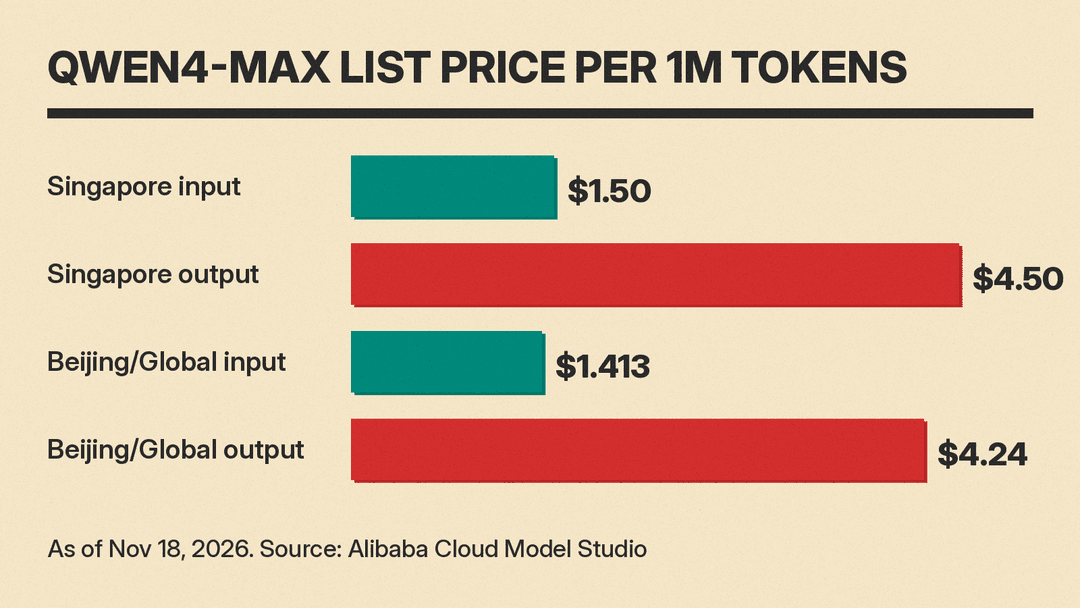
Alibaba Cloud's model page lists these prices per million tokens as of November 18, 2026:
- Singapore (International): $1.50 input, $4.50 output
- Beijing and the Global regions (Frankfurt, Hong Kong, Tokyo, US Virginia): $1.413 input, $4.24 output
QwenCloud's pricing page lists Singapore cache prices of $0.075 per million tokens for a cache hit and $1.875 or $3 for explicit cache creation with a 5-minute or 1-hour lifetime. The same page lists Qwen3.8-Max in Singapore at $2 input and $6 output. Singapore pay-as-you-go accounts get a free quota of 1 million tokens, per Alibaba Cloud's model page.
The model guide lists a 1,000,000-token context, up to 131,072 output tokens in non-thinking mode, and up to 262,144 tokens of thinking plus answer in thinking mode. Thinking is on by default at reasoning_effort high, with low and xhigh as the other settings. It accepts text, image and video input and returns text. Fine-tuning and model deployment are not supported, according to the guide.
What changed from the preview?
When we covered the Qwen4-Max preview on November 11, API access was through Token Plan only, with no pay-as-you-go option, and Alibaba had published no benchmarks, parameter count or weights.
The preview model still exists separately. As of November 18, Alibaba Cloud's qwen4-max-preview page still says the preview runs to 24:00 on November 25, 2026 (UTC+8) and that the model will be retired after it ends. The page now also says model capabilities "continue to be iterated and upgraded during the preview."
Are the weights open?
No. We found no Qwen4 model in the Qwen organization on Hugging Face as of November 18, 2026. Qwen's launch post on X says "The open weights of smaller Qwen4 models will be released," and the press release says they "will soon be released." Neither names the models, a license or a date.
Why it matters
For developers, the practical change is access. During the preview, calling Qwen4-Max through the API required a Token Plan. Now it can be called per token in six regions, at list prices below Qwen3.8-Max in Singapore, according to QwenCloud's pricing page. For teams that run Qwen models on their own hardware, the flagship is not an option for now, and the timing of the smaller open releases is unknown. The efficiency and benchmark gains are Alibaba's own figures, mostly on a benchmark Alibaba designed, so outside testing will matter.
For background, see our explainers on what Qwen is and on Qwen3.8, the previous generation.
Sources
- Qwen: Qwen4-Max: Your New Teammate Has Arrived
- Alibaba Cloud press room: Alibaba Unveils Qwen4-Max
- Alibaba Cloud blog: Qwen4-Max for the enterprise (Nov 17)
- Alibaba Cloud Model Studio: qwen4-max
- QwenCloud: Latest model: Qwen4-Max
- QwenCloud: Model pricing
- Alibaba Cloud Model Studio: qwen4-max-preview
- Qwen on X: Meet Qwen4-Max
- Hugging Face: Qwen organization
