
Ant Group's AI lab, inclusionAI, has published two open-weight audio models under the MIT license: Ming-3.0-audio-flash and Ming-3.0-audio-tiny. Both take audio plus a text instruction and return text, or text with synthesized speech. One model covers transcription, spoken questions, sound and music understanding, reasoning over recordings, and voice replies. The Hugging Face commit history shows the first weight files were uploaded on September 3, 2026, and the model cards were added on October 19. The Flash release also has a thread on r/LocalLLaMA.
This explainer covers what the two models are, what inclusionAI's own benchmark tables show, and what hardware the official setup expects.
What Ming-3.0-audio is
The inclusionAI organization page on Hugging Face describes the group as the home of Ant Group's artificial general intelligence (AGI) initiative. It also ships the Ling-3.1-flash text model. The model card calls Ming-3.0-audio-flash a "native audio-language model". It combines an audio encoder and projector with a mixture-of-experts language backbone, so one model handles both the listening and the answering.
The two sizes, per the model cards:
- Ming-3.0-audio-flash: 126B total parameters, 6.5B active per inference step. About 259 GB of files on Hugging Face.
- Ming-3.0-audio-tiny: 9.3B total parameters, 2.7B active per inference step. About 21 GB of files.
- Languages: Chinese and English, "including varied accents and dialects".
- License: MIT for both.
The Flash config file lists a mixture-of-experts backbone with 512 experts, 8 active per token, 42 layers and a 131,072-token maximum position setting. An optional component, which inclusionAI calls the Talker, turns the model's output into speech.
What it does
The GitHub README lists five abilities:
- Speech recognition in Chinese and English across dialects, accents, noisy rooms and multi-speaker meetings.
- Understanding of long recordings.
- Perception of speech, non-speech sounds, acoustic scenes and music.
- Reasoning over audio content.
- Spoken dialogue, with optional synthesized speech.
For voice output you can pick a built-in voice, a registered voice ID, or clone a voice from a reference WAV file plus its exact transcript. The voice guide lists the built-in voices.
That breadth is why the release matters. A self-hosted voice app usually wires together a transcription model, a text model and a text-to-speech model. Ming puts those jobs behind one set of MIT-licensed weights that teams can run on their own servers, which matters for anyone who cannot send recordings to a cloud API.
Benchmarks: strong on transcription, behind on long audio and voice chat
All numbers below come from inclusionAI's own charts. The README says Flash was tested in non-thinking mode. It also says competitor results were "reproduced under our evaluation setup and may differ from their official reports". Treat them as vendor numbers until someone tests them independently.
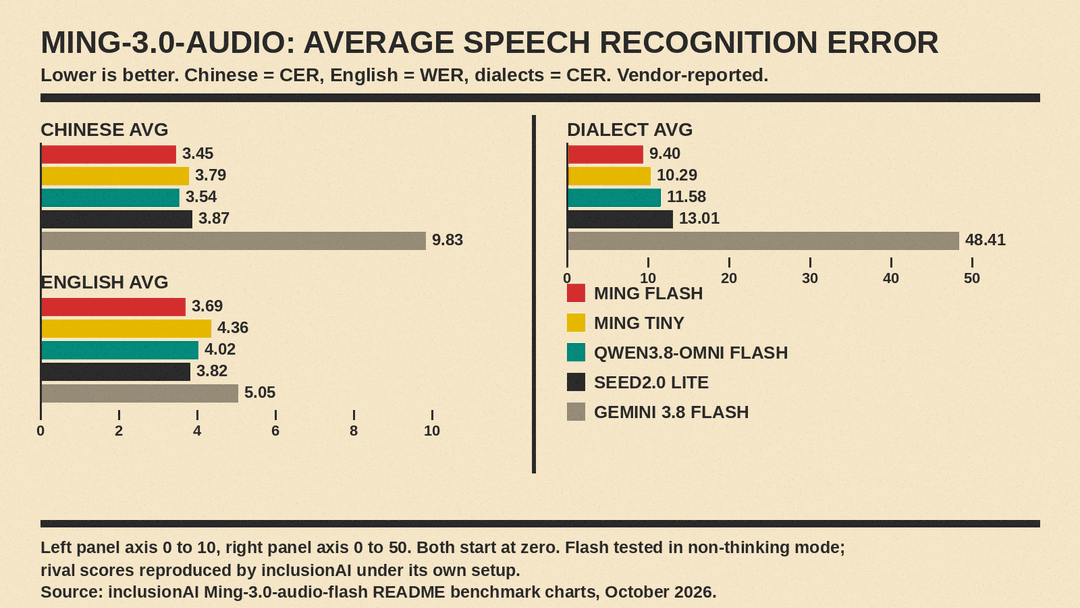
Transcription is the strongest result. Lower error is better. Flash posts the best average on all three recognition groups in the chart:
- Chinese average character error rate: 3.45, against 3.54 for Qwen3.8-Omni Flash (non-thinking), 3.87 for Seed2.0 Lite and 9.83 for Gemini 3.8 Flash.
- English average word error rate: 3.69, against 3.82 for Seed2.0 Lite, 4.02 for Qwen3.8-Omni Flash and 5.05 for Gemini 3.8 Flash.
- Chinese dialect average: 9.40, against 11.58 for Qwen3.8-Omni Flash, 13.01 for Seed2.0 Lite and 48.41 for Gemini 3.8 Flash.
Tiny scores 3.79, 4.36 and 10.29 on the same three averages. That puts it ahead of Seed2.0 Lite on Chinese and dialects, and ahead of Qwen3.8-Omni Flash on dialects, with less than one thirteenth of Flash's total parameters.
Meetings are a weak spot. The README lists multi-speaker meetings as a strength, but the long-form table shows Qwen3.8-Omni Flash well ahead on speaker attribution. On AliMeeting, Flash's cpWER (word errors with speaker labels counted) is 37.37 against 17.20. On AISHELL-4, Flash's diarization error rate is 8.58 against 2.80. Flash does lead on the Earnings22 earnings-call sets, with a word error rate of 11.60 against 11.99 for Qwen3.8-Omni Flash.
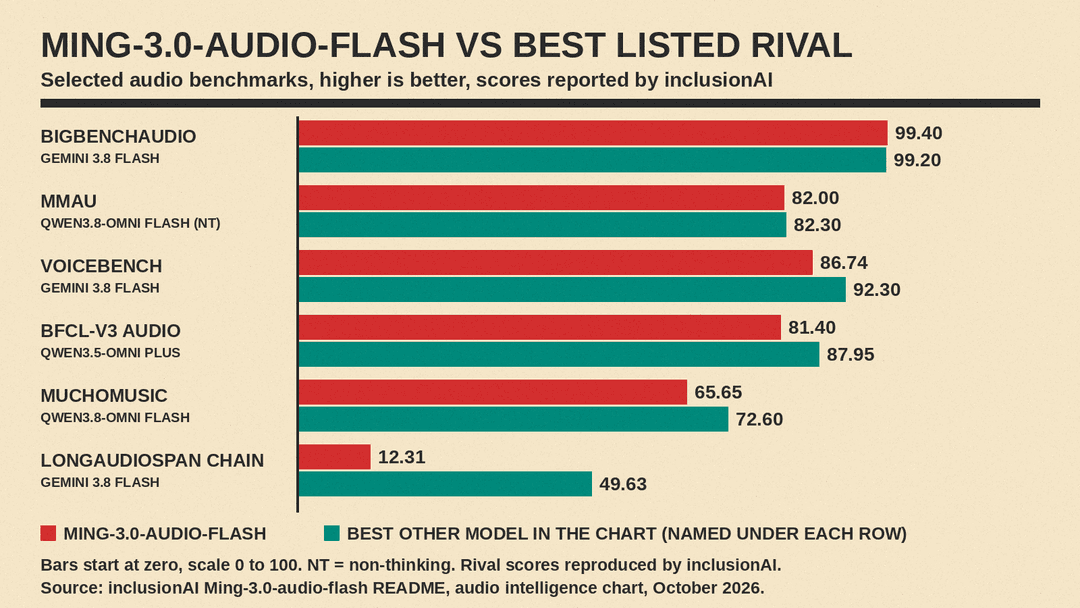
Audio understanding is mixed. Flash tops BigBenchAudio at 99.40. Tiny and Gemini 3.8 Flash both score 99.20. It is close on MMAU at 82.00 against 82.30 for Qwen3.8-Omni Flash (non-thinking). The gaps are wider elsewhere:
- VoiceBench (spoken interaction): 86.74, against 92.30 for Gemini 3.8 Flash.
- MuchoMusic (music): 65.65, against 72.60 for Qwen3.8-Omni Flash.
- BFCL-v3 Audio (tool calling from speech): 81.40, against 87.95 for Qwen3.5-Omni Plus.
- LongAudioSpan chain score (long audio): 12.31, against 49.63 for Gemini 3.8 Flash.
Text skills trail Qwen3.8-Omni Flash. In the text table, Flash scores 82.45 on GPQA Diamond, 80.00 on MMLU-Pro and 79.90 on LiveCodeBench v6. Qwen3.8-Omni Flash scores 91.00, 87.70 and 92.60. Flash does beat Qwen3.5-Omni Plus on six of the eight text tests.
The pattern is clear. If your main job is transcribing Chinese or English, especially regional Chinese dialects, Flash is the open model to test first. If you need a voice assistant that holds long conversations or reasons over long recordings, the vendor's own numbers say other models do better.
What it takes to run
Flash is not a desktop model. The weights total about 259 GB in BF16, and the official serving profiles are sized for datacenter GPUs:
- vLLM-Omni (inclusionAI's fork): the default Flash profile uses tensor parallelism across eight 80 GB H800 GPUs. The README says this is needed for the default 128K context, because vLLM reserves KV-cache memory for the full context at startup. You can shrink the context limits in the deploy files for smaller hardware.
- SGLang (an audio branch of sglang_ling_v3): a validated four-GPU profile for Flash, text output only.
- Transformers: direct inference for local tests and research, with
trust_remote_code=True. inclusionAI tells users to review the model code before turning that on.
Tiny is the practical option for a single machine. Its text and transcription profile runs on one GPU. The full speech-output profile puts the main model on one GPU and the Talker on a second. Both servers expose an OpenAI-compatible API. For speech output, the README points to vLLM-Omni or Transformers; the SGLang example covers text output only.
For background on sizing local hardware, see our earlier explainer on MiniCPM-V 4.7, a vision model built to run on phones.
Why it matters
Ming-3.0-audio is an MIT-licensed model that listens, reasons and talks, with a small version whose text profile runs on one GPU. The transcription numbers are strong enough to matter for anyone building Chinese or bilingual products. The meeting and long-audio numbers show where the work is not done. Independent tests will show how much of the vendor's lead holds up.
