Choosing an LLM API in October 2026 is mostly a pricing question. The four largest first-party APIs (OpenAI, Anthropic, Google, and DeepSeek) now each sell a ladder of models from a few cents to tens of dollars per million tokens, and each adds its own rules for caching, batch jobs, long prompts, speed tiers, and time-limited promotions. List prices alone do not tell you what a workload will cost.
This guide collects the current list prices from each provider's official pricing page, explains the modifiers that change the bill, and runs one example workload through every major model. All prices are in US dollars per one million tokens (MTok) and were checked on October 19, 2026. Prices change often, so confirm on the linked pages before you commit.
How to read LLM API prices
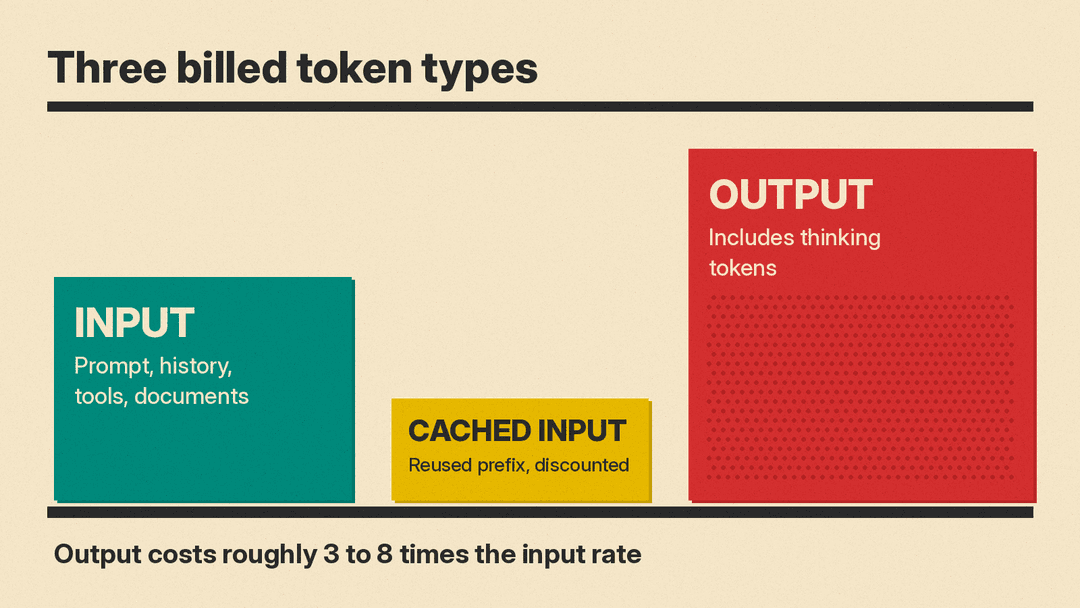
Every provider in this guide charges separately for three things:
- Input tokens: everything you send, including the system prompt, chat history, tool definitions, and retrieved documents.
- Cached input tokens: input that the provider has already processed and stored from an earlier request. These are billed at a fraction of the normal input rate.
- Output tokens: everything the model generates. For reasoning models this includes thinking tokens, which you pay for even when you do not see them. Google states this directly on its Gemini pricing page ("Output price (including thinking tokens)").
Output is always the expensive side. Across the models below, output costs roughly 3 to 8 times the input rate. A chat or agent workload that reads a lot and writes a little will cost far less than one that generates long answers.
The request cost formula is the same everywhere. OpenAI's ChatGPT rate card writes it out: cost = (input tokens / 1,000,000 x input rate) + (cached input tokens / 1,000,000 x cached rate) + (output tokens / 1,000,000 x output rate).
Flagship models compared
These are the top general-purpose models each provider sells on its self-serve API. Limited-access models (such as Anthropic's Claude Mythos 5.1 and OpenAI's cyber and life sciences models) are excluded.
| Model | Input | Cached input | Output | Notes |
|---|---|---|---|---|
| OpenAI GPT-6 Astra | $10.00 | $1.00 | $50.00 | $20 / $75 above 272K input tokens |
| Anthropic Claude Fable 5.1 | $10.00 | $0.25 | $50.00 | Same rate across 1M context |
| OpenAI GPT-5.6 Sol | $4.00 | $0.40 | $20.00 | Promotional price through at least Nov 21, 2026 |
| Anthropic Claude Opus 5.5 | $4.00 | $0.20 | $20.00 | Same rate across 1M context |
| Google Gemini 4 Argon | $2.00 | $0.10 | $10.00 | Rises to $4 / $20 on Dec 1, 2026 |
| OpenAI GPT-6.1 Sol | $2.00 | $0.10 | $10.00 | $4 / $15 above 272K input tokens |
| Google Gemini 3.1 Pro Preview | $2.00 | $0.20 | $12.00 | $4 / $18 above 200K prompt tokens |
| DeepSeek V4-Pro | $1.32 | $0.044 | $3.96 | Peak rate; off-peak is half |
Sources: OpenAI API pricing, Claude pricing, Gemini API pricing, DeepSeek pricing.
Three points stand out.
First, the top tier has split in two. GPT-6 Astra and Claude Fable 5.1 both sit at $10 input and $50 output. Below them, a group of strong models (GPT-6.1 Sol, Gemini 4 Argon, Claude Sonnet 5.5 in the next section) sits at $2 input and $10 output, which is one fifth of the top tier.
Second, two of the flagship prices are promotional. OpenAI says GPT-5.6 Sol's promotional pricing "is available at least through November 21, 2026," and Google lists Gemini 4 Argon at $2 / $10 "through November 30, 2026" and $4 / $20 "starting December 1, 2026." If you build a cost model today, use the post-promotion price for anything that will run into December.
Third, DeepSeek is priced well below the rest. Its V4-Pro peak rate is $1.32 input and $3.96 output, and the off-peak rate is half that.
Mid-tier and budget models compared
Most production traffic does not need a flagship model. Classification, extraction, routing, summarization, and simple tool calls usually run on a smaller model.
| Model | Input | Cached input | Output | Notes |
|---|---|---|---|---|
| Anthropic Claude Sonnet 5.5 | $2.00 | $0.10 | $10.00 | Same rate across 1M context |
| OpenAI GPT-5.6 Terra | $2.00 | $0.20 | $12.00 | $4 / $18 above 272K input tokens |
| Google Gemini 3.8 Flash | $0.75 | $0.075 | $3.75 | Rises to $1.50 / $7.50 on Jan 1, 2027 |
| Google Gemini 3.5 Flash-Lite | $0.30 | $0.03 | $2.50 | Free tier available |
| DeepSeek V4.1 Flash (deepseek-flash) | $0.30 | $0.006 | $1.20 | Peak rate; off-peak is half |
| OpenAI GPT-5.6 Luna | $0.20 | $0.02 | $1.20 | $0.40 / $1.80 above 272K |
| OpenAI GPT-6 Luna | $0.10 | $0.01 | $0.50 | $0.20 / $0.75 above 272K |
| Anthropic Claude Haiku 5.5 | $0.10 | $0.01 | $0.50 | Prompts up to 100K tokens |
| Anthropic Claude Haiku 5.5 (long) | $0.50 | $0.05 | $2.50 | Prompts over 100K tokens |
At the low end, GPT-6 Luna and Claude Haiku 5.5 have the same list price: $0.10 input and $0.50 output. The difference is the long-prompt rule. Haiku 5.5 bills the whole request at five times the rate once the prompt passes 100,000 tokens, and Anthropic notes that this threshold counts cache reads and cache writes too. Above 272,000 input tokens, GPT-6 Luna doubles its input rate and raises its output rate by half, to $0.20 and $0.75. If your prompts are long, these thresholds matter more than the headline price.
Gemini 3.8 Flash is the only budget model here with a scheduled price increase. Google lists $0.75 / $3.75 through December 31, 2026 and $1.50 / $7.50 starting January 1, 2027.
Modifiers that change the bill
List prices are the starting point. The following modifiers often change the real cost by 50 percent or more.
Prompt caching
All four providers discount repeated input, but the discount size differs by model.
- Anthropic charges 0.1x the base input price for cache hits on most models, 0.05x on Opus 5.5 and Sonnet 5.5, and 0.025x on Fable 5.1 and Mythos 5.1. Writing to the cache costs extra: 1.25x base input for a 5-minute cache and 2x for a 1-hour cache. Anthropic's docs say the 5-minute cache pays off after one cache read and the 1-hour cache after two.
- OpenAI lists cached input at 0.1x on GPT-6 Astra, GPT-6 Sol, and the GPT-5.6 models, and 0.05x on GPT-6.1 Sol ($0.10 against $2.00). The newest models also list a cache write price, for example $2.50 on GPT-6.1 Sol.
- Google lists context caching at 0.05x on Gemini 4 Argon ($0.10 against $2.00) and notes "implicit caching only (explicit caching is not supported)" for that model. Gemini 3.8 Flash charges 0.1x plus a storage fee of $0.50 per million tokens per hour through the end of 2026.
- DeepSeek has the deepest cache discount: a cache hit on
deepseek-flashcosts $0.006 at peak against $0.30 for a cache miss, which is 2 percent of the miss price.
For agents and chat apps that resend a long system prompt and history on every turn, cache hit rate is often the largest single factor in cost.
Batch and flex processing
If you can wait for results, every provider except DeepSeek offers a 50 percent discount:
- Anthropic's Batch API is 50 percent off input and output. Batch discounts stack with caching.
- OpenAI's Batch and Flex tiers are both priced at half of Standard for the current models.
- Google lists "Batch API (50% cost reduction)" for paid tier users.
DeepSeek does not list a batch tier. Instead, it has time-of-day pricing (see below).
Speed tiers
All three US providers now sell faster output at a premium.
- OpenAI renamed Priority processing to Fast mode on July 30, 2026. Fast mode is 2x Standard on the current models, for example $4 / $20 on GPT-6.1 Sol. An Ultrafast tier is listed only for GPT-6 Astra and GPT-6.1 Sol, at 6x Standard.
- Anthropic's Fast mode costs $8 / $40 on Opus 5.5 (2x) and $10 / $50 on Opus 5 (2x). It is not available with the Batch API.
Long context surcharges
OpenAI's current models charge a higher "long context" rate when input exceeds 272,000 tokens. Google charges more on Gemini 3.1 Pro Preview above 200,000 prompt tokens. Anthropic, in contrast, says Claude 4.6 and later models (except Haiku 5.5) bill "the full 1M token context window at standard pricing." For workloads that routinely send 300,000 tokens or more, this difference alone can decide the provider.
Data residency
Both OpenAI and Anthropic charge a 10 percent uplift for regional processing. OpenAI applies it to models released on or after March 5, 2026. Anthropic applies a 1.1x multiplier when you set inference_geo: "us" on Claude 4.6 and later models.
Off-peak pricing at DeepSeek
DeepSeek's off-peak rates are half of its peak rates. Peak hours are 01:00 to 04:00 and 06:00 to 10:00 UTC, Monday through Friday. In US Pacific time, while daylight saving time is in effect (through November 1), that is 6:00 PM to 9:00 PM and 11:00 PM to 3:00 AM, Sunday evening through Thursday night. Weekends and Chinese public holidays are off-peak in full. Scheduled jobs that run during US business hours fall in off-peak time.
Tokenizer differences
A million tokens is not the same amount of text on every model. Anthropic states that Claude 4.7 and later models use a newer tokenizer that "produces approximately 30% more tokens for the same text." When you compare Claude against another provider, measure token counts on your own data instead of assuming parity.
Worked example: one monthly workload across every model
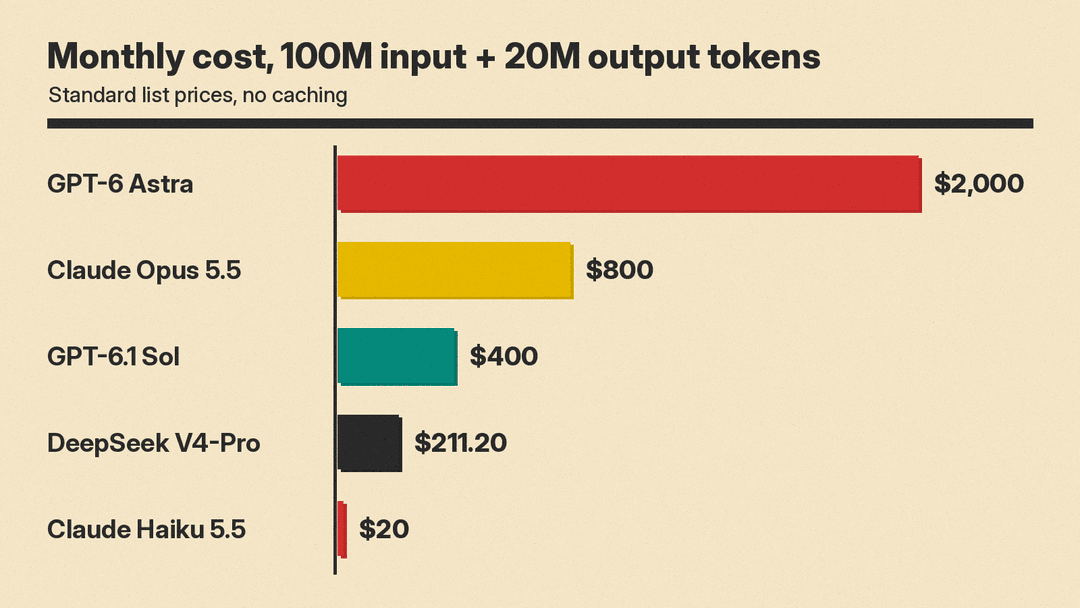
To make the tables concrete, take a workload of 100 million input tokens and 20 million output tokens per month. That is roughly a mid-sized support or coding assistant. The table shows two cases: no caching, and 80 percent of input served from cache. The cached case uses the cache hit price only and ignores cache write charges, so treat it as a lower bound. All figures use Standard tier list prices, short-context rates, and DeepSeek peak rates.
| Model | No cache | 80% cached |
|---|---|---|
| OpenAI GPT-6 Astra | $2,000 | $1,280 |
| Anthropic Claude Fable 5.1 | $2,000 | $1,220 |
| OpenAI GPT-5.6 Sol (promo) | $800 | $512 |
| Anthropic Claude Opus 5.5 | $800 | $496 |
| Google Gemini 3.1 Pro Preview | $440 | $296 |
| OpenAI GPT-6.1 Sol | $400 | $248 |
| Anthropic Claude Sonnet 5.5 | $400 | $248 |
| Google Gemini 4 Argon (promo) | $400 | $248 |
| DeepSeek V4-Pro | $211.20 | $109.12 |
| Google Gemini 3.8 Flash (promo) | $150 | $96 |
| DeepSeek V4.1 Flash | $54 | $30.48 |
| OpenAI GPT-6 Luna | $20 | $12.80 |
| Anthropic Claude Haiku 5.5 | $20 | $12.80 |
How the numbers were calculated: for GPT-6.1 Sol with no cache, 100 x $2.00 + 20 x $10.00 = $400. With 80 percent cached, 20 x $2.00 + 80 x $0.10 + 20 x $10.00 = $248.
Some notes on this table:
- After the promotions end, Gemini 4 Argon at $4 / $20 would cost $800 uncached, the same as Opus 5.5. Gemini 3.8 Flash at $1.50 / $7.50 would cost $300.
- At DeepSeek off-peak rates, both DeepSeek figures fall by half.
- Batch processing would halve every non-DeepSeek figure, for work that can wait.
- Output is 20 of the 120 million tokens here, but on most models it is half of the uncached bill. On GPT-6.1 Sol, output is $200 of $400.
- Price per token is not cost per task. A model that needs fewer turns, fewer retries, or fewer reasoning tokens to finish a task can cost less overall even at a higher rate.
Which API is cheapest for which job
Based only on list prices and the modifiers above:
- Lowest cost for high-volume simple tasks: GPT-6 Luna and Claude Haiku 5.5, both at $0.10 / $0.50. Choose Haiku 5.5 only if prompts stay under 100,000 tokens.
- Lowest cost per token overall with a capable model: DeepSeek V4.1 Flash, especially off-peak and with high cache hit rates. Check your data residency and compliance needs first.
- Mid-price general use: GPT-6.1 Sol, Claude Sonnet 5.5, and Gemini 4 Argon all list at $2 / $10 today. Argon's price doubles on December 1, 2026.
- Very long prompts: Anthropic's Opus 5.5 and Sonnet 5.5 bill the full 1M context at the standard rate, while OpenAI and Google charge more above 272K and 200K tokens.
- Top-tier quality where cost is secondary: GPT-6 Astra and Claude Fable 5.1 are priced the same. Fable 5.1 has the cheaper cache hit price ($0.25 against $1.00).
How to estimate your own costs
- Log real token counts. Every API returns input, cached, and output token counts in its usage field. Collect a week of traffic before you compare providers.
- Count tokens per provider. Run the same sample prompts through each candidate's token counter. Tokenizers differ, and Anthropic documents a 30 percent increase on its newer models.
- Measure cache hit rate. Put static content (system prompt, tool definitions, reference documents) at the start of the prompt so it can be cached.
- Split traffic by urgency. Send anything that can wait to Batch or Flex for 50 percent off, or schedule DeepSeek jobs off-peak.
- Plan for promotions to end. Use the post-promotion rates for GPT-5.6 Sol (once OpenAI publishes them), Gemini 4 Argon, and Gemini 3.8 Flash in any budget that runs past their end dates.
- Recheck monthly. Providers change prices and add models often. Google's pricing page, for example, was last updated on October 16, 2026.