
Data scientists turn raw data into findings that a business can act on. The U.S. Bureau of Labor Statistics (BLS) projects the job to grow much faster than average over the next decade, and it names AI as one reason. This guide covers what the job involves, what it pays, what employers ask for, and the free books and courses that teach the core skills.
Every number below comes from the BLS Occupational Outlook Handbook page for data scientists, last modified August 27, 2026. Course and book details were checked on each resource's own page as of October 2026.
What a data scientist does
BLS defines the job in one line: data scientists "use analytical tools and techniques to extract meaningful insights from data." Its list of typical duties:
- Determine which data are available and useful for the project
- Collect, categorize, and analyze data
- Create, validate, test, and update algorithms and models
- Use data visualization software to present findings
- Make business recommendations to stakeholders based on data analysis
A project often starts with large, unstructured "raw data." BLS says data scientists must "clean" that data, which means giving it a structure that software can read. Then they build models, use machine learning to classify data or make predictions, and test those models for accuracy as new data comes in.
The last step is communication. BLS says data scientists use charts, maps and other graphics so that "technical and nontechnical audiences" can follow the analysis and act on it.
BLS also notes that the job splits into focus areas. Some data scientists with "a strong coding or engineering background" build machine learning algorithms and systems. Others do research for reports or academic journals. Others work on business strategy, such as marketing, sales and user engagement.
If the line between AI, machine learning and data science is fuzzy for you, our explainer on AI vs machine learning vs deep learning sorts out the terms.
Data scientist pay and job outlook
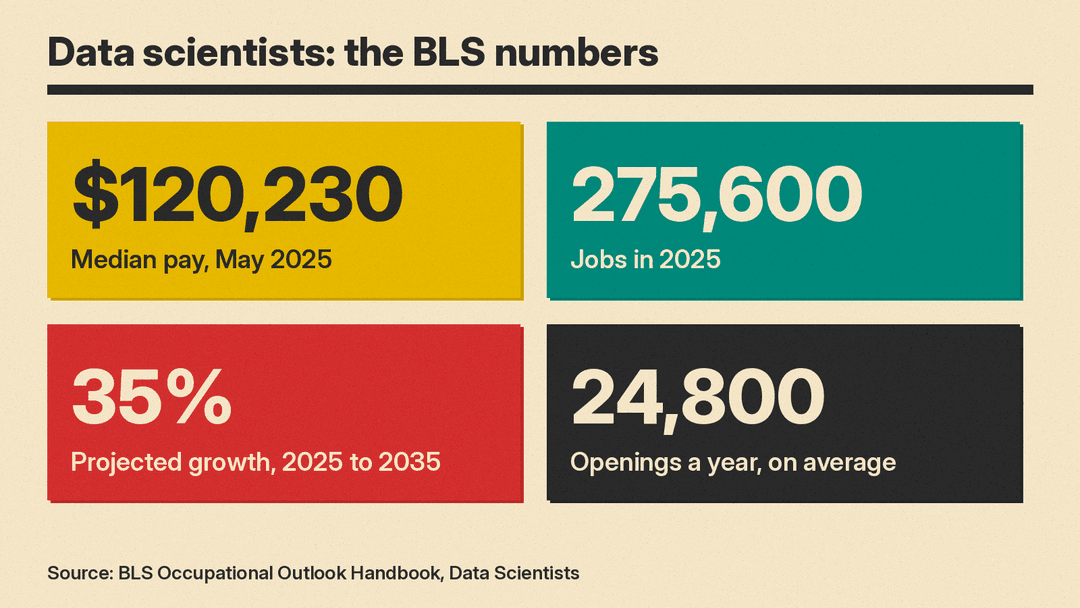
The BLS figures, in brief:
- Median pay: $120,230 a year in May 2025, or $57.80 an hour. The median for all U.S. occupations was $50,980.
- Pay range: the lowest 10 percent earned less than $67,240, and the highest 10 percent earned more than $199,130.
- Jobs: about 275,600 in 2025.
- Growth: employment is projected to grow 35 percent from 2025 to 2035, which BLS calls "much faster than the average for all occupations." The average for all occupations is 3 percent.
- Openings: about 24,800 a year on average over the decade. BLS says many of those come from the need to replace workers who change jobs or retire.
Pay also differs by industry. BLS lists these median wages for May 2025:
- Publishing, broadcasting, and content providers: $142,240
- Computer systems design and related services: $132,380
- Credit intermediation and related activities: $129,490
- Management of companies and enterprises: $128,050
- Insurance carriers and related activities: $108,650
These are U.S. figures from a federal survey. BLS notes that its wage data does not include self-employed workers.
Where AI fits
BLS gives two reasons for the projected growth. The first is "an increased demand for data-driven decisions" as the volume of data grows. The second is AI. In the agency's words, firms "are expected to continue to integrate artificial intelligence (AI)-based systems into their workflows," and data scientists "will be needed to help businesses leverage AI and other technologies."
For a related job, our look at software engineer jobs and AI covers how postings for software roles have moved.
What employers ask for
BLS says data scientists "typically need at least a bachelor's degree in mathematics, statistics, computer science, or a related field." It adds that "some employers require or prefer" a master's or doctoral degree. It lists business and engineering as other common degree fields.
Some employers also want industry knowledge. BLS gives the example of an asset management company, which may ask for finance experience or coursework in investments or banking.
The qualities BLS lists as important:
- Analytical skills: researching, and examining and interpreting findings.
- Computer skills: writing code, analyzing data, building or improving algorithms, and using data visualization tools.
- Communication skills: explaining results to technical and nontechnical audiences.
- Logical-thinking skills: designing and building statistical models.
- Math skills: using statistical methods to collect and organize data.
- Problem-solving skills: solving problems in data collection and cleaning, and in building models.
On study, BLS says students need "extensive study in mathematics and statistics." It suggests high school students take linear algebra, calculus, and probability and statistics. At the college level it adds computer science, "data-oriented programming languages," and database and statistical software.
If you do not have a degree in one of those fields, our post on AI jobs without a CS degree covers what hiring data shows about degree requirements.
Courses and books for each skill
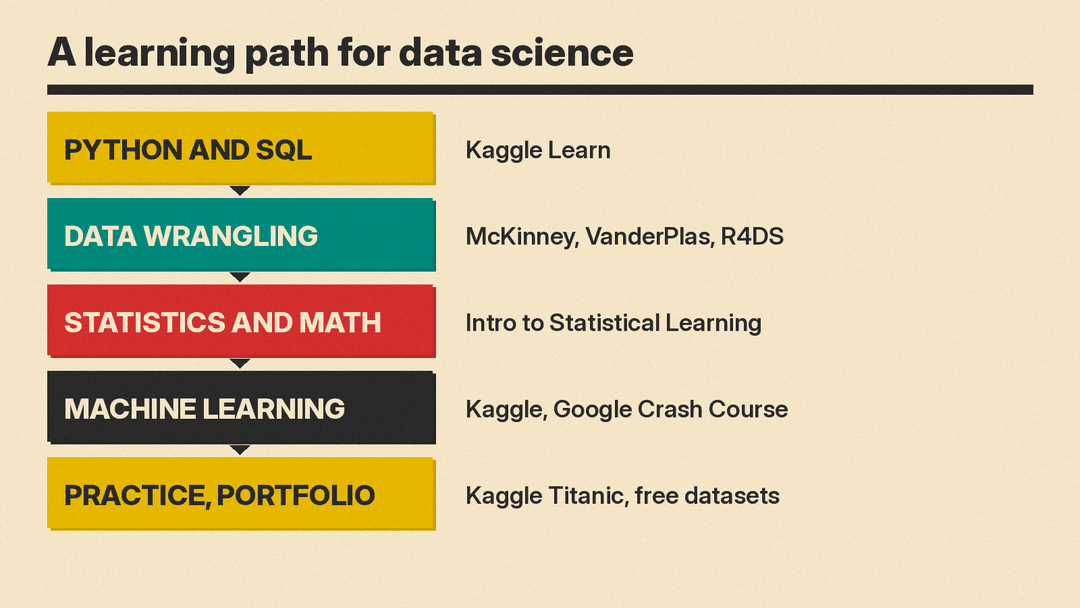
The resources below line up with the skills BLS lists. The notes for each one say what its own page offers. Each step has a name, and you can do them in order or skip what you already know.
Python and SQL
- Kaggle Learn describes its catalog as "no-cost courses." Start with Python and Intro to SQL, which teaches "SQL for working with databases, using Google BigQuery."
Data wrangling and visualization
- Python for Data Analysis, 3rd edition by Wes McKinney has an "Open Access" HTML version on the author's site. It is updated for pandas 2.0.0 and Python 3.10.
- Python Data Science Handbook by Jake VanderPlas. The site has the full text, with chapters on NumPy, pandas, Matplotlib and machine learning with Scikit-Learn.
- R for Data Science, 2nd edition by Hadley Wickham, Mine Çetinkaya-Rundel and Garrett Grolemund, if you prefer R. The site says it "is and will always be free."
- Kaggle's Pandas course uses "short hands-on challenges," and its Data Visualization course covers charts.
Statistics and math
- An Introduction to Statistical Learning by Gareth James, Daniela Witten, Trevor Hastie, Rob Tibshirani and, for the Python edition, Jonathan Taylor. The book's site links PDF downloads of both the R and Python editions. Each chapter ends with a lab in R or Python, and topics run from regression and classification to tree-based methods, deep learning and unsupervised learning.
- For linear algebra, calculus and probability, our list of math for machine learning courses and books covers MIT, Harvard and other options.
Machine learning
- Kaggle's Intro to Machine Learning, where you "build your first models."
- Google's Machine Learning Crash Course, which Google calls a "fast-paced, practical introduction to machine learning." Modules cover linear and logistic regression, classification metrics, working with numerical and categorical data, overfitting, neural networks, and ML fairness.
Practice and portfolio
- Kaggle's Titanic competition page tells newcomers to start there: predict survival on the Titanic and "get familiar with ML basics."
- Our free datasets for machine learning list has data for your own projects.
- When you have projects to show, our guide to building an AI portfolio that gets interviews covers how to present them, and our AI and ML interview questions guide covers how to prepare.
A realistic plan
Free resources can teach many of the skills BLS lists. They do not replace the degree that BLS says data scientists typically need, and BLS says some employers require or prefer a master's or doctoral degree. If you already have a degree in math, statistics, computer science, business or engineering, the path above fills in the tools. If you are still choosing a degree, BLS points to math, statistics and computer science coursework.
Either way, the job comes down to the duties BLS lists: find the right data, clean it, model it, test it, and explain what it means to the people who make decisions.
Sources
- U.S. Bureau of Labor Statistics: Data Scientists, Occupational Outlook Handbook
- Kaggle Learn
- Kaggle: Intro to SQL
- Kaggle: Intro to Machine Learning
- Kaggle: Titanic competition
- Python for Data Analysis, 3E (open edition)
- Python Data Science Handbook
- R for Data Science (2e)
- An Introduction to Statistical Learning
- Google Machine Learning Crash Course
