
A California judge has refused to throw out former NPR host David Greene's lawsuit against Google over the male AI voice in NotebookLM. The ruling does not decide whether Google copied his voice. It decides only that his four claims, taken as true at this stage, are pleaded well enough to proceed against Google LLC. Greene alleges that Google used his voice; Google denies it.
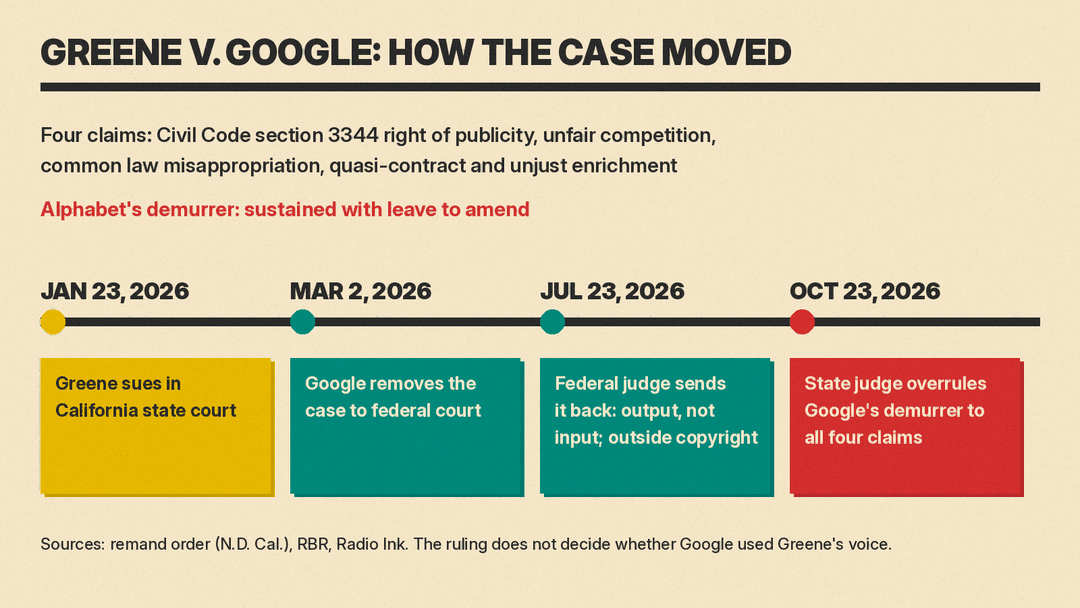
Santa Clara County Superior Court Judge Shella Deen overruled Google LLC's demurrer, a challenge to the legal sufficiency of the claims, to all four causes of action, in an order filed October 23, Radio Ink reports. She sustained Alphabet Inc.'s demurrer with leave to amend, according to Radio & Television Business Report (RBR). Leave to amend means the claims against Alphabet are not dismissed for good: Greene can file an amended complaint against it. Both outlets note that at this stage the court takes the complaint's allegations as true. The judge first issued a tentative ruling with the same outcome on October 21 and took the matter under submission after a contested hearing, Bloomberg Law reported. llms.blog read an indexed copy of the court's posted tentative ruling (case No. 26CV485291) but did not review the final order.
What Greene claims
Greene hosted NPR's Morning Edition for almost 10 years, hosted NPR's Up First podcast, and reported on the White House for NPR for four years, Radio Ink reports. He now hosts Left, Right & Center and other podcasts.
He alleges that Google used recordings of his voice to create the default male voice for the Audio Overviews feature in NotebookLM, then used that voice to market and sell the product without his permission. Audio Overviews, introduced in September 2024, turns documents a user uploads into a podcast-style conversation between two AI hosts, one male and one female. (For how the product works today, see our Gemini Notebook explainer.)
According to the complaint, as summarized by RBR and Radio Ink:
- Google offers NotebookLM through paid subscriptions, including the $19.99-per-month Google One AI Premium tier.
- Google used the voice in a December 2024 Spotify partnership.
- Listeners wrote that the male voice "sounds exactly like" Greene.
- A forensic voice-recognition firm found "relatively high" evidence of a match.
His four claims are a statutory right of publicity under California Civil Code section 3344, unfair competition, common law misappropriation, and quasi-contract and unjust enrichment. He seeks damages, restitution, disgorgement, and injunctive relief. These are allegations. No court has found that Google used his voice.
Google has denied the claims. "These allegations are baseless," Google spokesperson José Castañeda told The Washington Post in February. "The sound of the male voice in NotebookLM's Audio Overviews is based on a paid professional actor Google hired."
What the judge said
Google argued that the complaint shows only that Greene's journalism, not his voice, is well known. Judge Deen disagreed, RBR reports. In the order, as quoted by Radio Ink, she wrote: "That distinction is difficult to maintain for a radio broadcaster. A radio host reaches the audience through the voice, and it is reasonable to infer that the voice is widely known."
She also set out the limits of the ruling. "Whether Google actually made the male host's voice from Greene's recordings or from another source that merely resembles him is a factual question," she wrote, as quoted by RBR. She added, in the same report, that "the court recognizes that this is a novel application of a statute enacted well before generative AI."
The court also rejected Google's argument that the Copyright Act preempts the claims. RBR reports that the court found a voice is not copyrightable and that the claims concern the program's outputs, not its inputs.
How the case got here
Greene filed suit in state court on January 23, 2026. Google removed the case to federal court on a copyright preemption theory. On July 23, US District Judge Charles Breyer of the Northern District of California sent it back to state court.
Breyer's remand order is the clearest statement of the input-versus-output idea that now runs through the case. "Because Greene's claims are based on the output (his likeness) of Google's AI and not its input (copying), the claims fall outside the reach of the Copyright Act," the order says. It relies on Midler v. Ford, the 1988 Ninth Circuit case about a sound-alike singer, and says: "Greene's voice misappropriation claims are just like those in Midler, but with AI rather than a voice actor." The federal court did not rule on Google's motion to dismiss.
A new California law in the background
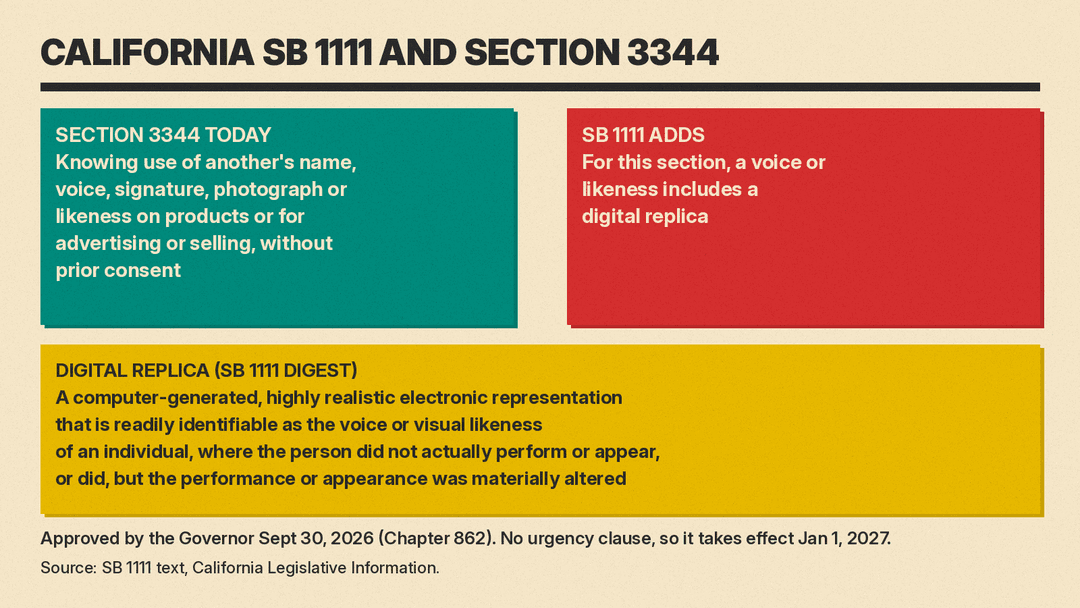
California's SB 1111 (Chapter 862) was approved by the Governor on September 30, 2026. It amends section 3344, the same statute Greene sues under, to say that "a voice or likeness includes a digital replica." The Legislative Counsel's digest of the bill describes a digital replica as "a computer-generated, highly realistic electronic representation that is readily identifiable as the voice or visual likeness of an individual" in which the person did not actually perform, or did perform but "the fundamental character of the performance or appearance has been materially altered."
The bill passed by majority vote with no urgency clause, so under California's standard rule for new statutes it takes effect January 1, 2027. RBR reports that the court noted that date. The court did not decide whether the change applies to earlier conduct, and said its ruling does not depend on it.
What happens next
Greene has 10 days from notice of the order to file an amended complaint limited to allegations about Alphabet's liability, RBR reports. Google must respond within 10 days after service of any amended complaint or, if Greene does not amend, within 10 days after the amendment period expires. RBR reports that no statements from either side accompanied the order.
Why it matters
Many AI copyright fights so far turn on training data: whether copying books, songs or articles to train a model is fair use. Greene's case is built on a different theory. It asks whether an AI output that sounds like a real person uses that person's identity. At this early stage, two courts have now rejected Google's argument that copyright law preempts Greene's claims.
That matters for anyone who ships AI voices. Voice cloning is already a product feature: ElevenLabs and Cartesia offer it on paid plans, and AI video translators clone a speaker's voice to dub videos into other languages. A state court has let a broadcaster's voice claims go forward against Google, and California's updated statute names digital replicas outright from January 1, 2027. Whether the change reaches earlier conduct has not been decided.
Federal law is still unsettled. Radio Ink reports that the NO FAKES Act, which would create a federal right to control digital replicas of a voice, stalled in October, with no action expected until the session resumes following midterms.
Sources
- Radio Ink: Google Must Answer Former NPR Host's AI Voice Claims In Court
- RBR: Judge Won't Toss Former NPR Host's AI Challenge Against Google
- The Washington Post: Radio host David Greene says Google's AI podcast tool stole his voice (Feb. 15, 2026)
- Bloomberg Law: Google Is Unlikely to Axe Ex-NPR Host's AI Voice Use Lawsuit (Oct. 21, 2026)
- Greene v. Google, Order Granting Motion to Remand, N.D. Cal. No. 3:26-cv-01773-CRB (July 23, 2026)
- California SB 1111, Digital replicas (Chapter 862, Statutes of 2026)
