
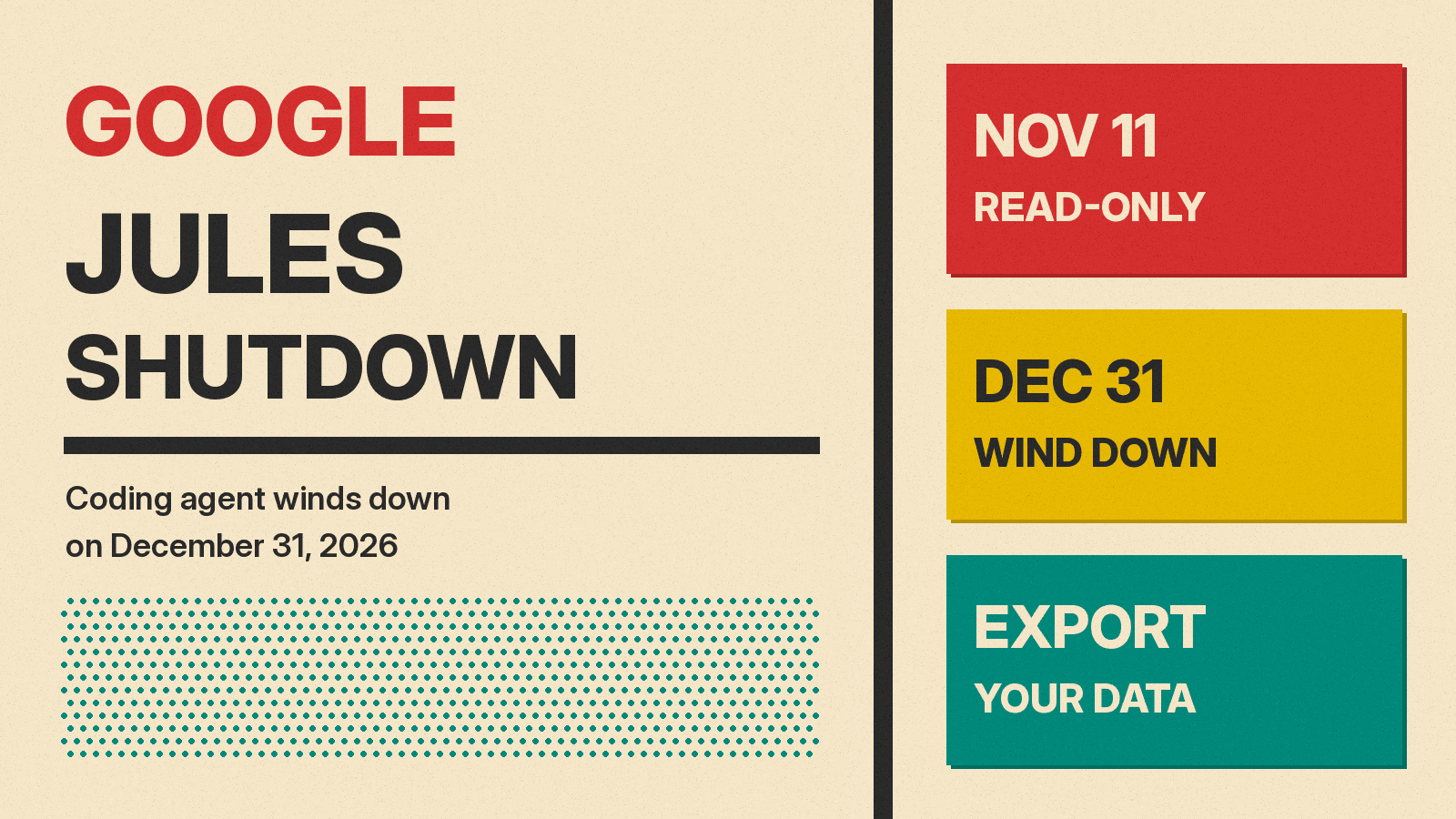
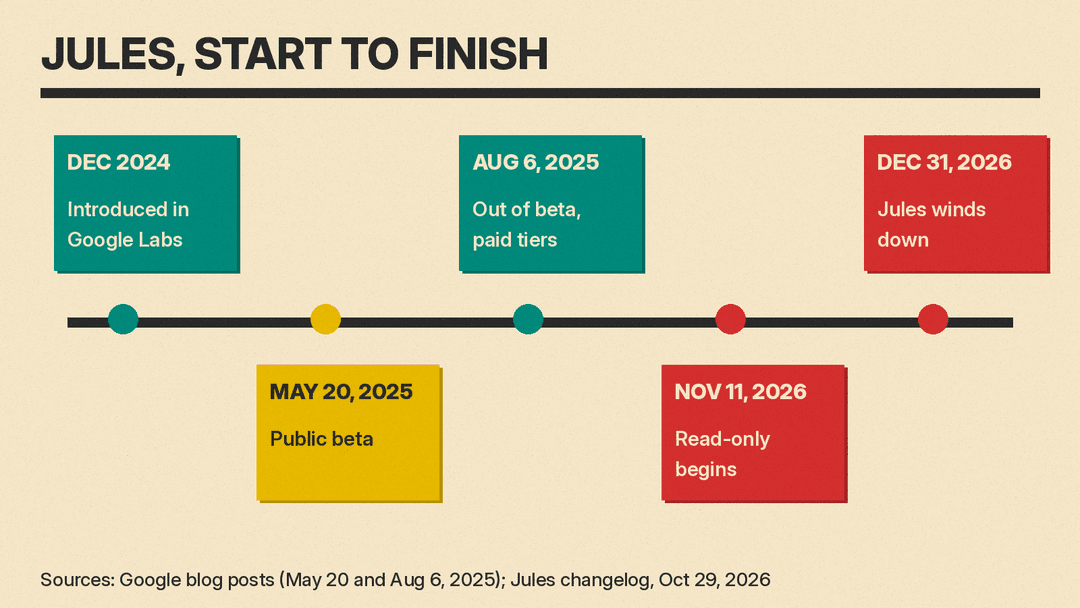
Google is closing Jules, the asynchronous coding agent it first showed in Google Labs in December 2024. A Jules changelog entry dated October 29, 2026 says Jules "will wind down on December 31, 2026" as part of Google's "work to unify our agentic coding efforts." Users have until November 11, 2026 to finish sessions. After that date, Jules turns read-only until the end of the year.
Google points users to Google Antigravity, which the same notice calls "our agent-first platform."
What happens and when
The changelog sets out three stages:
- Now to November 11, 2026: users "continue finishing up sessions."
- November 11 to December 31, 2026: Jules is read-only.
- December 31, 2026: Jules winds down.
The Jules account on X posted the news on October 29. The post says: "We're working on bringing our learnings from Jules into @antigravity so you get the best of both worlds: autonomous remote background task execution and an agent-first development environment." It adds: "As we focus on this unified experience, Jules will be winding down."
The Verge reported the shutdown the same day. Dutch site Tweakers reports that Google also told users by email, and that a small banner on the Jules home page tells users to try Google Antigravity as a replacement.
What Jules was
Jules worked in the background. Google's public beta post from May 20, 2025 says Jules "clones your codebase into a secure Google Cloud virtual machine (VM)" and performs tasks such as writing tests, building features, fixing bugs and bumping dependency versions. When it finished, it showed "its plan, reasoning and a diff of the changes made." The same post says Jules was first introduced "last December in Google Labs."
On August 6, 2025, Google said Jules was out of public beta. That post says that during the beta, "thousands of developers tackled tens of thousands of tasks, resulting in over 140,000 code improvements shared publicly." It also added new tiers with higher limits for Google AI Pro and Ultra subscribers.
The shutdown notice now describes Jules in the past tense: "When we launched Jules, it was an experiment to learn how asynchronous coding agents could help you tackle your backlog and ship faster."
How to export your Jules data
The changelog says users "can now export everything Jules knows about your work into a local folder." The export covers:
- account settings
- environment variables
- scheduled tasks
- connected repositories
- memories
- setup scripts
- every session, "including its prompt, plan, full activity log, and code patches"
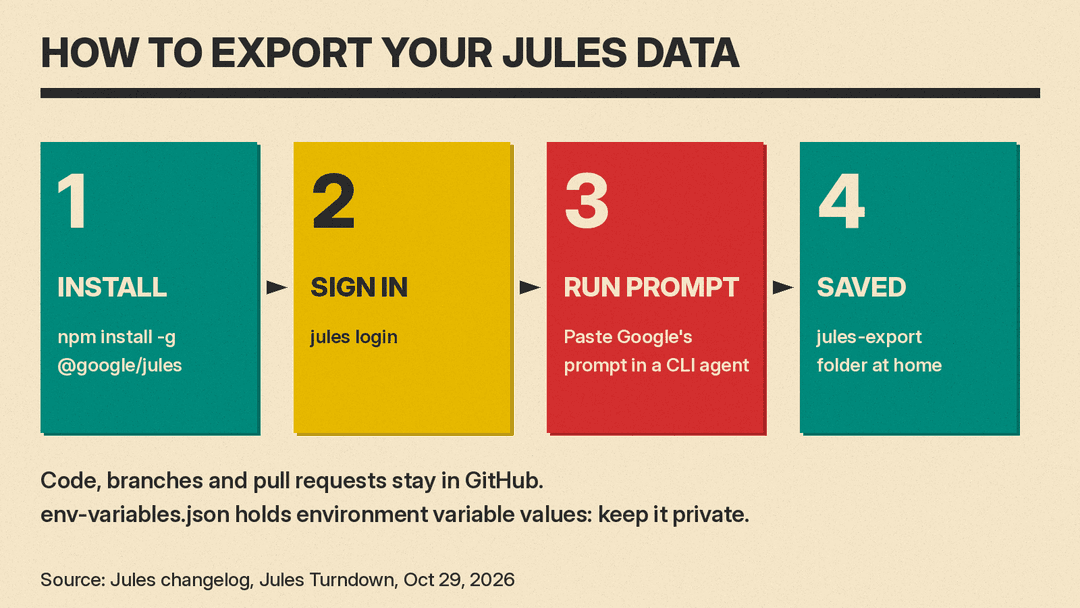
Code itself does not need an export. The notice says: "Your code, branches, and pull requests already live in GitHub, so they stay where they are."
The export runs through a command-line tool. Google tells users to install Jules Tools with npm install -g @google/jules, sign in with jules login, and then open "a CLI coding agent, such as Claude Code" from the home directory and paste an export prompt that Google provides on the page. The agent then checks the setup, runs an export script and reports what it saved.
The prompt itself warns that some of the endpoints it uses are undocumented, and asks the agent to report a failing call "rather than guessing at fixes." Data lands in a jules-export folder in the home directory. The page also gives a caution: env-variables.json holds environment variable values, "so keep the export folder private and out of your repositories." Users who work with GitHub repositories in Jules need to connect their GitHub account before they export, or "the export won't include repository data."
Where Antigravity fits
Google's Antigravity documentation says Antigravity "supports both synchronous interactive pair-programming and asynchronous background agent workflows independent of a single IDE." It lists four surfaces: a desktop app, a command-line interface, IDE extensions and a Python SDK. The docs say tasks can go to "concurrent subagents working across isolated Git worktrees."
Google's X post says the goal is to bring "autonomous remote background task execution" from Jules into Antigravity. As of October 29, 2026, neither the changelog nor the X post gives a date for that.
Users who leave Jules have other coding agents to consider. We covered recent changes to two of them: GitHub added projects and computer use to the Copilot app, and Android Studio opened up to Claude, Codex and other agents.
What Jules users should do now
- Finish open work before November 11, 2026. After that, Jules is read-only.
- Run the export. It saves memories, setup scripts and session history that do not live in GitHub.
- Keep the export private. It includes environment variable values.
- Note your scheduled tasks. The export saves them, so you can set them up again in another tool.
Readers who rely on agents that hold repository access may also want to review how those tools handle credentials. Our report on a gray-market relay that turned off Codex and Claude Code sandboxes covers one recent case.
Sources
- Jules changelog: Jules Turndown (October 29, 2026)
- Jules (@julesagent) on X, October 29, 2026
- The Verge: Google is sunsetting its AI coding agent, Jules
- Tweakers: Google stopt eind dit jaar met zijn AI-codinghulp Jules
- Google: Build with Jules, your asynchronous coding agent (May 20, 2025)
- Google: Jules is now available for everyone (August 6, 2025)
- Google Antigravity docs: Choose your Antigravity
