
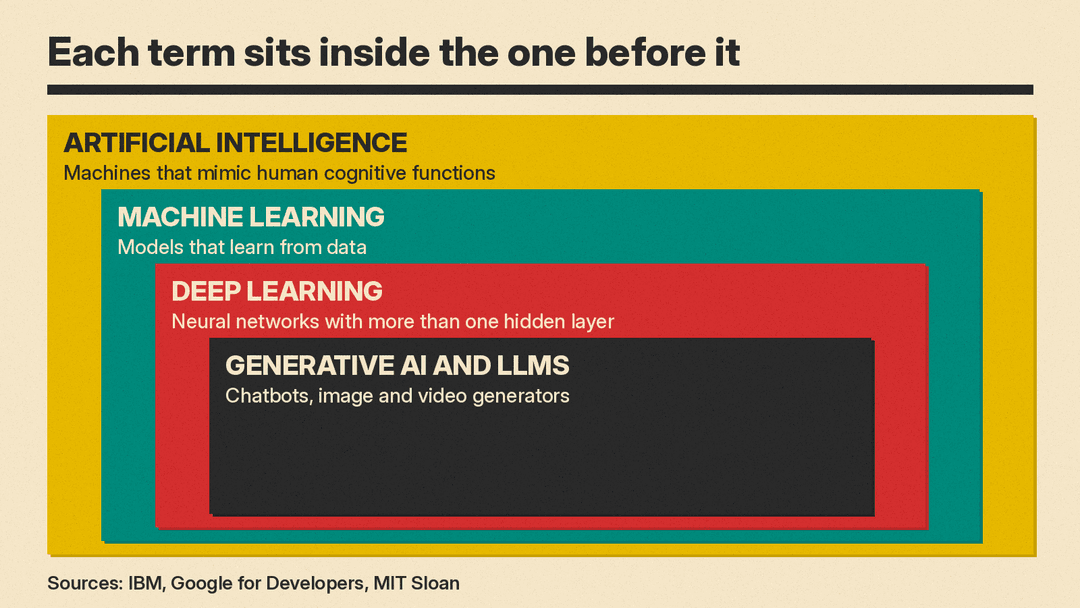
"AI," "machine learning" and "deep learning" get used as if they mean the same thing. They don't. The short version: artificial intelligence is the broad field, machine learning is one way to build AI, and deep learning is one kind of machine learning that uses neural networks with many layers. Generative AI tools such as chatbots and image generators sit inside that picture too.
IBM describes the terms as "a series of AI systems from largest to smallest, each encompassing the next." This guide walks through each layer in plain English, shows where the sources agree and where they draw the lines differently, and points to free places to learn more.
The one-paragraph answer
IBM puts it this way: "AI is the overarching system. Machine learning is a subset of AI. Deep learning is a subfield of machine learning, and neural networks make up the backbone of deep learning algorithms." MIT Sloan gives the same order, calling machine learning "a subfield of artificial intelligence that gives computers the ability to learn without explicitly being programmed." Google's Machine Learning Glossary defines a deep model as "A neural network containing more than one hidden layer."
So every deep learning system is a machine learning system, and every machine learning system is a form of AI. The reverse is not true.
What is artificial intelligence?
AI is the widest term. Google Cloud defines it as the use of technologies to build machines and computers that can "mimic cognitive functions associated with human intelligence," such as seeing, understanding and responding to language, analyzing data and making recommendations. IBM's definition is similar: AI covers machines that mimic human intelligence and cognitive functions "like problem-solving and learning."
Both Google Cloud and IBM sort AI into three capability levels:
- Artificial Narrow Intelligence (ANI): AI built for a specific task. Google Cloud calls it "the specialized AI common today (like image recognition)." IBM lists natural language processing and computer vision as examples.
- Artificial General Intelligence (AGI): Google Cloud describes it as "human-level AI capable of any intellectual task."
- Artificial Super Intelligence (ASI): Google Cloud calls it "theoretical AI that surpasses human intellect."
IBM states that neither of the two stronger forms, AGI or ASI, "exists yet, but research in this field is ongoing."
Machine learning is not the whole of AI. Google Cloud notes that the AI umbrella also covers areas such as robotics, expert systems and natural language processing.
What is machine learning?
Machine learning is the part of AI where a system learns from examples instead of following rules a person wrote by hand. MIT Sloan credits the classic definition to AI pioneer Arthur Samuel in the 1950s: "the field of study that gives computers the ability to learn without explicitly being programmed."
Google's Intro to Machine Learning course describes it as the process of training a piece of software, called a model, "to make useful predictions or generate content" from data. Its example is a rainfall app. The traditional approach would model the atmosphere with physics equations. The machine learning approach feeds a model "enormous amounts of weather data" until it learns the relationship between weather patterns and rain, then asks it to predict rainfall from current data.
Google sorts machine learning systems into four groups by how they learn:
- Supervised learning: the model trains on data that includes the correct answers. Google compares it to a student studying old exams that contain both questions and answers. Spam filters and price predictors fall here.
- Unsupervised learning: the model looks for patterns in data with no answers attached, for example by clustering similar data points into groups.
- Reinforcement learning: the model gets rewards or penalties for actions in an environment. Google cites robots learning to walk around a room and AlphaGo playing Go.
- Generative AI: a class of models that create content, such as text, images, music or video, from user input.
MIT Sloan's 2021 explainer adds a useful point about why the words blur together. "So that's why some people use the terms AI and machine learning almost as synonymous … most of the current advances in AI have involved machine learning," MIT Sloan professor Thomas W. Malone said in the piece.
What is a neural network?
Neural networks are the building block that separates deep learning from other machine learning. IBM explains that they are called "neural" because they mimic how neurons in the brain signal one another.
A neural network is made of layers of nodes: an input layer, one or more hidden layers and an output layer. In IBM's description, each node connects to the next and has a weight and a threshold. When a node's output is above its threshold, it passes data to the next layer. IBM's deep learning explainer describes training as adjusting the strength of the connections between neurons, the weights and biases, so the network yields more accurate outputs.
Google's glossary defines a neural network as "A model containing at least one hidden layer."
What is deep learning?
Deep learning is machine learning that uses neural networks with several hidden layers. The "deep" refers to that depth.
The sources set the line in slightly different words, but they agree:
- Google's glossary: a deep model is "A neural network containing more than one hidden layer."
- IBM: "A neural network of more than three layers, including the inputs and the output, can be considered a deep-learning algorithm."
- IBM's deep learning explainer: deep learning "refers to the training of models with at least 4 layers."
Four layers counting input and output means at least two hidden layers, which is the same as Google's "more than one hidden layer."
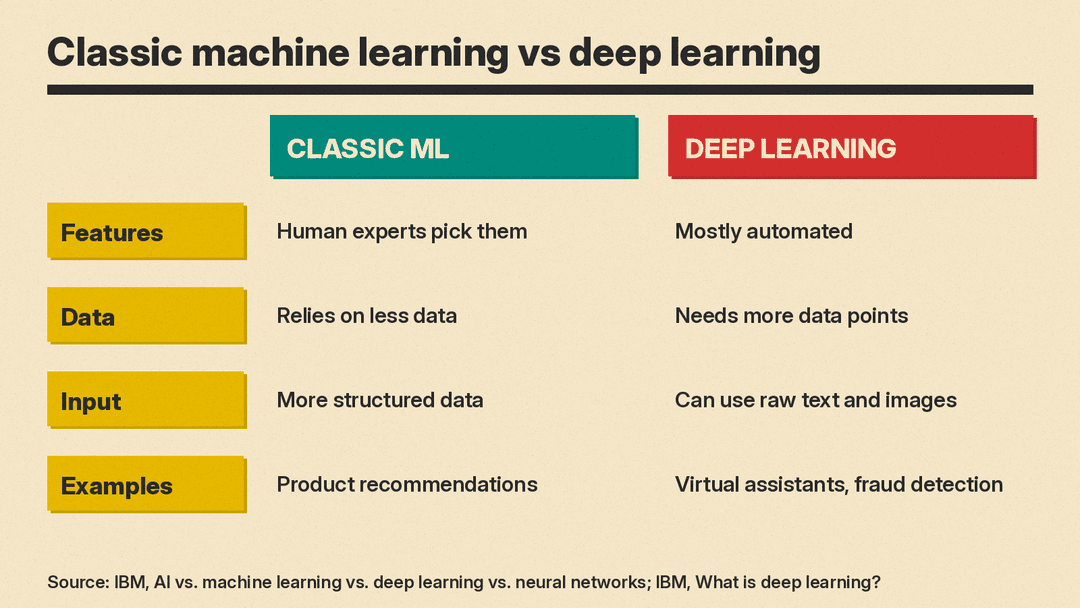
The practical difference from classic machine learning is who picks the features. In IBM's example of sorting photos of pizza, burgers and tacos, a classic machine learning setup relies on human experts to decide which features matter, such as the bread. Deep learning "automates much of the feature extraction piece of the process," IBM writes, and can work from raw, unstructured data such as text and images.
That flexibility has a cost. IBM says a deep learning model "requires more data points to improve accuracy," while a classic machine learning model "relies on less data given its underlying data structure." IBM's deep learning explainer adds that deep learning needs "a tremendous amount of computing power for both training and inference," and credits advances in GPUs with making it practical at scale.
Where generative AI and LLMs fit
Chatbots such as ChatGPT, Claude and Gemini, and AI image generators, sit at the center of the nested picture.
- IBM's deep learning explainer says deep learning models "power most state-of-the-art artificial intelligence (AI) today, from computer vision and generative AI to self-driving cars and robotics."
- The same explainer says the transformer architecture "was a watershed moment in deep learning that led directly to the current era of generative AI," and that transformers "are most commonly associated with large language models (LLMs)."
- Google's glossary defines a large language model as, at a minimum, "a language model having a very high number of parameters," and more informally "any Transformer-based language model, such as Gemini or GPT."
So a chatbot is generative AI, built on a large language model, which is a deep learning model, which is a form of machine learning, which is a branch of AI. Each label is correct; they just name different levels.
For the next layer of vocabulary, see our explainers on tokens, multimodal AI, RAG and AI agents.
Side by side
| Artificial intelligence | Machine learning | Deep learning | |
|---|---|---|---|
| What it is | The broad field of machines that mimic human cognitive functions | A subset of AI where models learn from data | A subset of machine learning using neural networks with more than one hidden layer |
| Who picks features | Depends on the method | Human experts, in classic machine learning (IBM) | Largely automated (IBM) |
| Data needs | Depends on the method | Less data than deep learning (IBM) | More data points to improve accuracy (IBM) |
| Examples in the sources | Image recognition, speech recognition, translation | Product recommendations, spam filters, rainfall prediction | Virtual assistants, fraud detection, generative AI |
Where the sources draw the lines differently
These terms have no single official definition, and good sources group them in slightly different ways. Two differences are worth knowing:
- Is deep learning inside machine learning, or next to it? IBM and MIT Sloan place deep learning inside machine learning. Google Cloud's AI vs ML page lists deep learning as one of the "other major subfields" under the AI umbrella, alongside machine learning, robotics, expert systems and natural language processing. IBM and MIT Sloan use the nested view (AI, then machine learning, then deep learning), and this guide follows it.
- What data can machine learning use? Google Cloud's comparison says "ML can only use structured and semi-structured data." IBM says deep learning, which it treats as part of machine learning, can ingest unstructured data such as text and images in raw form. If a source says machine learning cannot handle text or images, check whether it counts deep learning as part of machine learning.
When you read a job post, course page or news story, check which level the writer means.
Where to start learning
Knowing which level a course or job post means helps you pick what to study. If you are starting out, here are two free options:
- Elements of AI, which its site describes as "A free online introduction to artificial intelligence for non-experts," created by MinnaLearn and the University of Helsinki.
- Google's Machine Learning Crash Course, described on its page as "Google's fast-paced, practical introduction to machine learning."
For a full study plan, see our 12-week plan to learn AI from scratch and our list of verified free AI courses.
Quick FAQ
Is ChatGPT AI or machine learning? Both. It is generative AI built on a large language model. Google's glossary informally describes LLMs as Transformer-based language models, and IBM covers transformers as a deep learning architecture.
Is all AI machine learning? No. Google Cloud lists robotics and expert systems under the AI umbrella next to machine learning.
How many layers make a network "deep"? More than one hidden layer, per Google's glossary. IBM's equivalent wording is more than three layers counting input and output.
Sources
- IBM: AI vs. machine learning vs. deep learning vs. neural networks
- IBM: What is deep learning?
- Google Cloud: Artificial intelligence (AI) versus machine learning (ML)
- Google for Developers: What is Machine Learning?
- Google for Developers: Machine Learning Glossary
- MIT Sloan: Machine learning, explained (2021)
- Elements of AI
- Google Machine Learning Crash Course
