
You do not need a math degree to start machine learning. You do need three subjects sooner or later: linear algebra, calculus and probability. This list collects 11 free resources for those three subjects, plus two paid Coursera specializations for learners who want graded work, each checked on its own page in October 2026. Every item links to the page that offers it, and each note uses only what that page says.
How much math do you need to start?
For a first course, not much. Google's Machine Learning Crash Course prerequisites page says learners "must be comfortable with variables, linear equations, graphs of functions, histograms, and statistical means." It lists background topics in algebra, linear algebra (tensors and matrix multiplication), trigonometry and statistics. It marks calculus as optional, for advanced topics, and says you will not have to calculate derivatives yourself.
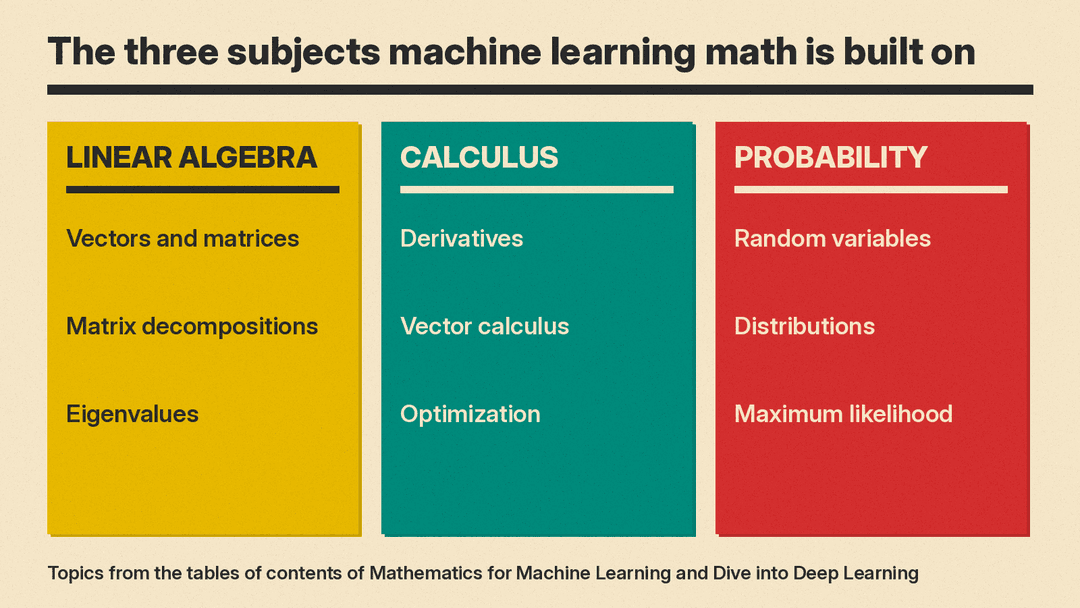
That changes when you want to read papers, debug training, or understand why a model works. The textbooks below all start with the same core: vectors and matrices, derivatives and gradients, and probability distributions.
Linear algebra
Models store data and weights as vectors and matrices, so this is the subject to start with.
- 3Blue1Brown: Essence of linear algebra. A free YouTube playlist from 3Blue1Brown, Grant Sanderson's math channel. Use it to get a picture of what vectors, matrices and transformations do before you work problems.
- MIT 18.06 Linear Algebra (Spring 2010). Gilbert Strang's undergraduate course on MIT OpenCourseWare. The course page calls it "a basic subject on matrix theory and linear algebra" and lists systems of equations, vector spaces, determinants, eigenvalues, similarity and positive definite matrices. The page offers lecture videos, problem sets with solutions, and exams with solutions.
- MIT 18.065 Matrix Methods in Data Analysis, Signal Processing, and Machine Learning (Spring 2018). Also taught by Gilbert Strang. The course page says it reviews linear algebra with applications to probability and statistics and optimization, and above all gives a full explanation of deep learning. It lists lecture videos, problem sets and a final project. Take it after 18.06 or a similar course.
- Stanford CS229 Linear Algebra Review and Reference. A free PDF by Zico Kolter, updated by Chuong Do and dated September 30, 2015. Its contents run from basic notation and matrix multiplication through the transpose, trace, norms, rank, inverses, determinants and eigenvalues to matrix calculus (gradients and Hessians). It works as a reference to keep open while you read other material.
Calculus
Training a model means changing its weights to reduce an error. Derivatives and gradients tell you which way to change them.
- 3Blue1Brown: Essence of calculus. A free YouTube playlist from the same channel as the linear algebra series.
- MIT 18.01SC Single Variable Calculus (Fall 2010). An undergraduate calculus course on MIT OpenCourseWare, taught by David Jerison. The course page lists units on differentiation, applications of differentiation (including optimization and Newton's method), the definite integral, techniques of integration, and Taylor series. It includes lecture videos, problem-solving videos, lecture notes, problem sets and exams with solutions.
Single variable calculus is the base. Machine learning uses multivariable calculus (gradients of functions with many inputs), which the books and the Imperial College course below cover.
Probability and statistics
Models make predictions under uncertainty, and many are trained by fitting probability distributions to data.
- Harvard Stat 110: Probability. Joe Blitzstein's course page says a free online version of the second edition of the book based on Stat 110, Introduction to Probability by Joe Blitzstein and Jessica Hwang, is available. It also points to Stat 110 lecture videos on YouTube and to Stat110x, an edX course that the page says has free signup.
- Seeing Theory. "A visual introduction to probability and statistics" with interactive visualizations, created by Daniel Kunin while an undergraduate at Brown University. Its six chapters cover basic probability, compound probability, probability distributions, frequentist inference, Bayesian inference and regression analysis. The site says it "is archived for reference," so do not expect updates.
Free textbooks that cover all three
These books put the math in one place and connect it to machine learning methods.
- Mathematics for Machine Learning by Marc Peter Deisenroth, A. Aldo Faisal and Cheng Soon Ong. Published by Cambridge University Press in April 2020. The authors say they "will keep PDFs of this book freely available." Part I covers linear algebra, analytic geometry, matrix decompositions, vector calculus, probability and distributions, and continuous optimization. Part II applies them to linear regression, principal component analysis, Gaussian mixture models and support vector machines. The authors say the book does not try to cover advanced machine learning techniques. Instead, it aims to give readers the math skills to read the books that do.
- Deep Learning by Ian Goodfellow, Yoshua Bengio and Aaron Courville (MIT Press). The site says the online version "will remain available online for free." Part I, "Applied Math and Machine Learning Basics," has chapters on linear algebra, probability and information theory, numerical computation and machine learning basics. There is no PDF: the FAQ says the MIT Press contract forbids it, so you read it as HTML in the browser.
- Dive into Deep Learning: Appendix, Mathematics for Deep Learning. An appendix of the online book Dive into Deep Learning. It "aims to provide you the mathematical background you need to understand the core theory of modern deep learning, but it is not exhaustive." Its sections cover geometry and linear algebra, eigendecompositions, single variable, multivariable and integral calculus, random variables, maximum likelihood, distributions, naive Bayes, statistics and information theory.
Paid courses with assignments
If you want deadlines, quizzes and graded programming work, two Coursera specializations teach math for machine learning. They are not free. Both Coursera pages answer "Can I take the course for free?" with "No, you cannot take this course for free," and both say you can apply for financial aid if you cannot afford the fee. The DeepLearning.AI specialization FAQ puts a Coursera subscription at $49 a month and says you can preview the entire first module at no cost. If you do not want to pay, the free courses and books above cover the same three subjects.
- Mathematics for Machine Learning Specialization from Imperial College London. A three-course series: linear algebra (19 hours), multivariate calculus (18 hours) and PCA (21 hours), per the Coursera page. The FAQ says: "High school maths knowledge is required." It adds that basic Python is not necessary for courses 1 and 2, while course 3, which it calls intermediate difficulty, needs basic Python and NumPy.
- Mathematics for Machine Learning and Data Science Specialization from DeepLearning.AI, taught by Luis Serrano. Coursera lists three courses: linear algebra (34 hours), calculus (27 hours) and probability and statistics (33 hours). Coursera labels it intermediate level; the DeepLearning.AI page labels it beginner. The DeepLearning.AI page says that at 5 hours per week, the courses take about 4, 3 and 4 weeks. It also says courses one and two build on each other, while course three is independent.
A simple order to follow
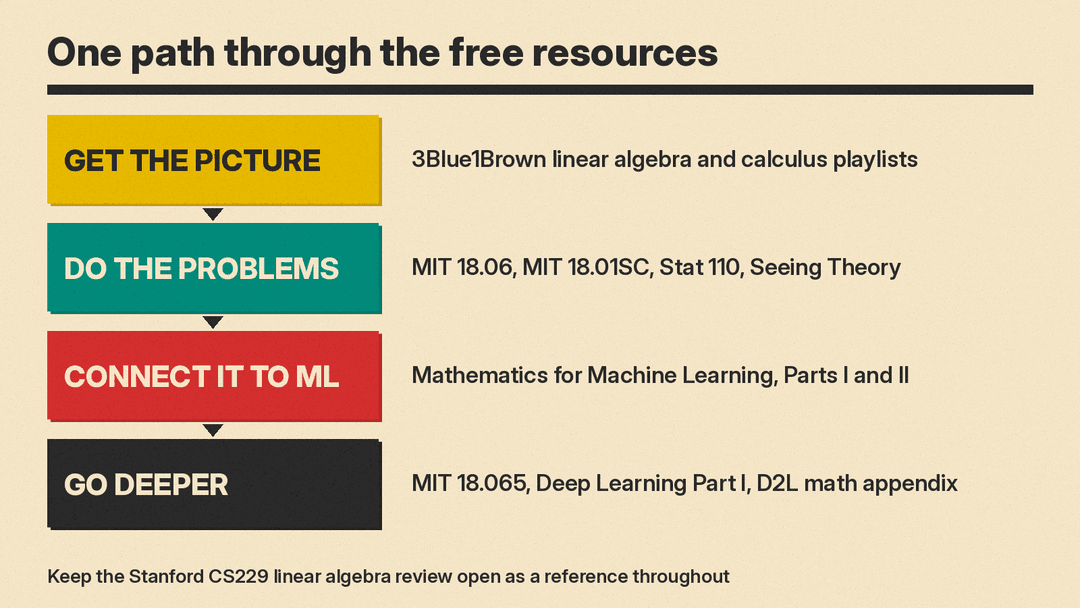
You do not have to finish everything before you write code. One workable path, using only the resources above:
- Get the picture. Watch the two 3Blue1Brown playlists.
- Do the problems. Take MIT 18.06 for linear algebra and MIT 18.01SC for calculus, or, if you will pay for structured assignments, one of the two Coursera specializations. Add Stat 110 or Seeing Theory for probability.
- Connect it to ML. Read Part I of Mathematics for Machine Learning, then try the Part II chapters on linear regression and PCA.
- Go deeper. Move on to MIT 18.065, Part I of the Deep Learning book, or the Dive into Deep Learning math appendix when you start reading papers.
Keep the CS229 linear algebra review open as a reference at every stage.
Where this fits on llms.blog
If you are still choosing a direction, start with our 12-week plan to learn AI from scratch and our list of free AI courses. For hands-on practice once the math clicks, see free GPU options for AI.
Sources
- Google Machine Learning Crash Course: Prerequisites and prework
- 3Blue1Brown: Essence of linear algebra (YouTube playlist)
- 3Blue1Brown: Essence of calculus (YouTube playlist)
- MIT OpenCourseWare 18.06 Linear Algebra
- MIT OpenCourseWare 18.065 Matrix Methods in Data Analysis, Signal Processing, and Machine Learning
- MIT OpenCourseWare 18.01SC Single Variable Calculus
- Stanford CS229 Linear Algebra Review and Reference (PDF)
- Harvard Statistics 110: Probability
- Seeing Theory, Brown University
- Mathematics for Machine Learning (Deisenroth, Faisal, Ong)
- Deep Learning (Goodfellow, Bengio, Courville)
- Dive into Deep Learning: Mathematics for Deep Learning appendix
- Coursera: Mathematics for Machine Learning Specialization (Imperial College London)
- Coursera: Mathematics for Machine Learning and Data Science Specialization (DeepLearning.AI)
- DeepLearning.AI: Mathematics for Machine Learning and Data Science
