
Kling AI has released a first look at Minibots, an animated feature from UK company Evolutionary Films, and says the footage is "powered by Kling 4.0." The clip went out on Kling's X account on October 28, with the film set for release in 2027. It is a public test of whether an AI video model can hold up across a full-length animated film, not only in short clips.
This post covers what Kling and Evolutionary Films have said, who is making the film, how the production says it uses AI, and what the first look does and does not prove.
What was announced
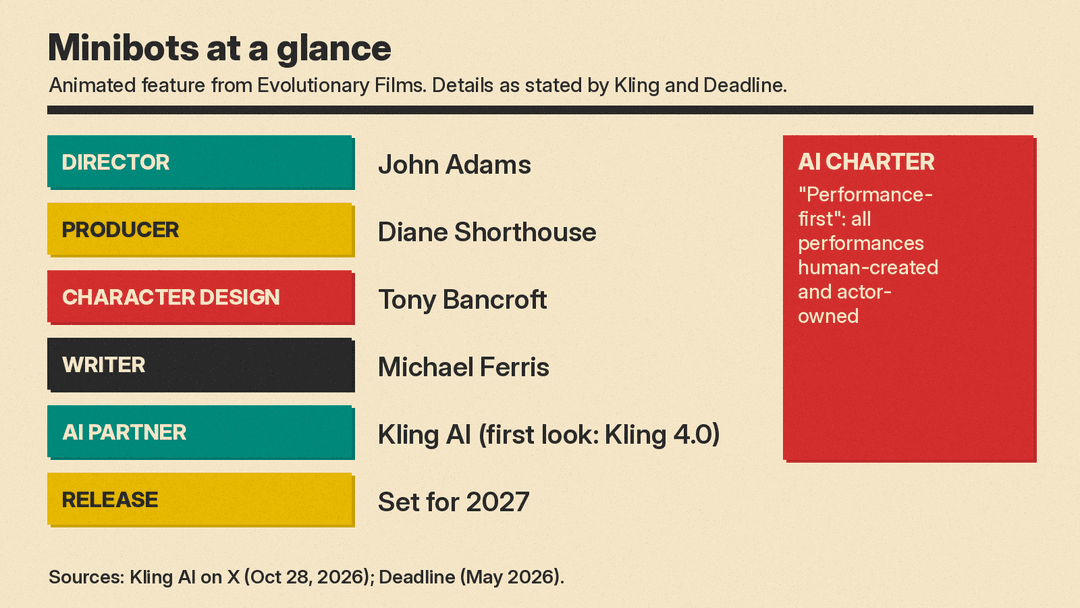
In the October 28 post, Kling said it is "teaming up with @EvoFilmsUK as the exclusive technology partner on Minibots, their upcoming animated feature." The post lists the main creative team:
- Director: John Adams of Evolutionary Films
- Producer: Diane Shorthouse, described as BAFTA-nominated
- Character design: Tony Bancroft, co-director of Mulan
- Writer: Michael Ferris (Terminator 3)
Kling also said the project "has already been making the rounds at major film festival markets at Cannes and TIFF." The attached first-look video runs about two minutes and ten seconds.
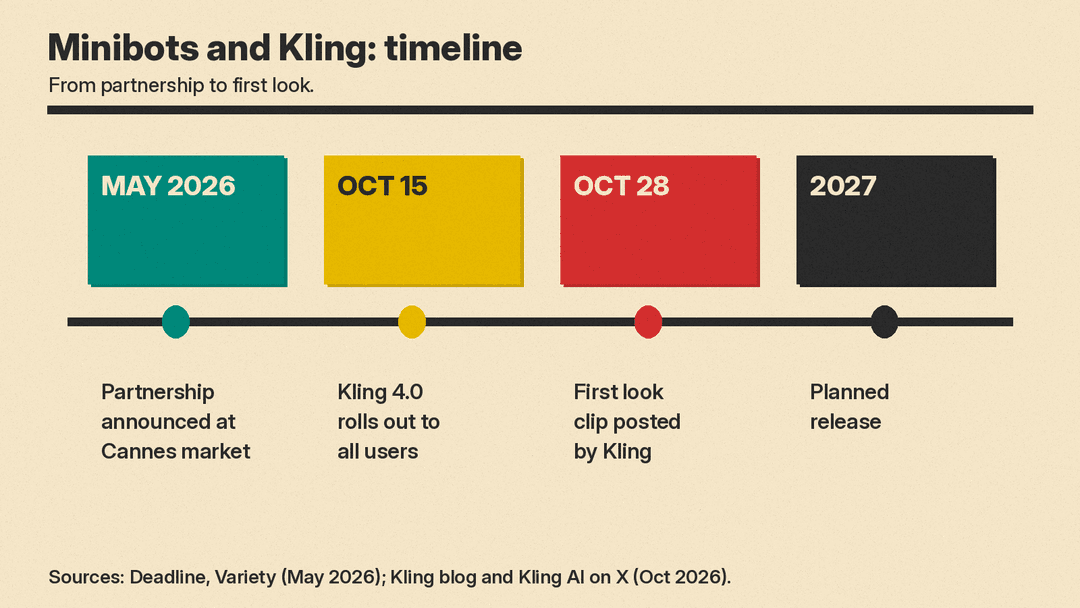
The partnership itself is not new. It was first announced in May 2026 at the Cannes Film Market. Deadline reported that Kling became the exclusive global "technological brand partner" on the film. Under that deal, Kling provides production support, platform access and a Creative Partnership Programme for the film's AI artist team. What is new this week is footage made with Kling 4.0, the model Kling says rolled out to all users on October 15.
What Minibots is about
According to Deadline, the film is set at a robotics summer camp, where three teenage geniuses accidentally create miniature sentient robots that escape into human society. Deadline says the film explores themes of technology, identity and humanity.
The writing team named at Cannes also includes Alistair Audsley and Scott Christian Sava (Animal Crackers), Variety reported. Deadline lists an AI creative team led by AI producer Giulio Musi, with Samuele Poggi, Sebastian Kamph, Edmond Yang, Billy Boman, Erica Montanaro and Josef Samuel.
Evolutionary Films is not an AI-only studio. Deadline lists its conventional credits as the Paramount+ thriller Curfew, the action film I Am Vengeance and The Magnificent Eleven. The company also handles international sales for Minibots.
The "performance-first" AI charter
The production's main pitch is about how it uses AI, not only that it does. Deadline reports that Minibots has adopted a strict "performance-first" AI charter, under which all performances remain human-created and actor-owned. Adams and Shorthouse also say the project has attracted significant interest from A-list voice talent, though no cast was named in those reports.
Adams said in the announcement, per Deadline: "Minibots is not about replacing artists. It's about empowering some of the most exciting new creative voices in filmmaking with extraordinary new tools."
Kling's Head of Operations, Yushen Zeng, said Minibots is the kind of collaboration AI should enable: "artist-led, ambitious and responsibly executed."
Evolutionary Films says the project was designed from the outset as a direct response to growing industry concerns about generative AI. A film that keeps performances human and uses AI elsewhere in production is a different model from one that generates everything.
How Kling 4.0 fits in
Kling's October 27 blog post, "Kling 4.0 at Work," lists what the company says is new: "More dynamic motion. Longer shots. Omni Reference for more coherent storytelling." In the animation section, Kling names Minibots and writes that "feature animation requires characters, settings, and performances to remain coherent across hundreds of shots."
That is the hard part of AI animation. A single good shot is easy to show. Keeping the same robot, the same face and the same set across a feature is much harder. For an overview of the current tools, see our best AI video generators guide.
The same Kling post includes other production claims, all from Kling's partners:
- Ash Koosha of Fountain 0 says that, based on early tests with Kling 4.0, his team anticipates at least a 50% reduction in discarded footage.
- Director Kim Sung-soo resumed his AI short film WormTrain after Kling 4.0 let him create physical collisions that earlier models struggled with.
- Cao Han, co-director of the AI animated feature Born of the Tide, pointed to more accurate execution of detailed creative instructions.
These are vendor-published testimonials, not independent tests. For a side-by-side look at the model, see our Kling 4.0 vs Seedance 2.5 comparison.
Kling's bigger push into film
Minibots is part of a wider effort by Kling, a division of Kuaishou, to get its model into professional productions. At the May Cannes panel, Variety reported, Kling also launched a "next-gen initiative" that offers qualifying filmmakers cash incentives and compute resources.
At that same panel, director Wei Li said his Kling collaboration Born of the Tide cut production time and budget by roughly a third compared with his earlier animated features. He also said he hand-drew about 80% of his own storyboards. That detail echoes the artist-led pitch Minibots makes: people still plan the shots.
Kling's Tony Pu said at the time that the platform served more than 60 million creators and more than 30,000 enterprises, per Variety.
What the first look does not prove
A two-minute first look is a promotional clip, not a finished film. It shows what the team chose to show. It does not tell us:
- how much of the final film is generated with Kling and how much is made by hand
- how many generations were discarded to get each shot
- whether characters stay consistent over a full running time
- who will distribute the film, or when in 2027 it will open
Evolutionary Films has also shown footage before. In an October 14 LinkedIn post, it said it gave a delegation of cultural dignitaries from Shanghai, visiting London, "an exclusive glimpse at new footage from MINIBOTS."
Why it matters for creators
For people who make AI video, Minibots is a useful signal. Kling is now pitching its model for long projects, where consistency across shots and human direction matter more than one striking clip. If you are choosing a tool for that kind of work, our Kling vs Runway comparison compares the two tools for creators.
The open question is the one every AI feature faces: will audiences watch it for a full feature? Adams said, per Deadline, that "audiences don't care whether something was made with AI, they care whether it's imaginative, emotional and visually unforgettable." The 2027 release will test that claim.
Sources
- Kling AI on X: Minibots first look (October 28, 2026)
- Kling AI blog: Kling 4.0 at Work (October 27, 2026)
- Deadline: Kling AI Partners With UK's Evolutionary Films On Feature Animation Minibots (May 2026)
- Variety: Kling AI Partners With Evolutionary Films on Minibots, Unveils Filmmaker Initiative (May 2026)
- Evolutionary Films on LinkedIn (October 2026)
