
If you use AI tools at work, or pay for an AI service by usage, you will keep running into one word: tokens. Plans have token limits, pricing pages list prices per million tokens, and chat apps warn when a message is too long in tokens. This guide explains what a token is, how AI models turn text into tokens, why the count changes from one model or language to another, and how token-based billing works. No coding knowledge needed.
The short answer
A token is a small chunk of text that an AI model reads and writes. It can be a whole word, part of a word, a single character or a punctuation mark.
Google's guide to tokens for its Gemini models puts it simply: "Tokens can be single characters like z or whole words like cat. Long words are broken up into several tokens." It adds that "the set of all tokens used by the model is called the vocabulary, and the process of splitting text into tokens is called tokenization."
IBM's context window explainer describes what happens next: "each token is assigned an ID number; these ID numbers, rather than the words or even the tokens themselves, are used to train the model." In other words, a model does not see letters the way you do. It sees a sequence of numbered pieces.
How text becomes tokens
Many language models use subword tokenization. Hugging Face says one such method, byte pair encoding (BPE), is used by models like Llama, Gemma and Qwen2. Instead of keeping a separate token for every possible word, the tokenizer (the part that does the splitting) learns a set of common pieces and builds words out of them.
Hugging Face, which maintains the Transformers library, explains that subword methods "split text into units between words and characters, keeping the vocabulary compact while still capturing meaningful pieces. Common words stay intact as single tokens, and rare or unknown words decompose into subwords."
Its example is the word "annoyingly," which "might be split into ["annoying", "ly"] or ["annoy", "ing", "ly"] depending on the vocabulary."
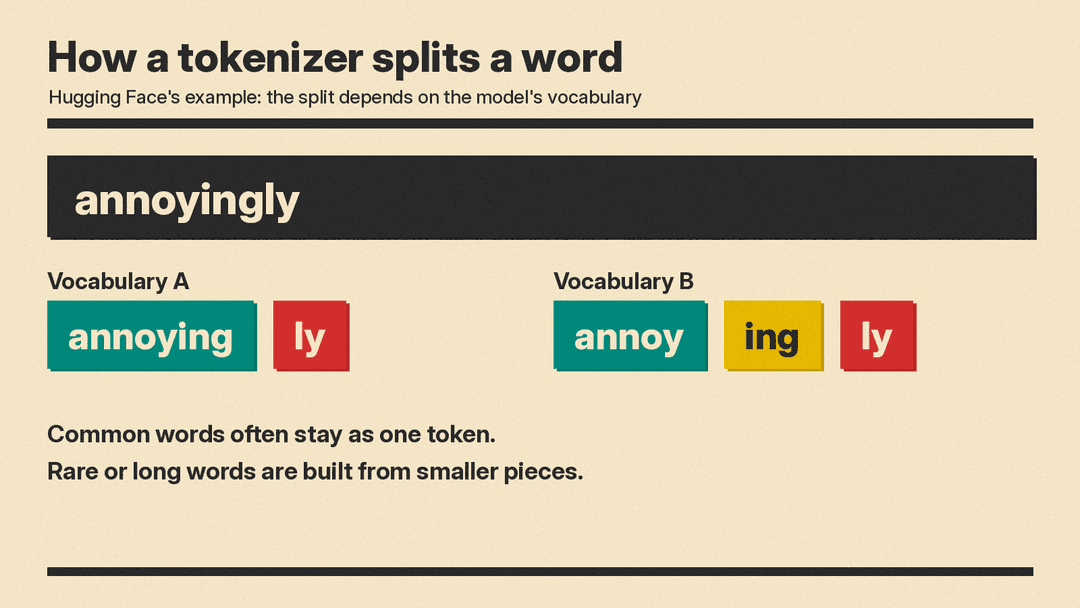
Hugging Face says Transformers supports three subword tokenization algorithms: "Byte pair encoding (BPE), Unigram, and WordPiece." You do not need to know how they differ to use AI tools. What matters is the result: the split depends on the tokenizer's vocabulary, and models differ, so two models can split the same sentence in different ways.
How many tokens is a word?
There is no exact answer, but vendors publish rules of thumb.
- Google's token guide says: "For Gemini models, a token is equivalent to about 4 characters. 100 tokens is equal to about 60-80 English words."
- IBM's explainer says that "for general purposes, a decent estimate would be roughly 1.5 tokens per word."
Both are estimates for English text. IBM is clear that "there is no fixed word-to-token 'exchange rate,'" and that "different models or tokenizers ... might tokenize the same passage of writing differently."
The same text can count differently on different models
This matters when you compare costs or limits across models. Anthropic's token counting documentation says that some of its newer Claude models use a newer tokenizer, and it warns developers moving to those models: "don't reuse token counts measured on the older model to estimate costs or context window fit." Instead, it tells them to count prompts with the model they plan to use.
The same advice works for anyone. If you want to know how many tokens your text uses, measure it with the model you will actually use.
Some languages use more tokens
Tokenizers are shaped by the text they were built from, so not every language is split equally well. IBM notes that "variations in linguistic structure and representation in training data can result in some languages being more efficiently tokenized than others." It describes a study in which the same sentence in Telugu had far fewer characters than its English version but "resulted in over 7 times the number of tokens in context."
For people who work in more than one language, this means the same document can use a different number of tokens, and so a different share of a limit or budget, depending on the language it is written in.
Not only text: images, audio and video
Tokens are not limited to words. Google's token guide says: "All input to the Gemini API is tokenized, including images, video, and audio." The same page sets out how images, video and audio are converted into token counts for its models.
Anthropic's context windows documentation likewise says that images and documents sent in a request count toward the context window, which is measured in tokens.
So when you upload a photo, a PDF or a recording to an AI tool, it is turned into tokens too, and those tokens count toward both limits and usage.
Why tokens matter: limits and bills
Tokens are the unit AI services use to measure two things: how much a model can handle at once, and how much you pay when you are billed per use.
Limits
A model's context window, the amount it can consider at one time, is measured in tokens. IBM defines the context window as "the amount of text, in tokens, that the model can consider or 'remember' at any one time." Output limits, the maximum length of a single reply, are also set in tokens.
Billing
When you use an AI model through a pay-as-you-go API (the way developers and many business tools connect to models), the bill is based in part on tokens. Google's token guide says that "the cost of a call to the Gemini API is determined in part by the number of input and output tokens."
Pricing pages show how this works in practice:
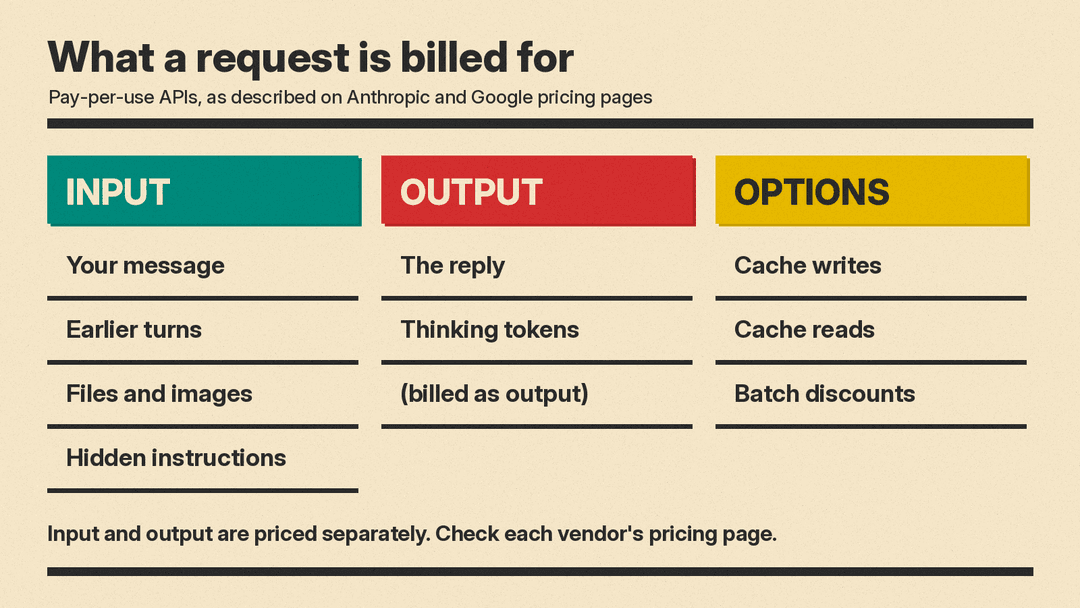
- Input and output are priced separately. Anthropic's pricing page lists separate "Input" and "Output" prices for each Claude model, quoted per "MTok" (million tokens). Google's Gemini API pricing page also quotes paid tier prices "per 1M tokens."
- Thinking counts as output. Models that reason before they answer generate extra tokens while they think. Google's pricing page labels its output prices as "including thinking tokens." Anthropic's context windows documentation says thinking tokens "are billed as output tokens."
- Repeated content can cost less. Both companies offer caching, which lets you reuse the same long input across requests. Anthropic's pricing page explains that "cache write tokens are charged when content is first stored" and "cache read tokens are charged when a subsequent request retrieves the cached content," and that a cache hit costs a fraction of the standard input price.
- Waiting can cost less. Anthropic's pricing page says its Batch API "allows asynchronous processing of large volumes of requests" with a discount "on both input and output tokens." Google's pricing page lists a Batch API for its paid tier as well.
- Some prices depend on prompt length. Anthropic's pricing page notes that at least one Claude model "is priced by prompt length," with higher prices for requests whose prompt is over a set token threshold. Always check the pricing page for the exact rules of the model you use.
This guide does not list prices, because they change. Check each vendor's pricing page for current rates. For a dated snapshot, see our LLM API pricing comparison.
Hidden tokens you may not see
A request can include more tokens than you typed. IBM points out that chatbots are often given a "system prompt," which is "often hidden from the user," and that "special characters, line breaks and other formatting measures also consume some portion of the available context." Anthropic's context windows documentation lists the system prompt, tool definitions and tool results among the things that count toward a request.
On the other hand, Anthropic's token counting documentation says token counts "might include tokens added automatically by Anthropic for system optimizations" and states: "You are not billed for system-added tokens."
Conversations add up
In a chat, each new message is sent with the conversation so far. Anthropic's context windows documentation says each turn's input "contains all previous conversation history plus the current user message." That means a long conversation uses more input tokens with every turn, which is one reason long chats can get slower or more expensive on per-use plans.
How to count tokens
You do not have to guess.
- Vendor tools. Google's token guide describes a count_tokens call that "returns the total number of tokens in the input only," and usage figures on each response that report input, output, thinking and cached tokens. Anthropic offers a token counting feature that its documentation describes as "free to use but subject to requests per minute rate limits."
- Counts are estimates before you send. Anthropic notes that "the token count is an estimate. In some cases, the actual number of input tokens used when creating a message might differ by a small amount."
- Try it visually. IBM mentions that the Tokenizer Playground on Hugging Face "is an easy way to see and experiment with how different models tokenize text inputs."
Simple ways to use fewer tokens
If you pay per use, or keep hitting limits, these habits help:
- Trim what you paste. Remove repeated headers, signatures and sections the model does not need.
- Start a new chat for a new task. Since earlier turns are sent again with each message, a fresh chat keeps input small.
- Ask for the length you need. A short answer uses fewer output tokens than a long one.
- Use reasoning settings with care. Thinking tokens count as output, so a deep-thinking mode adds output tokens. Save it for tasks that need it.
- Reuse long instructions with caching if your tool supports it, and use batch processing for large jobs that do not need an instant answer.
- Measure, do not assume. Token counts vary by model and language, so check with the model you plan to use.
Quick glossary
- Token: a chunk of text (or image, audio or video data) that a model reads or writes.
- Tokenizer: the part of a model system that splits input into tokens.
- Vocabulary: the full set of tokens a model knows.
- Input tokens: everything sent to the model, including earlier messages and hidden instructions.
- Output tokens: everything the model generates, including thinking tokens on models that reason.
- MTok: shorthand for a million tokens, used on Anthropic's pricing page.
- Caching: storing a long input so later requests can reuse it.
The bottom line
Tokens are the pieces AI models use to read and write. Common words are often one token, while longer or rarer words are split into parts, and the split differs by model and language. Tokens also set the limits on how much a model can handle and, on pay-per-use services, the size of the bill, with input and output priced separately and thinking counted as output. When the numbers matter, count tokens with the model you will actually use and check the vendor's pricing page.
Sources
- Understand and count tokens, Gemini API documentation (Google)
- Gemini Developer API pricing, Google
- What is a context window?, IBM Think
- Tokenization algorithms, Hugging Face Transformers documentation
- Token counting, Claude Platform Docs (Anthropic)
- Context windows, Claude Platform Docs (Anthropic)
- Pricing, Claude Platform Docs (Anthropic)
