
AI detectors can flag a lot of AI text, but none of them can prove who wrote something. That is not only a critic's view. OpenAI, Turnitin, Grammarly and QuillBot all say a score should not be the only basis for a decision. This guide explains how the tools work, what the independent research found, what the main tools offer as of October 2026, and what to do if a detector flags your own writing. We also built a small detector of our own to show where the method breaks.
How AI detectors work
Most detectors try to measure how predictable a text is. A language model writes by picking likely next words, so its output tends to be smooth and probable. Human writing is usually less even. GPTZero's FAQ names the common signals: perplexity (how predictable the writing is), burstiness (how much sentence length and style vary) and generic or repetitive style. GPTZero says its own model uses "hundreds of factors."
Commercial tools now train classifiers on large sets of human and AI text instead of using one simple score. Turnitin says its current system is a transformer model trained on its academic data, and that it "is not explicitly programmed" to check signals such as burstiness or perplexity. Turnitin also says its predictions "may not always be explainable in simple feature-by-feature terms."
The result is always a probability, not a fact. A detector can tell you that a text looks like the AI text it was trained on. It cannot see how the text was made. Watermarking is a different method: the model maker hides a statistical signal in the text as it is generated. Our guide to LLM text watermarking explains how that works and how it can be evaded.
What the evidence says
Three sources are worth knowing before you trust any score.
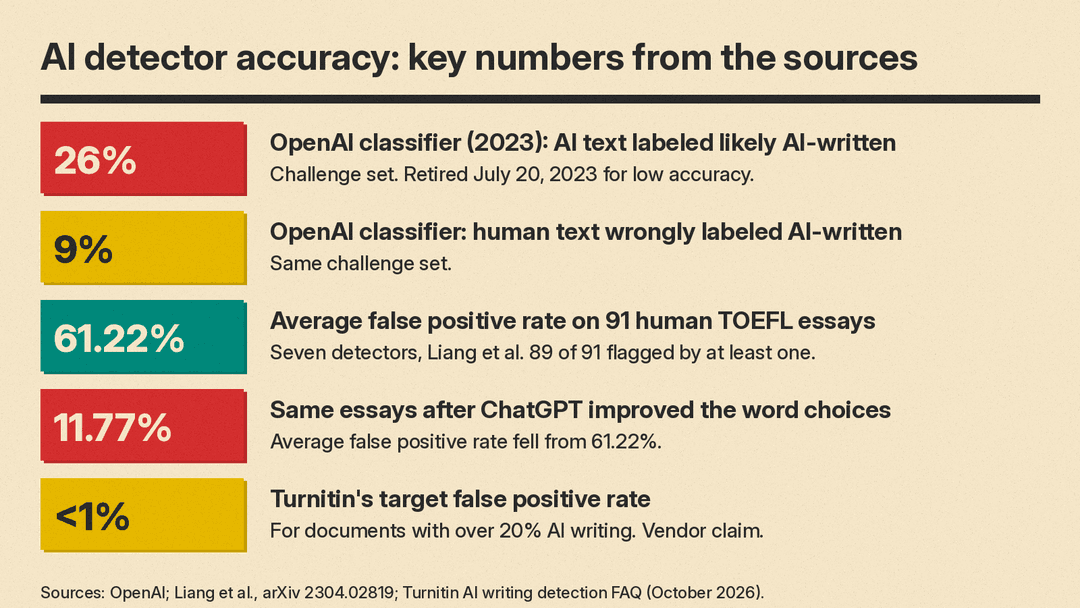
OpenAI retired its own detector. In January 2023 OpenAI released an AI text classifier. On its challenge set it correctly labeled 26% of AI-written text as "likely AI-written" and wrongly labeled human text as AI-written 9% of the time. OpenAI said it was "very unreliable on short texts (below 1,000 characters)" and that AI text "can be edited to evade the classifier." As of July 20, 2023, the tool was no longer available "due to its low rate of accuracy."
Detectors flagged non-native English writers. A Stanford-led study (Liang et al., arXiv 2304.02819, published in Patterns) ran seven widely used detectors on 91 human-written TOEFL essays. The detectors misclassified over half of them as AI-generated, with an average false positive rate of 61.22%. All seven detectors flagged 18 of the 91 essays, and 89 of the 91 were flagged by at least one detector. When the researchers asked ChatGPT to "enhance the word choices to sound more like that of a native speaker," the average false positive rate fell to 11.77%. The authors also showed that simple prompting strategies can bypass detectors, and they cautioned against using detectors in "evaluative or educational settings."
A large benchmark found detectors easy to fool. The RAID benchmark (ACL 2024) has over 6 million generations from 11 models, with 11 adversarial attacks and 4 decoding strategies. Its authors note that many detectors claim 99% accuracy or more, but they found current detectors "are easily fooled by adversarial attacks, variations in sampling strategies, repetition penalties, and unseen generative models."
Vendors say they have worked on these problems. Turnitin says its training data includes second-language learners. GPTZero says it repeatedly trains its model to reduce the false positive rate for ESL writing to 1%. Those are the vendors' own claims.
Our test: a homemade detector
To see the perplexity idea in action, we built a toy detector with Gemma 3 1B, a small open model, running locally with llama.cpp. For each token in a text, we asked the model how likely that token was given the words before it. Lower perplexity means the text was more predictable to the model, which is what a simple detector reads as "AI-like." We recorded the share of tokens that were the model's single top guess. Our perplexity numbers are lower bounds, because we only read the model's top 10 guesses at each step.
We scored four texts:
- The opening of the Declaration of Independence (1776), human-written and quoted all over the web.
- A 135-word passage from Jerome K. Jerome's novel Three Men in a Boat (1889), human-written.
- A paragraph Gemma 3 1B wrote from a plain prompt: "Write one paragraph of about 130 words about a camping trip where the camp stove leaked fuel all over the boat."
- A paragraph Gemma 3 1B wrote from the same prompt plus a style instruction: "Write it in first person like a grumpy, funny storyteller. Mix very short sentences with long ones. Use concrete, odd details and no summary at the end."
Results (perplexity, lower is more "AI-like"; then the share of tokens that matched the model's top guess):
- Declaration of Independence: 3.82, 70.7% top guess
- Gemma, style prompt: 5.05, 58.6% top guess
- Gemma, plain prompt: 6.15, 50.7% top guess
- Three Men in a Boat: 14.59, 35.3% top guess
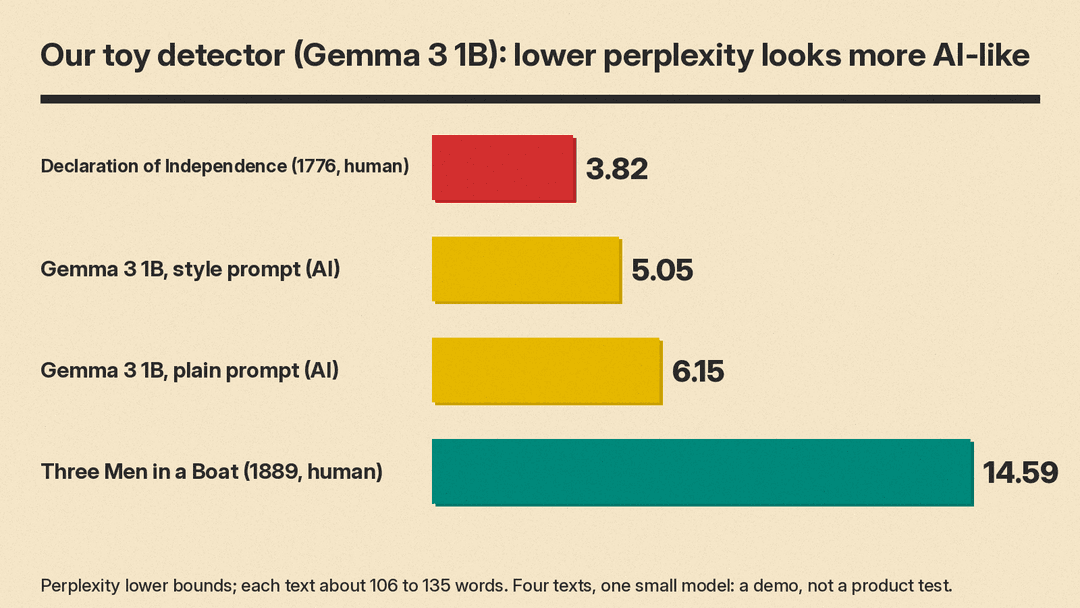
The most "AI-like" text in our test was written in 1776. A likely reason is that a famous text is very predictable to a model that has seen it many times in training. The novel scored as the most human, and both AI paragraphs fell in between. The style prompt did not make the AI text look more human to this detector. It made the text more predictable.
This is a small, rough test. It used four texts, one small model and no threshold, and the scoring model was the same model that wrote the AI paragraphs. Commercial detectors use trained classifiers, so their results can differ. The test only shows the basic weakness: predictable human writing, such as famous text, formulaic prose or simple language, can look like AI to a predictability score. QuillBot says the same on its own page: "Formulaic human writing (academic definitions, legal copy, structured templates) can score higher than expected for any AI writing detector."
The main AI detectors, as of October 2026
These are the facts each company publishes. We did not test these products, and accuracy figures below are the vendors' own.
Turnitin's AI writing detection is only available to customers that license Turnitin Originality, or to iThenticate 2.0 customers that license the AI writing add-on. Key details from its FAQ:
- It needs at least 300 words of prose and accepts files up to 30,000 words. It skips lists, headers, references, tables and code.
- It does not show scores from 1% to 19%. Those show as an asterisk, to reduce false positives.
- Turnitin aims to keep false positives under 1% for documents with over 20% AI writing, and tests each update on over 700,000 papers written before ChatGPT.
- It says it can detect AI text that was changed by paraphraser or "humanizer" tools, in English only.
- Students cannot see the indicator. Instructors can download the report and share it.
- Turnitin says it "does not make a determination of misconduct" and the score "should not be used as the sole basis for action."
- Grammar fixes from Grammarly were "in most cases" not flagged in Turnitin's tests, but text from Grammarly's generative features "will likely be flagged."
GPTZero has a free scanner on its site. According to its support center, the free plan covers 10,000 words a month, up to 10,000 characters per scan and up to 3 files per batch upload. GPTZero claims 99.9% accuracy and says that on RAID it detected 95.7% of AI texts while wrongly flagging 1% of human texts. It fully supports English, German, Portuguese, French and Spanish. Premium features include a Google Docs extension that replays how a document was written. Paid plans on its pricing page on October 29, 2026: Premium at $23.99 a month, or $12.99 a month billed annually, for 300,000 words a month; Professional at $45.99 a month, or $24.99 a month billed annually, for 500,000 words a month.
Grammarly's AI detector is free to try. You paste text or upload a file and get a percentage. Grammarly claims 99% detection accuracy and a top rank on RAID. It also says "there is no AI detector that can conclusively or definitively determine whether AI was used to produce text." Grammarly Pro adds an AI Detector agent that shows which parts may sound AI-generated.
QuillBot's AI detector is free to use. Its page lists a free limit of up to 1,200 words per scan and up to 6 scans a day, with a minimum of 80 words. Premium has no word limit and unlimited scans. It says it supports 20+ languages and labels text as AI-written, human-written, or human-written with AI refinement. QuillBot also cites RAID for a "99% detection rate."
Note that three of these vendors point to the same RAID benchmark for top results. Check the RAID leaderboard yourself for how each tool was tested. On October 29, 2026, its default view (AUROC, no adversarial attacks) listed Winston AI first and Grammarly sixth, with QuillBot and GPTZero lower.
If a detector flags your writing
A flag is a starting point for a conversation, not a verdict. Turnitin, GPTZero, Grammarly and QuillBot all say so in their own documentation.
- Ask what tool and score were used. A Turnitin score under 20% is not shown as a number. For a text of only a few hundred words, Turnitin says the prediction is mostly "all or nothing."
- Show your process. Drafts, notes, outlines and document version history are the strongest evidence you have. Keep them for every graded piece.
- Point to the known limits. The TOEFL study and OpenAI's withdrawn classifier are good, citable sources for why a score alone is weak evidence.
- Do not try to game the score. QuillBot and Grammarly both say the goal is not to hide AI use. If you used AI, follow your school's or employer's rules and disclose it.
If you are a teacher or editor
Use detectors as one signal among several. Read the flagged passages, compare them with the writer's earlier work, and talk to the writer before you act. Be careful with short texts, non-native English writers and formulaic genres, where both the research and the vendors say false positives are more likely. Our report on how AI detectors are creating a new era of distrust covers how widely teachers now use them.
Two prompts you can paste into ChatGPT, Claude or Gemini to support a fair process (not tested in our run). Our ChatGPT prompts for teachers cover lesson plans, rubrics and feedback.
I am a teacher. A student's essay got a high AI detector score. Write five open, non-accusing questions I can ask the student about how they planned, drafted and revised this essay. Base the questions on this assignment: [paste assignment].Rewrite this assignment so students show their process: an outline, one rough draft and a short note on what changed between drafts. Keep the same learning goals. Assignment: [paste assignment].The short version
Detectors are probability tools. They can help you decide where to look, but they cannot settle who wrote a text. The tools' own makers say not to use a score as the only basis for a decision, and the research shows why: human text can look predictable, and AI text can be edited to look less so.
Sources
- Turnitin: AI writing detection capabilities FAQs
- OpenAI: New AI classifier for indicating AI-written text
- Liang et al., GPT detectors are biased against non-native English writers (arXiv 2304.02819)
- Dugan et al., RAID: A Shared Benchmark for Robust Evaluation of Machine-Generated Text Detectors (arXiv 2405.07940)
- GPTZero and GPTZero pricing
- GPTZero Support Center: What is the difference between the free and paid for plans?
- Grammarly AI Detector
- QuillBot AI Detector
- RAID benchmark leaderboard
- National Archives: Declaration of Independence transcript
- Project Gutenberg: Three Men in a Boat by Jerome K. Jerome
