
A phishing campaign is sending fake invitations to a private Anthropic AI preview to steal Google and Microsoft logins, according to research published October 29 by email security company Cofense. Cofense says the emails have been going out since September 2026. They look like a GoTo Webinar meeting invite, pass through a link shortener and two CAPTCHA pages, and end on look-alike Google and Microsoft sign-in pages.
"It sells exclusivity," Frank Dickson of Dickson Research told CSO Online. "Fear of missing out is the oldest lure in the book." He added: "The attackers did not pick Anthropic at random. They picked whatever is hottest in the news cycle. Next month, it may be another name."
What the email looks like
Cofense says the emails claim to be an exclusive invitation to see Anthropic's new AI tool. CSO Online quotes the invitation text: "This private, invitation-only virtual session brings together a select group of participants to a focused conversation on AI systems, research, and the future of frontier models."
The sender address appears to be customercare@gotowebinar[.]com, and the footer carries GoTo Webinar branding. Cofense says threat actors abused that same address and GoTo Webinar's free trial in 2020. Cofense says GoTo Webinar, whose meeting emails are usually not blocked by email security tools, was abused to send the attackers' link.
Cofense found no obvious spelling errors in the body text. The giveaway is the sender name, which reads "Austin from nthropic," with the "A" missing. "Although this is a small misspelling, it is still a useful warning sign," the researchers wrote.
The link in the email appears to come from Zapier's URL shortener (zpr[.]io). Cofense notes that Zapier is a legitimate automation company and that the shortener is built to work with Claude, ChatGPT and other MCP-compatible AI. The attackers also use subdomains and dashes to hide the real address.
Five steps from inbox to stolen password
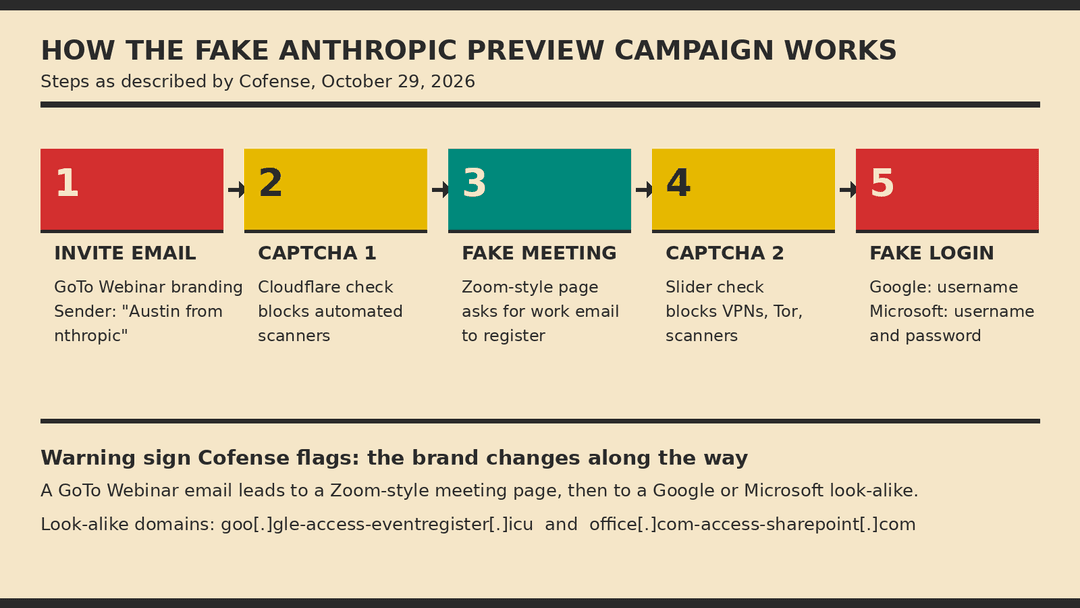
Cofense lays out the chain like this:
- Invite email. A GoTo Webinar-branded message offers a private Anthropic preview.
- First CAPTCHA. Clicking the link opens a Cloudflare CAPTCHA that must be solved before any phishing content appears. Cofense says it helps block automated scans, and that people may read a CAPTCHA as a sign that everything is safe.
- Fake meeting page. A Zoom-spoofing page on the domain us968web-zoom[.]us shows the Anthropic event and asks visitors to register with their work email, using "Continue with Google" or "Continue with Microsoft."
- Second CAPTCHA. A custom slider CAPTCHA appears next. Cofense says it seems good at detecting and blocking the most popular VPN services, scanners, the Tor browser and other defender tools.
- Fake login. The Google look-alike sits at goo[.]gle-access-eventregister[.]icu. The Microsoft look-alike sits at office[.]com-access-sharepoint[.]com.
The two login pages behave differently. Cofense says the Google page currently captures only usernames and is likely misconfigured, since it never asks for a password. The Microsoft page captures both username and password. Neither page redirects to the real login page or shows a confirmation after the victim submits.
Because the chain has two separate CAPTCHAs, Cofense says automated analysis tools may not be able to follow every step. "A CAPTCHA was built to keep bots out," Dickson told CSO Online. "Here, it keeps the security scanners out and lets the victims in."
Why it matters
Cofense lists the risks for a company whose employee falls for it: an attacker can take over a sensitive account, read the documents in it, and use it as a foothold to move further into the organization.
Dickson's point about the news cycle matches what readers have seen here, from Anthropic's IPO plans to security partnerships such as SentinelOne's plan to add Claude Mythos 5.1 to Wayfinder. CSO Online also reports Dickson's view that the AI industry's habit of gated previews and waitlists trains people to expect exactly this kind of invitation.
People who use AI tools have other risks to watch too. We also covered a gray-market relay that turned off users' Codex and Claude Code sandboxes.
How to spot and stop it
Cofense's advice:
- Check that the brand stays the same from the email to the login page. A GoTo Webinar email is unlikely to lead to a Zoom registration page.
- Remind staff that the URL and domain decide whether a login page is real, not the logos. "Threat actors are skilled at mimicry especially now with the use of AI," the researchers wrote.
Dickson's short list, from CSO Online:
- Verify any AI preview invitation through an account team or a known contact.
- Treat branding that changes from email to meeting page to login page as a red flag.
- Roll out phishing-resistant multi-factor authentication. If someone entered credentials on one of these pages, reset them and review that account's activity.
Anthropic's own Help Center lists its official marketing email addresses and says all its marketing emails come from addresses ending in anthropic.com or claude.com. The addresses are outbound only, with unmonitored inboxes. A preview invite from a GoTo Webinar address does not match that list.
With the IPO in the news, a related warning is worth knowing. Anthropic's Help Center page on investment scams tells people to be especially cautious of anyone who contacts them unsolicited offering Anthropic shares or claims "exclusive" or "limited-time" access to Anthropic stock.
Cofense says indicators for this campaign are in its Active Threat Reports 423868, 423866 and 423475.
Sources
- Cofense: Would Your Employees Join a Fake Anthropic AI Preview? (October 29, 2026)
- CSO Online: Fake Anthropic AI previews lure in overeager employees (October 29, 2026)
- Claude Help Center: Official Anthropic marketing email addresses
- Claude Help Center: Unauthorized Anthropic stock sales and investment scams
